
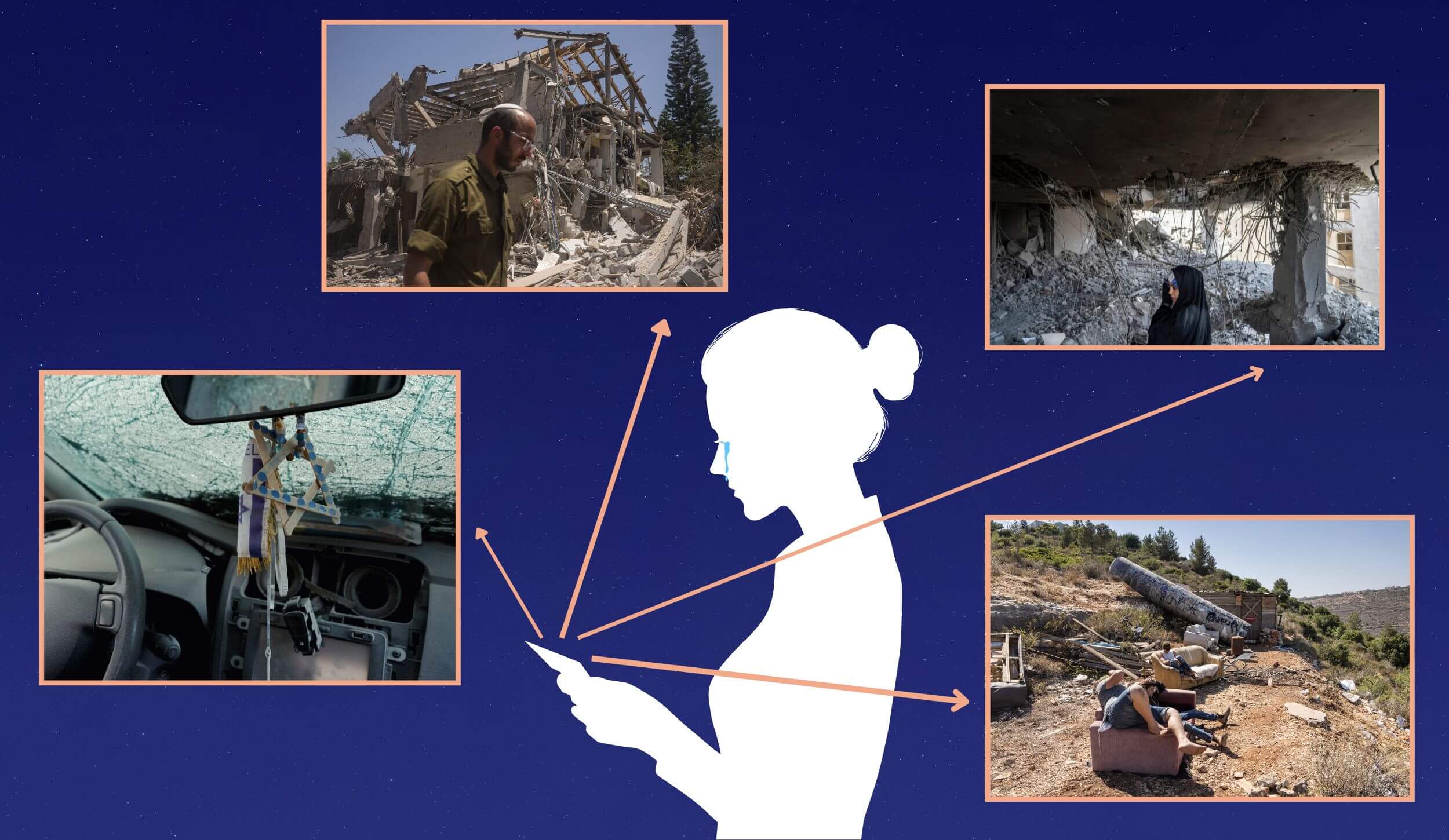

Caught in a war I never expected, I found solace with one of the rare people who could actually understand my emotions. Graphic by Canva/Menahem Kahana/Afp/Kobi Wolf/Bloomberg/Aldema Milstein/Middle East Images/Afp/Majid Saeedi/Getty Images

Judith Hertog
October 4, 2025
In the middle of June’s Israel-Iran war, I posted a video on Facebook of myself and my mother huddled in her bathroom in her house near Haifa, sheltering from the missiles coming our way. “So sorry,” commented Amna, a Palestinian friend of mine who lives in East Jerusalem. “Probably you should be away from windows and doors. Be safe.”
Suddenly, I realized I was crying. Since the abrupt onset of war, I’d had no time for emotions. I was too busy trying to improvise a shelter at my mother’s house, shuttling between there and my husband’s parents’ home in Raanana, always afraid to be caught on the road when the sirens wailed again. Amna’s matter-of-fact remark unleashed all the emotions I had been holding back.
I had never met her in person, as my husband and I have lived in the United States for almost 30 years, only returning to Israel for annual family visits. I knew Amna because she had worked with my sister for many years as an Arabic-English translator on documentaries about the occupation and Jewish settlements in the West Bank.
Her comment was practical and to the point. And of all the messages and comments my video received, none touched me like hers. As a Palestinian from the West Bank — who has experienced the constant harassment of the Israeli occupation — she could, I thought, have cheered that bombs were falling on Jewish Israeli homes.
Two years after the Hamas attack of Oct. 7, 2023, as death and suffering have grown, animosity between Israelis and Palestinians has as well. I have some Palestinian friends who stayed silent after Oct. 7. Others have hardened and stopped talking with me since the Israeli army entered Gaza, later that same month. I understand. When your people and your loved ones are being killed indiscriminately, how can you not turn pain and fear into hatred of the other?
A murky reality
From my viewpoint in the U.S., through most of this war, I’ve seen so many people with little connection to the region — and nothing personal at stake — resort to angry simplifications, declaring themselves either “pro-Palestine” or “pro-Israel,” as if war is a game in which you pick a team for which to cheer. That’s how Hamas, and Israel’s far-right, want us to see the world. They benefit from easy judgments.
Amna reminded me that reality is murky and complex, and that people are so much more than the nationality, religion or ethnicity they were born into.
I hadn’t expected to be caught in a war when my husband and I arrived in Israel for a two-week visit to help our elderly parents. But less than 12 hours after we landed, our phones went off in the middle of the night with an emergency message announcing that Israel had attacked Iran, the country was in a state of alert, and Israeli airspace had been closed.
My husband and I had left Israel at a more hopeful time. When we went to the U.S. in the mid 1990s for graduate school, we thought that by the time we finished our studies, Israelis and Palestinians would have reached a peaceful compromise, and we’d return to a place where we could all live together.
But then Prime Minister Yitzhak Rabin was assassinated by an extremist settler who opposed his concessions for peace. Now Prime Minister Benjamin Netanyahu came into power for the first time, and the far-right’s ideology of violent Jewish supremacy came to dominate.
Still, when your family and the people you love still live in the region, you can’t just give up. So, we kept coming back to visit. Each time, it seems, we found our friends in a deeper state of shock at the country’s slide into violence. In December 2023, during our first visit back after the Hamas terror attack, we stayed with friends in Kibbutz Kabri, near the Lebanese border. We were practically the only people there, because everyone had evacuated to central Israel.
As we stood at the edge of the kibbutz, watching the occasional flashes that came as the Iron Dome intercepted another drone or rocket from Lebanon, our friends fantasized about selling their house and moving to a Greek island.
‘We pray that nothing bad happens’
When I shared online that I was stuck in a war in Israel, friends from everywhere sent me messages of concern and support. One person wrote that I was brave. She didn’t see me on the first day, hyperventilating on the phone with my husband after I’d gotten an alert that Iranian missiles were on their way, and that the air-raid sirens would sound in a few minutes.
“What do I do? What do I do? What do I do?” I cried over and over. If that’s bravery, then anyone who has ever been in a war is brave.
Amna has visited my mother’s house, so when she made that Facebook comment, she knew which bathroom we were in. I knew that she was right: It wasn’t a safe shelter. If a missile hit nearby, the force of impact would shatter windows and ceramic tiles, turning them into potentially deadly projectiles. But my mom’s house didn’t have a shelter, and at 84, she wasn’t able to rush to the public shelter down the road.
So I had duct-taped cardboard over the bathroom windows and mirrors, and we hoped for the best each time we huddled together as the sky exploded above us. I tried to reassure myself that the Israeli defense system would intercept the majority of missiles, and that the chance that any of the remaining ones would fall exactly on my mom’s house was very small.
And I felt lucky, aware of the many civilians in Iran who were awaiting Israeli bombs without shelter or a sophisticated defense system. And the many more, in Gaza, who have been facing relentless death and destruction for nearly two years.
I asked Amna how she was doing amid the barrage of Iranian missiles. Although they targeted Israel, they didn’t distinguish between Jews and Arabs, Israelis and Palestinians.
“Here there are no shelters also,” she replied, “every night we pray that nothing bad happens. If you need anything, please let me know. Maybe I can help.”
“Here” was the Palestinian neighborhood in East Jerusalem where Amna lives with her husband and three small children. I had been following her life from afar for years: First when she worked with my sister, as a young translator who had just graduated with a degree in English from Hebron University; then when she got married, and gave birth to twins, who were quickly succeeded by a third baby.
I learned about her troubles when her Israeli residency permit was suddenly revoked while she was on a visit to her parents near Hebron, in the West Bank. For months, she and her children were unable to return to their home in East Jerusalem, victims of a deliberate Israeli policy to discourage Palestinians from living in territories annexed by Israel.
I know that compared to hers, my life is easy. And I felt grateful that, even so, she still had room in her heart to care about my safety.
‘If we survive’
Mixed with my gratitude was embarrassment. Just before I posted on Facebook, I’d read in the news that Gaza was experiencing such a shortage of food and clean water that children were dying of hunger. (Two months later, a top international agency studying food scarcity would confirm famine in parts of Gaza.) I felt ashamed that I had been so absorbed by fears about my own survival that I hadn’t been paying attention to the horrors happening some 100 miles away from me.
In that context, I’d hesitated to share an update about my own safety, figuring that my own fear of being killed by an Iranian rocket would seem frivolous. Some of my progressive American and European Facebook “friends” had been expressing such intense anger at Israel’s actions in Gaza that I didn’t expect sympathy from them. I imagined they probably thought that my being in Israel was an invitation to be killed by a missile. One person even wrote to me to ask me if I had gone to Israel intentionally to be in the war.
I struggled to express the complexity of the situation. Until the war with Iran began, I had planned, during this visit, to join my Israeli friends at what was expected to be the largest anti-war protest since October 2023. Conveniently for Netanyahu, the protest had to be cancelled as we were all sheltering from the Iranian rockets. A few weeks earlier, crowds of Palestinians in Gaza had protested against Hamas, despite Hamas’s threats to round up and execute anyone voicing opposition.
It seemed as if only people trapped in the same conflict really understand how twisted it all is. Circumstances have pitted us against each other as enemies, making us distrustful and hurt. Ultimately, most of us just want to live our lives in peace. But resolving decades of violence and bloodshed takes such immense generosity that only few can muster it.
A few days later, as I sat recovering on my mom’s balcony from yet another Iranian strike that had sent us into that shaky bathroom, my phone pinged with a message from my Iranian friend Susie in Amsterdam, asking if I was okay.
She reported that she was trying to stay in touch with a cousin in Tehran, but hadn’t heard from her in two days, because the Iranian internet was down. I feel as if I know that cousin through Susie’s stories. I thought about the time, two years ago, when Susie visited Tehran after a long absence, and arrived at the airport carefully veiled to comply with the Iranian modesty police. When Susie’s cousin met her at arrivals, she laughed and immediately pulled off the veil. “Here we try not to wear those,” she said.
Now, each time the Israeli fighter jets roared through the sky above us on their way to bomb Iran, I thought of Susie’s cousin in Tehran. I wondered if she was safe, and if she was as fearless facing Israeli bombs as the Iranian modesty police.
And my thoughts returned again to Amna. I wrote to her, saying that when the war ended we should finally try to meet in person.
“Hopefully someday,” she responded, “ If we survive…”



