
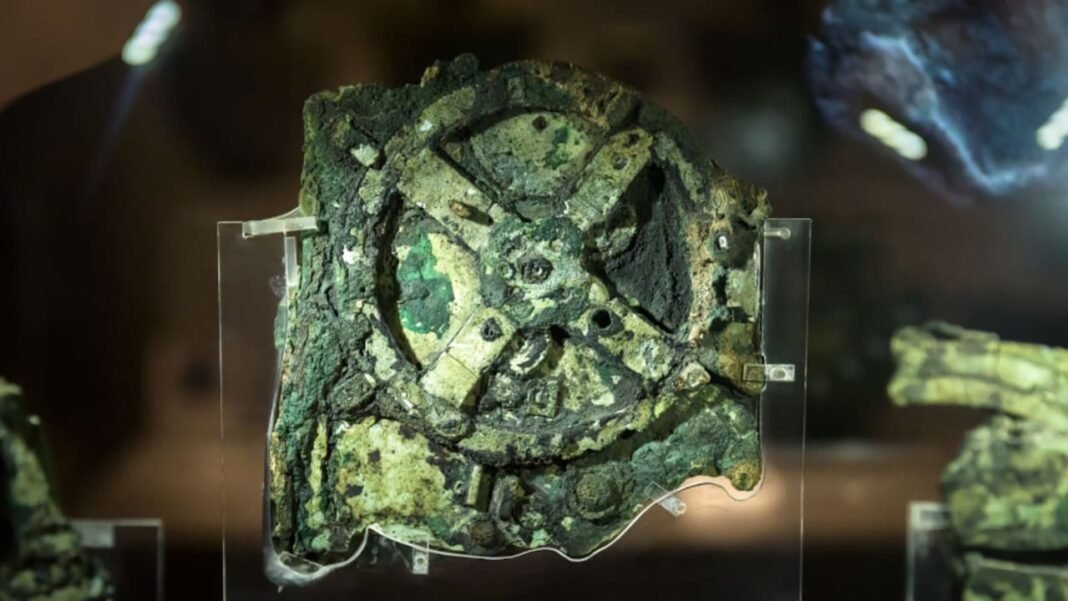

An analysis of the Antikythera Mechanism’s calendar ring sharps how precisely the ancient device tracked time. Researchers concluded in 2024 that the ring likely contained 354 to 355 holes, an almost exact match for the lunar year. The study from the University of Glasgow applied techniques adapted from those used to study black holes. It built on attempts to recreate the mechanism that prompted a fresh look at its surviving fragments. Joseph Bayley, one of the researchers, said that previous studies had suggested the calendar ring tracked the lunar calendar, but that deploying two independent methods “greatly increased the likelihood” of this being correct and gave him “a new appreciation for the Antikythera Mechanism and the precision of its Greek craftspeople,” in a press statement, according to Popular Mechanics.
The project’s impetus came from a modern reconstruction. YouTuber Chris Budiselic of the channel Clickspring had examined and recreated the calendar ring, providing data that researchers Graham Woan and Bayley recognized as crucial for refining estimates of the ring’s original layout. Their approach borrowed tools designed to sift for faint patterns in astrophysical noise, repurposed here to infer a pattern of tiny, uniformly spaced holes around a damaged ring. The calendar ring’s manufacturing tolerances underscored the device’s ambition and craftsmanship, with an estimated gap of just 0.028 mm between each hole. The findings align with broader evidence that the mechanism’s dials and gears were engineered to simulate astronomical cycles with unusual fidelity, reviving interest in how its components converted celestial observations into practical timekeeping.
The Antikythera Mechanism’s path from seabed to museum case began in 1901. Divers exploring a Roman-era shipwreck off the Greek island of Antikythera recovered corroded bronze fragments that would later be recognized as parts of an ancient analog computer dating to the early 1st century BCE. The device’s complex construction, comprising dozens of bronze gears and interlinked dials, was designed to model the movements of the heavens, including cycles of the Sun and Moon. Research has increasingly suggested that by systematically simulating these cycles, the mechanism could transform astronomical data into local climate and maritime predictions, including tracking intense seasonal winds, mapping hazardous regional sea currents, and anticipating high tides. Such capabilities positioned the instrument as a tool for navigation and planning in the Aegean, even as it lay submerged for nearly two millennia before its recovery.
The fragments discovered in the wreck have also reshaped debates about the origins of computing. Milestones such as the 1945 creation of ENIAC are widely cited as the beginning of modern programmable computing, and earlier steps in the lineage include Charles Babbage and Ada Lovelace’s work on the Analytical Engine in the 1830s and the Jacquard Loom at the turn of the 19th century. Against that backdrop, the Antikythera Mechanism predates these advances by almost two thousand years, reframing the timeline of technological evolution. Its survival in 82 known fragments, now preserved at the National Archaeological Museum of Athens, has enabled modern scientific methods to peer inside what remains of its architecture. High-resolution computed tomography and 3D reconstruction software have allowed researchers to visualize internal components without damaging the artifact, while studies have also reported that ancient Greek sailors relied on the mechanism’s exact predictions to reduce the risk of shipwrecks on dangerous trade routes in the Aegean Sea, according to Newsbomb.
Source:
www.jpost.com



