
When representatives of Israel and a neighboring state with which it has been in a formal state of war since 1948 sit down across the same table for the first time in 33 years, there is a natural tendency to hear the faint flutter of a peace dove’s wings.
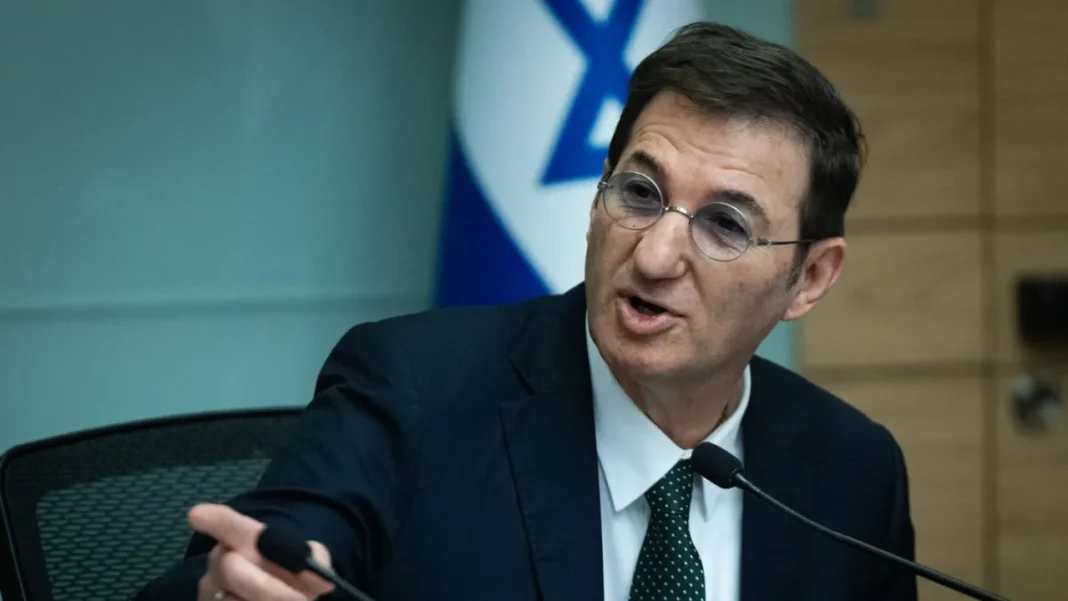
That tendency is further reinforced when Israel’s ambassador to the US, Yechiel Leiter – Israel’s representative to these talks with Lebanon held on Tuesday in Washington – speaks of a long-term vision in which there will be a clear border between the two countries and “the only reason we’ll need to cross each other’s territory will be in business suits to conduct business or in bathing suits to go on vacation.”
But Leiter is anything but a starry-eyed peacenik, and no one can accuse him of naivete. As he stressed, he was talking about a long-term vision, not something that will happen tomorrow, next month, next year, or even within the decade.
Or, as US Secretary of State Marco Rubio, who hosted the talks, said, “This is a process, not an event.”
As such, it’s nice to have hope – to dream of a day when the Good Fence on the border at Rosh Hanikra lives up to its name – but it’s dangerous to have illusions, or to create them.
Israel and Lebanon are talking, which is very good. But symbolism is not substance, and symbols do not bring quiet and normalcy to residents of the North.
The more honest way to understand what unfolded this week is not as a breakthrough, but as the opening of a narrow and uncertain window, perched somewhere between the truly historic and the illusory.
The problem is that Lebanon – or, more precisely, the government of Lebanon – is not the problem. It is not the one ordering the rocket and drone attacks on Israel. Hezbollah is doing that, and it is taking its orders from Iran.
Without lebanon joining the fight, what is talking worth?
Israel and Lebanon can talk all they want, but if Lebanon cannot force its will on Hezbollah, then what is it worth?
The degree to which the Lebanese government is impotent vis-à-vis Hezbollah can be illustrated by a simple example. On March 24, the Lebanese foreign ministry declared Iran’s ambassador to the country, Mohammad Reza Sheibani, persona non grata, accusing him of violating diplomatic protocol and interfering in internal politics. He was given until March 29 to leave.
It is now April 17, and Sheibani is still there.
Why? Because Iran rejected the order, and Hezbollah – and its allies, including the powerful speaker of parliament, Nabih Berri, who has dominated Lebanese politics for what seems an eternity – opposed it. Hezbollah instructed him to stay put. And stay put he has, remaining behind the walls of the Iranian Embassy in Beirut.
So it is reasonable to ask: if the Lebanese government cannot even implement an order to expel a diplomat it itself declared persona non grata, how in the world is it going to disarm Hezbollah?
And therein lies the dilemma. The Lebanese government may have the will to reach an accommodation with Israel, but what it lacks – glaringly – is the means to carry it out.
So then what good are these talks? What do they mean? Why do they matter?
they matter because, for the first time in decades, the conversation itself has changed.
For years, the problem has not been hard to identify: Hezbollah. What has been less clear is whether Lebanon itself saw it the same way. What emerged this week in Washington is not a new diagnosis, but a potentially new alignment – Israel and elements of the Lebanese government, at least rhetorically, pointing to the same source of instability.
Or, as Leiter put it after the meeting, “We are both united in liberating Lebanon from an occupation power dominated by Iran called Hezbollah.”
That does not solve the problem. But it does identify it.
What this means is that Israel may have found a potential partner in Lebanon that views the issue in the same vein. That is the good news. The bad news is that the Lebanese government, under President Joseph Aoun, may be a partner, but it is not necessarily an enforcer.
Still, that partnership may serve as the basis for a better structure than the one that exists today.
That better structure includes one reported proposal for a layered security arrangement: a demilitarized zone in southern Lebanon up to the Litani River; a second zone stretching northward to the Awali River, which empties into the Mediterranean just north of Sidon, without military forces but with a limited police presence; and, further north, areas under Lebanese army control, with restrictions on heavy weaponry and some form of US-led international oversight. On paper, at least, the contours of a more stable arrangement begin to emerge.
“On paper,” however, is the operative phrase.
Other ceasefires looked good on paper as well – the one in 2006 that ended the Second Lebanon War, and the one from November 2024 that called for the Lebanese army to take action against Hezbollah. The Lebanese authorities said they did – until Hezbollah resumed fire on Israel on March 2, making clear that the Lebanese authorities had grossly overstated their case.
And yet, these talks are taking place at a particularly opportune moment. Hezbollah’s capabilities have been degraded, Iran’s position has been weakened, and the Lebanese government is showing tentative signs of trying to assert greater independence.
Tellingly, the talks went ahead in Washington despite adamant opposition from both Hezbollah and Iran, with Hezbollah leader Naim Qassem warning that “proceeding with the talks would represent capitulation and surrender.”
In the past, such words – especially when they came from his predecessor, Hassan Nasrallah – might have been enough to deter Beirut. This time, they were not.
But going to talks despite Hezbollah’s objections is one thing. Implementing what is decided there, over those objections, is quite another.
And here the central contradiction becomes clear. The party holding many of the cards – Hezbollah – is not at the table, is not participating, rejects the process, and continues to fire on Israel. The talks, in essence, aim to solve a problem controlled by an actor outside the diplomatic framework.
The US is trying to change that equation. By pointedly separating the Israel-Lebanon track from its parallel negotiations with Iran, Washington wants to redefine the diplomatic arena, treating Lebanon as a sovereign state, not just an extension of Iran’s regional network.
Prying Lebanon out of Iran’s orbit
The broader goal is clear: to begin, however gradually, prying Lebanon out of Iran’s orbit.
For decades, Hezbollah has functioned as Tehran’s forward arm on Israel’s northern border, blurring the line between Lebanese state interests and Iranian objectives. By insisting that any arrangement in Lebanon be negotiated directly between Beirut and Jerusalem, rather than folded into broader US-Iran understandings, Washington is trying to reinforce a different principle: that Lebanon’s future should be determined in Beirut, not in Tehran.
Whether that principle can take hold in reality, given Hezbollah’s entrenched power, is another question entirely.
Which brings us back to where we started.
These talks are both significant and limited. Significant because they signal a shift in how the problem is understood. Limited because the solution depends on forces not present at the table.
The breakthrough, if there is one, is not that Israel and Lebanon are talking. It is that, for the first time, they may be talking about the same problem.
Whether that shared understanding can be translated into reality will depend not on what is said in Washington, but on whether Lebanon can ultimately do something it has struggled to do for decades: act as a sovereign state within its own borders.
For that to happen, certain conditions – long absent – would need to take hold.
Some of those may now, tentatively, be emerging: a Hezbollah weakened enough to create limited space for state authority; a population exhausted by years of economic collapse and conflict; a leadership speaking more openly about sovereignty and the need for the army to be the sole authority; and an unusual alignment of external pressure – from Washington, Jerusalem, and the Gulf – pushing in the same direction.
Add to that the leverage created by Lebanon’s economic crisis, and, for the first time in years, there is at least a conceivable pathway toward greater state control.
Another, less-discussed factor may also be at play: the mood within Lebanon’s Shi’ite community. There are indications – still limited, but not insignificant – of growing fatigue.
Displacement, economic hardship, and repeated rounds of conflict have taken their toll, and there have been scattered reports of frustration in southern Lebanon and in Beirut’s Shi’ite suburbs over the price being paid for Hezbollah’s continuous battles with Israel.
This is not open rebellion, however, and it should not be overstated. Hezbollah still commands deep loyalty among the Lebanese Shi’ite population, which makes up an estimated one-third of the country’s population. But even a quiet erosion of support – more weariness than organized opposition – could, over time, have an impact.
Still, no one should hold their breath. After all, this is a country where the government can declare Iran’s ambassador persona non grata, set a deadline for his departure, and then watch as he completely ignores the order. This incident is not some side story; it is the story – a reminder of where power in Lebanon still lies, and of how difficult it will be to shift it.
Source:
www.jpost.com