
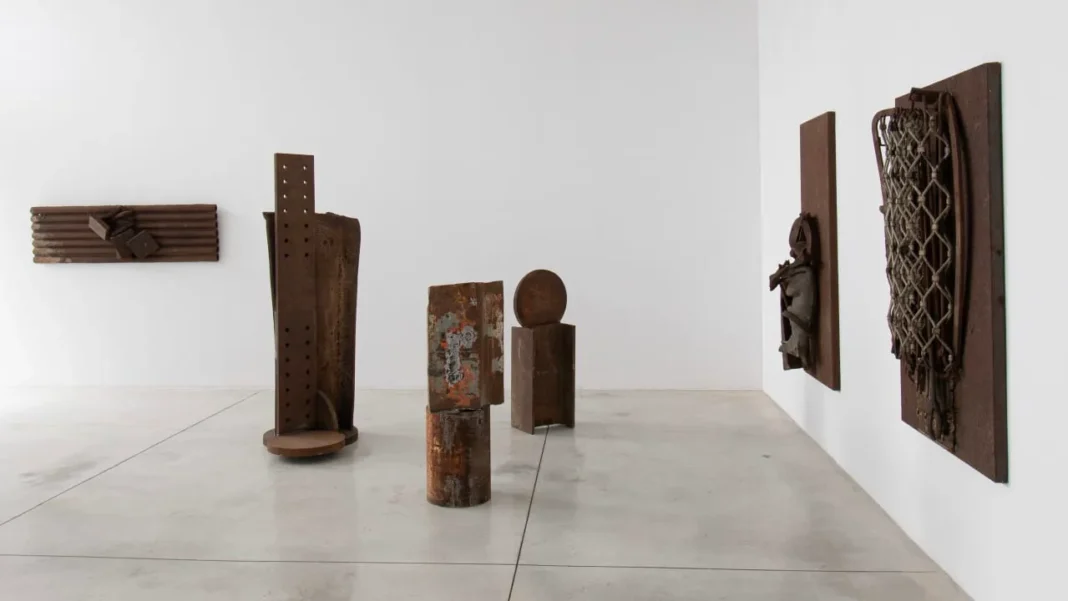

Renowned sculptor Yaacov Dorchin is the recipient of the 2004 Emet Prize for Culture and Art: Sculpture and the 2011 Israel Prize for Visual Arts; director of the Basis School of Fine Arts in Herzliya since 2015; a teacher since 1991; and head of the Department of Art at the University of Haifa from 1997 to 2001. On March 12 of this year, he celebrated his 80th birthday with the opening of his latest exhibition, Decapitated Fish and Additional Sculptures, at the Gordon Gallery in Tel Aviv.
Dorchin was born in Haifa in 1946. At age 12, he moved with his family to Kibbutz Kfar Hahoresh in the North, where he still lives and works. Since 1967, Dorchin’s works have been shown all over Israel; they are in the collections of the country’s major museums, such as The Israel Museum in Jerusalem and The Tel Aviv Museum of Art. In 1990, Dorchin exhibited at the Israeli Pavilion at the Venice Biennale. He has also held solo exhibitions in the United States and Europe.
Amid the war, in an exclusive phone interview with the Magazine, he talked about his approach to sculpting and why his heavy, stern-looking sculptures made of iron, steel, basalt, and other industrial materials often have very lyrical names and often refer to angels – decapitated angels, however.
First of all, thank you for talking to me in these not so easy days, and ‘mazal tov’ on your birthday! Your new exhibition, ‘Decapitated Fish and Additional Sculptures,’ opened on March 12, on your 80th birthday, two weeks into the war with Iran. It was opened as planned; however, without a big opening night.
Thank you, and yes, it is open to the viewers.
This exhibition is not full retrospective, but it still shows a span of your works over many years.
I start from the material. Unlike with narrative exhibitions, which have one leading theme, I’m trying to overload it and not have something that supports the creation of the show. And now this exhibition is exceptional in a way. When I built it, I completely changed the plan that it was based on before. I decided to change everything I had intended to do.
In what way did you change it?
Each sculpture gets its space, and it’s a more museum-style exhibition. I think that the sculptures are self-contained in a way that they can stand out, and when somebody is coming to see the exhibition, I want them to have lots of material to use to process their thoughts. And that was always advised against… Many people didn’t like it.
What do you mean people didn’t like it? You were awarded the Israel Prize in 2011. Some people must have liked it.
[He laughs.] Yes, I’m sure. But no, I mean this attitude. In Decapitated Fish, I treat time and space in a different way because of the way I changed it, and it brought with it something fresh. I took more sculptures than initially planned. There are about 15 sculptures. One is from 1993; it’s more than 30 years old. I suddenly wanted to see how my older works resonate with my recent works. If they are relevant. If there are recurring elements, images, or names. And that was something that was a surprise to me.
In what way?
In general. It’s a passage without any struggle. And in the process of working on the exhibition, all sorts of dialogues between the works appeared.
In your opinion, has your style changed over those 30 years?
It’s changed without changing. You can say something like that. Because the material and the forms that I use are the same.
And what’s different?
I mean, the attitude is quite the same. And… I am sorry, there is a siren. I think we must stop.
Of course, please go to the shelter! [After 20 minutes, he called me back.]
I’m glad you’re okay! Our phone conversation was interrupted by a siren in your area, and the reality of war hit us. Before we return to talking about sculptures, could you tell me about your life? You were born in Haifa in 1946, two years before the establishment of the state. What do you remember from your childhood, from the early days of Israel?
A lot. I’m running to my childhood always. I try to understand my childhood. I lived in Haifa until I was 12, before we moved to a kibbutz. All the seascapes in my works are the sights from the balcony to the bay, port, and the sea.
So then you build your connection with the sea. That explains why you have seascape and fish in the names of your sculptures, and many of your works have sea-related motifs.
Yes. I didn’t live by the sea, but you could see it from the window.
I believe that you grew up in a completely different Israel than it is now, right?
Yeah, completely. I don’t know if we can have enough time to speak about it… I think the main thing for me is that it was handy in agricultural societies in Israel. I mean, it was all around, and you could use it.
Do you mean the material that was used in agriculture, and you started to use it in your sculptures?
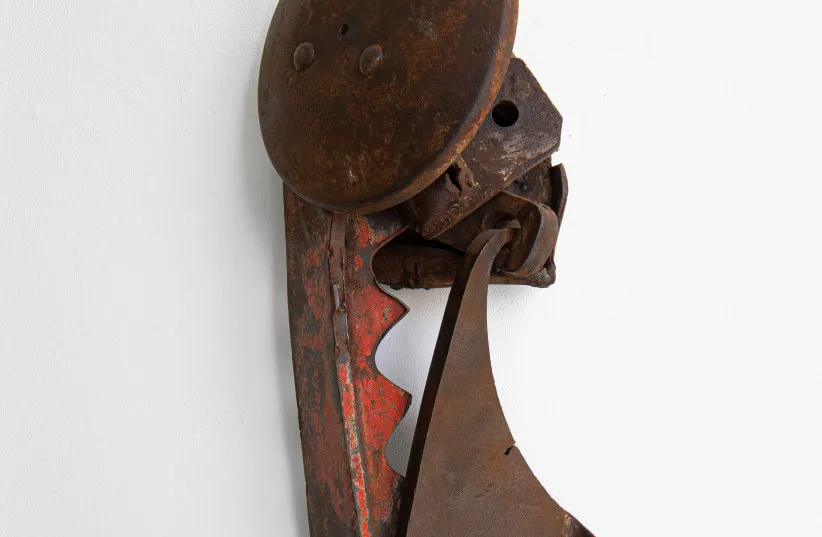
Yes. I mostly use steel and iron.
What do you like about these materials?
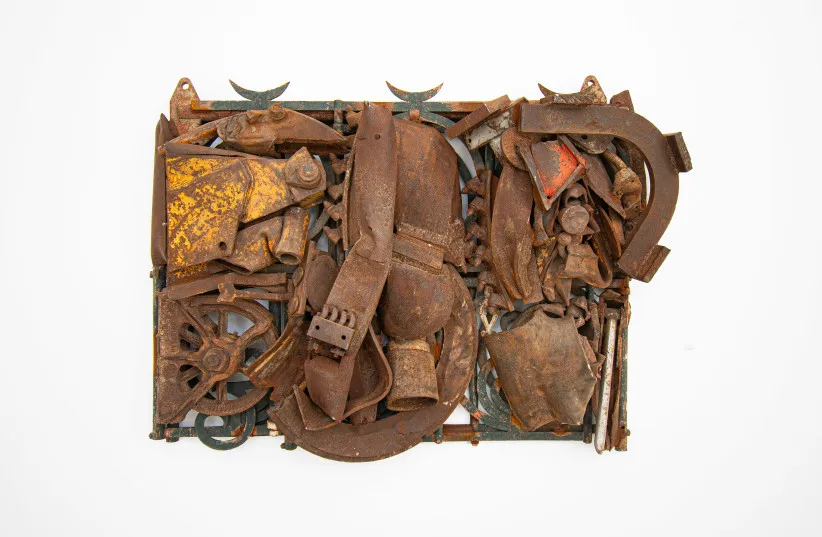
That it’s all around. You can weld a new iron sheet into something you found in the garbage.
You could say the same about wood, for example. It is also almost everywhere. So, there must be something that attracts you to iron.
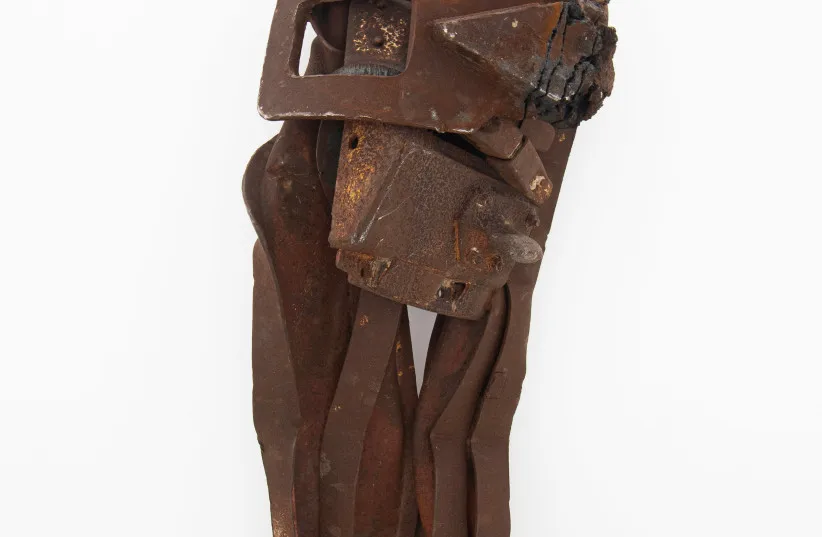
Iron is very ubiquitous. It’s found in agriculture, in the military, and in industry. It’s a very commonly used material in everyday life, so very accessible. And you can weld it.
Before sculpting, you started in art with painting. What made you change from painting to sculpture? What was the trigger?
I don’t know. It was in the ’70s. You see, I never thought too much about this matter. I just did what I felt like doing, and I was not trying to understand it. But my painting from the beginning was very heavy with material, and I stuck all kinds of things into assemblages. And then I went to sculpture itself, but sculpture, somehow, in a way, is presented like a painting on the wall.
But you also have many sculptures that are individually standing, not on the wall.
Yes.
How did you start with art in general?
It was natural. I am autodidactic. I never studied art, I only learned at artist studios when I was a boy.
This is amazing because now you are a very experienced art teacher, and you have educated many generations of students!
Yes, but I have no idea about teaching.
You are very modest. What’s the main thing you teach about sculpture?
I think, as the teacher, that there are better teachers. And I always know the limits of my abilities as a teacher. I don’t teach sculpture in a traditional way. I always try to find something that represents the student and try to see what the main thing is in their work that I want to reinforce.
Looking for individual threads in the students, not a general pattern in the sculpture?You can say that.
You once said that there is a different approach to art among different generations of artists. That to you, material-based sculpture was important, and now you feel people are more interested in narrative. Can you expand on this?
I belong to the generation that had a kind of shared cultural ethos. Today, everyone is like a one-person army. Now, for example, art is narrative-based, not material. Material is perceived as something that grounds. Of course, this is a generalization, but this is my feeling. The way I deal with material, there is something in the motion, the process. I take one piece, then weld it into another piece, and you are already holding something; you are in the world. That is interesting to me.
Apart from the material and forms you create, you also build a specific narrative with the names of your sculptures.My sculptures are related to the human figure.
Many of your sculptures are also called angels. What is it about angels that you see them in those metal structures, and what is it about angels that you find attractive or interesting?
It’s the same for years. And I think it’s some kind of piety. In a way, I’m trying to escape to another dimension. Something that is more spiritual than the chaotic material. I like this kind of dialectic.
Why the recurring theme of ‘decapitated angel’? That is a very heavy title…
Yes. In my opinion, it represents the human condition.
And what about decapitated fish, which is also in the name of your current exhibition?
Oh, it’s just the same. Somehow it presents itself. The names come after the figure is done, or during the process of making it, and it’s mixed together. Sometimes there is a name that all of a sudden found its material. It’s very tricky in a way.
I don’t want to go too far in interpretation, but I just thought, as we speak, that on Rosh Hashanah, in Ashkenazi traditions you eat the head of the fish to have a good, prosperous year. And you are giving us the fish without the head on a plate in your exhibition…
No, no, no. [He laughs.]
Okay, so what does the fish by itself represent to you?
I always like to relate to something that it’s not… that keeps its enigma. That it’s something that I can feel but not try to understand.
There’s a lot of psychology beneath your work. Your sculptures are often described as lyrical and spiritual, but they are far from being fragile in form. They tend to be austere and industrial, but you give them very poetic titles, such as ‘Seascape with Self-Portrait without Memory’ from 2016.
Yes, it’s a very nice work, and it’s very enigmatic, and I want to keep it like that.
We will respect that. Could you tell me about the process of your way of sculpting? How do you start working on a sculpture?
Usually, I make parts in the steel mill, and I don’t know in which sculpture they will play a part. But I make lots of pieces and press them, cut them with fire, with machines, and all the violent part in the work is finished before there is a sculpture. And then I just bring it to my studio, and I have parts that went through my hand, in a way.
Do you do everything by yourself, or do you have assistants?
For this work, I use workers who help me, but I’m always very involved in the work.
Do you have preferred hours of work, any specific time of the day?
No, it depends. Also, it was different years ago and now. I am aging. This is not easy work.
How long do you usually work on one sculpture?
Sometimes months, sometimes minutes.
In 1990, you represented Israel at the Venice Biennale, and you also had exhibitions in other countries.
Yes, in New York and Berlin. That’s now many years ago.
Do you think audiences in Israel and those abroad understood you the same way or differently?
It was strange for me to see my sculptures outside of Israel. And the place in Israel where I make them creates completely different interpretations. Besides, my works are very heavy and depend on the location. To see them in, say, New York, the main concern for me was how to transport them back and forth to Israel.
What is your favorite place in the world?
My home.
I thought you would say your studio.
Yes, it’s the same, right next to each other. In the North, an hour and a half from Tel Aviv. It used to be a kibbutz, then it changed its structure, but it’s the same place. My parents didn’t stay there. I did.
Yaacov, thank you so much for talking to me.
Thank you.
The interview was conducted on March 18. The exhibition was opened at the Gordon Gallery during the war on March 12 and has been on display ever since. However, the official celebration event in honor of Yaakov Dorchin’s 80th birthday was moved to April 16.
gordongallery.co.il/exhibition/decapitated-fish-and-additional-sculptures
Source:
www.jpost.com




