
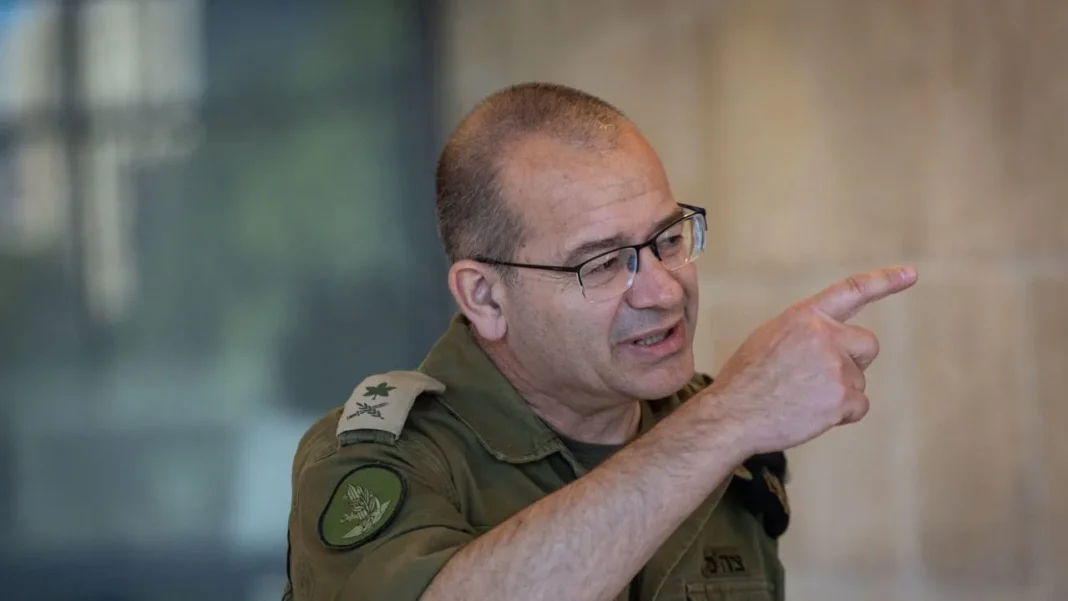

Attorney-General Gali Baharav-Miara asked the High Court of Justice to intervene in Prime Minister Benjamin Netanyahu’s appointment of Maj.-Gen. Roman Gofman as the next Mossad chief, arguing that the senior appointments committee’s renewed approval of him still cannot be relied upon.
In a response filed late Wednesday night after the Advisory Committee for Senior Appointments again cleared Gofman, Baharav-Miara said the committee majority failed to properly address key documents and testimony from the time of the events, and that its opinion could not serve as a valid basis for Netanyahu’s decision.
The petitions challenge Gofman’s appointment over the Ori Elmakayes affair, which centers on claims that Elmakayes, then a minor, was used in 2022 by IDF Division 210 as part of an influence effort while Gofman commanded the division.
Elmakayes was later arrested over publications on his Telegram channel, held behind bars for 44 days, indicted, and eventually released to house arrest. The indictment against him was canceled in 2023 after his lawyers raised claims that he had been operated by the division – claims the attorney-general said later proved correct.
The High Court had ordered the committee to complete its review after finding that its first decision lacked relevant real-time documents and direct testimony from people involved in the matter.
The committee then heard from Elmakayes, Brig.-Gen. “G,” who at the time headed the IDF Intelligence Directorate’s operational activation division, the officer who had been in direct contact with Elmakayes, and Gofman himself.
The petitioners said the committee majority ignored new and significant evidence
After that review, a majority of the committee again found no integrity flaw that would bar Gofman’s appointment. Committee chairman and former Supreme Court president Asher Grunis remained in dissent, saying he saw no reason to change his earlier position that Gofman should not be appointed.
Baharav-Miara’s new filing backs Grunis’s position and sharply criticizes the majority. According to the attorney-general, the central issue is not whether Gofman knew Elmakayes by name at the time, but whether he knew that his division had been in contact with an Israeli Telegram operator as part of an influence operation – and whether he failed to disclose that information when it mattered.
The attorney-general said a contemporaneous May 2022 memo showed that Gofman was asked whether he knew of any direct or indirect connection to a Telegram channel dealing with security current affairs, and answered in the negative.
In her view, that document strengthened Grunis’s finding that Division 210, and Gofman specifically, did not give an accurate answer when asked a concrete question.
The committee majority, however, read the exchange differently.
It said the question to Gofman should be understood in context as relating to the transfer of classified material or an unlawful leak, not to the broader existence of contact with Telegram channels. Baharav-Miara rejected that reading, saying it did not match the real-time documents and that the majority had failed to deal with the basic factual problem before it.
According to the attorney-general, Gofman had approved an irregular channel in which division officers contacted Israeli online platform operators for influence purposes, bypassing the authorized Military Intelligence bodies. That included, she said, the operation involving Elmakayes’s Telegram channel, “World News.”
Baharav-Miara argued that once Gofman knew the matter was tied to a criminal investigation of an Israeli blogger, he should have disclosed the division’s contact with the channel to investigators, or at least directed them to the officer who had been in contact with it.
She said his failure to do so before the arrest, after the arrest, and after the indictment harmed the investigation and Elmakayes’s rights as a suspect.
The attorney-general also pointed to what she described as a sharp contrast in Gofman’s conduct. When the officer who had been in contact with Elmakayes was later questioned by the IDF Information Security Department, Gofman acted to clarify that the officer had acted with his approval, she said.
He did not do the same for Elmakayes, she argued, even though he knew the blogger had been arrested and questioned.
Elmakayes and the Movement for Integrity in Government filed a separate response, asking the court to issue an interim order preventing Gofman from taking office until the petitions are decided.
The petitioners said the committee majority ignored new and significant evidence, including Elmakayes’s testimony that in a March 2025 meeting, the officer who operated him allegedly said he had shown Gofman the Telegram channel before the operation was approved.
According to the petitioners, the same officer allegedly said he realized days after the arrest that Elmakayes was the person detained and reported that to Gofman.
The petitioners argued that, if that account is correct, it is directly relevant to whether Gofman’s 2022 answer to Brig.-Gen. G was truthful. They said it was unclear whether the committee even asked the officer about the alleged meeting, because the full committee transcripts are not public.
Netanyahu has rejected the continued challenge to the appointment
They further argued that the committee majority downplayed or ignored material that they say supported Elmakayes’s claims that Division 210 exposed him to classified or sensitive information, including WhatsApp correspondence and his inclusion in an internal division group where operational updates were shared.
The committee majority rejected the core of those claims. It said the WhatsApp correspondence did not support Elmakayes’s account that he was gradually given classified material or told that everything was approved from above.
It also found that Elmakayes had not produced evidence that Gofman knew his identity before the affair became public, and accepted Gofman’s position that he had only given general approval to transfer lawfully published, open-source material to an unnamed blogger.
Netanyahu has rejected the continued challenge to the appointment, saying the additional review found nothing that justified delaying Gofman’s entry into office. Gofman has denied Elmakayes’s claims and has said the allegations that he knew Elmakayes had been operated on and then abandoned him caused him serious harm.
The High Court has not yet ruled on the petitions. Gofman is slated to replace outgoing Mossad chief David Barnea, whose term is set to end in the coming days.
Source:
www.jpost.com



