
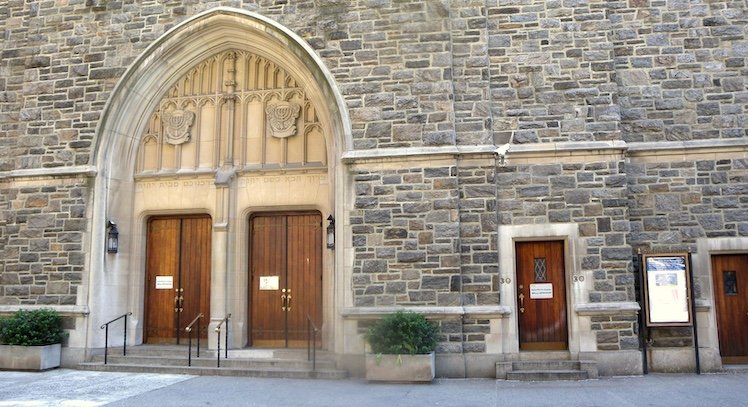

Rabbi Ammiel Hirsch, the senior rabbi at the Stephen Wise Free Synagogue in New York, gave a speech yesterday at a Reform Judaism conference that I predict will be studied, remembered, and referenced for the foreseeable future by his fellow rabbis.
The address should be watched, because Hirsch knows how to deliver a speech. And because often when there’s something you really need to hear, you need to literally hear it. The speech was a rousing call for Reform Judaism to wear its Zionism on its sleeve, to proudly embrace Jewish particularism, and to hold firmer than ever to its belief in Jewish peoplehood.
Because it is no surprise that I support Hirsch’s unapologetic love of Zion, I will comment on one specific aspect of the speech that I believe made it so profound. In organized American Jewry, just as in politics, an idea has taken hold: Because young people are wishy-washy on Zionism and Israel, institutions must either adapt to welcome their ideas or watch their membership crumble.
I won’t mince words: This is weaselly behavior. Which is why I’m not shocked to see it in politics, even as I find the self-debasement cringeworthy. But I have no patience at all for it in Judaism for one reason: Our clergy are our teachers.
Teaching, leadership, education—these are what saved Judaism after the destruction of the Second Temple and the ensuing exile. We argue endlessly about what our rabbis say and do and mean, but it is largely thanks to this system that we have something to argue about at all.
So if young people are straying from Jewish peoplehood, is it our responsibility to join them? Or to teach them?
One of the repeated explanations one hears from liberal Jews is that so many young people have never known a not-right-wing Israeli government. In political circles, this can make Israel advocacy difficult for Democratic officials.
Hirsch also shares this sentiment. He has many disagreements with the current Israeli government, and he does not shy from saying so. But he does not use this as an excuse:
“Given the growing hostility to Israel, especially in our circles, liberal and progressive spaces, it is not enough for us to proclaim our Zionist bona fides every now and again, often expressed defensively, and with so many qualifications, stipulations, and modifications that our enthusiasm for Zionism is buried under an avalanche of provisos. It is not enough to issue occasional press releases, or tweets, that we are a Zionist movement. We are the leaders. We must lead.”
Yes, this is exactly right. When the job gets harder, it still must be done. Obligations are not for easy times only.
As for the idea that institutions should go where the people are, Hirsch turns this against the anti-Zionist instinct as well: “While our movement is a religious body, committed to God and Torah, much of the Jewish world expresses their Jewish identity in secular form through a fierce commitment to the Jewish people and the State of Israel, the most eloquent expression of Jewish peoplehood in our times. Many of these Jews are members of our synagogues. The religious teachings of Judaism do not exhaust the full content of Jewish civilization.”
Anti-Zionism is an abandonment of Judaism and of Jews. Therefore, Hirsch says, the Reform Movement must be absolute in its refusal to ordain anti-Zionist rabbis: “Under what theory of liberal education is there a requirement on our part to even accept, let alone ordain, candidates for the rabbinate and cantorate who do not believe what our movement believes? Ours is a seminary, a sacred ordination, not a university graduate degree.”
It is this principle that I would like to see emphasized in our current moment. Because even those of us who need no convincing regarding Zionism and Jewish peoplehood will, at times, need reminding that we have a responsibility to teach our values as well as to live them.
Source:
www.commentary.org



