
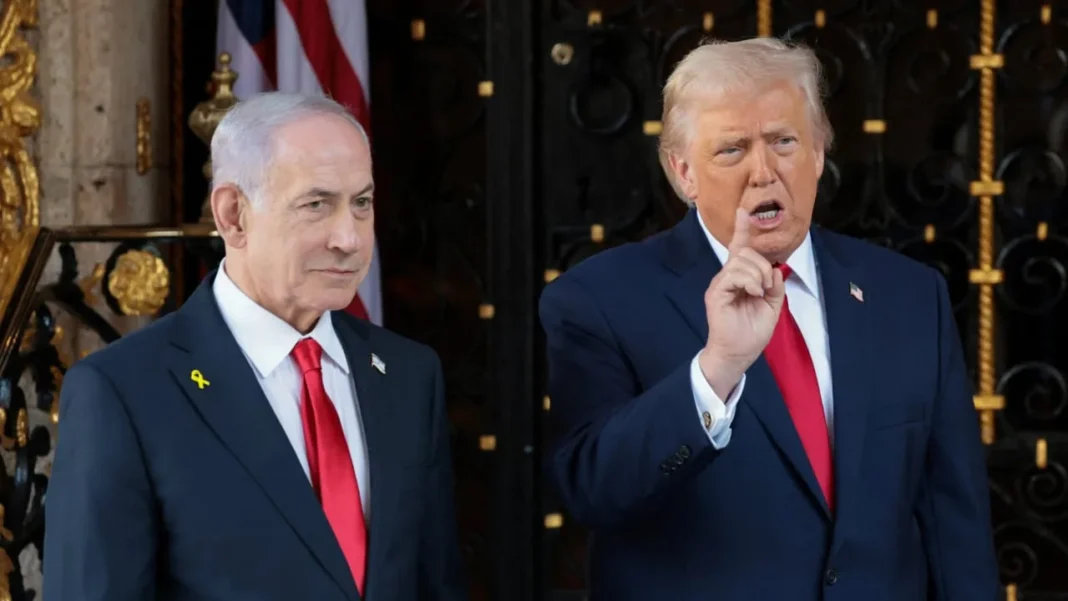

Before rushing too easily into accusations against the American administration and its policy toward Iran, we must pause and ask what lesson Israel should draw when world headlines report US President Donald Trump’s dramatic declaration that “the deal with Iran is done” and that the naval blockade is being lifted.
To arrive at the right lesson, it is worth returning to a foundational principle of international relations, one that many on the Israeli right refused, and still refuse, to internalize: at the helm of the world’s greatest power stands a leader who has made “America First” his banner, said it, and genuinely means it. Trump has a clear compass; sometimes Israel falls on the same needle, and sometimes it may point elsewhere. That does not mean the compass should be discarded when there is no alignment and the goals diverge.
I recall the first Trump inauguration ceremony in January 2017. Around me was a phenomenal euphoria. People danced in the streets of Washington, drunk on hope, certain that a savior had arrived who would fulfill every political dream of the settlement movement and the State of Israel.
Today, those very same people are full of criticism, angry, and even rushing to delete old photos of themselves smiling alongside Trump from their social media accounts. The euphoria has given way to bitter disappointment.
This inconsistency on our part does a disservice, first and foremost, to historical truth: Donald Trump was and remains a president who granted Israel unprecedented support, perhaps the greatest we have ever known from any American president.
The transfer of the embassy to Jerusalem, the recognition of sovereignty over the Golan Heights, and the signing of the historic Abraham Accords are all recorded in his name and have reshaped the Middle East in our favor.
But the mistake of those who danced then and those who are deleting photos today stems from a basic misunderstanding: Trump acted as he did not out of philanthropy or blind Zionism, but because, at that time, it aligned with the cool-headed national interest of the country he was entrusted to govern.
Trump’s actions aren’t based on Zionism, but on US calculations
Now, as Trump seeks to quickly end the regional war in order to present his voters at home with a swift diplomatic achievement, his priorities are shifting accordingly. And as we look toward a fog-shrouded future, Israel must prepare for three central scenarios.
The first scenario is that the agreement collapses or proves to be smoke and mirrors. Already, serious contradictions are emerging between the American and Iranian interpretations regarding the dismantling of nuclear materials and the flow of billions of dollars.
If mutual distrust prevails and the Washington understandings fall apart, we may find ourselves back in active combat, once again in a tight convergence of interests and an open alliance with the United States military against the Iranian octopus.
The second scenario is that the agreement, despite initial concerns in Jerusalem, proves to be good and satisfactory for Israel. It is possible that diplomatic pressure and high-level coordination will ultimately lead the American mechanisms to include close oversight, genuine dismantling of nuclear capabilities, and containment of the missile program and proxy networks. In such a case, the new regional architecture would grant Israel years of quiet and security.
But the third scenario, and the most sober of all, is the one in which the agreement is signed on Friday in Switzerland yet leaves Israel exposed and vulnerable, with our vital security interests pushed aside. In that case, exactly as we have done before the destruction of reactors in Iraq and Syria, we will be required to take independent and decisive action.
Israel has its own red line
We will need to make clear to our friends in Washington that we, too, have a red line, and that with all due respect to “America First,” Israel’s security and survival will always, for us, come first.
The truth is simple: the United States is our greatest friend, and Trump can be an enormous strategic partner, but we must free ourselves from the syndrome of the child waiting for parental approval. The conclusion from his recent moves should not be despair or anger, but sobriety: we must make use of America wherever possible, but never place our security and diplomatic fate on anyone’s shoulders but our own.
Oded Revivi is an Israeli public figure, attorney, and military officer who currently serves as the Chief Executive Officer (CEO) of the ANU Museum of the Jewish People in Tel Aviv. He is best known for his 16-year tenure as the Mayor of the Efrat local council from 2008 to 2024.
Source:
www.jpost.com



