
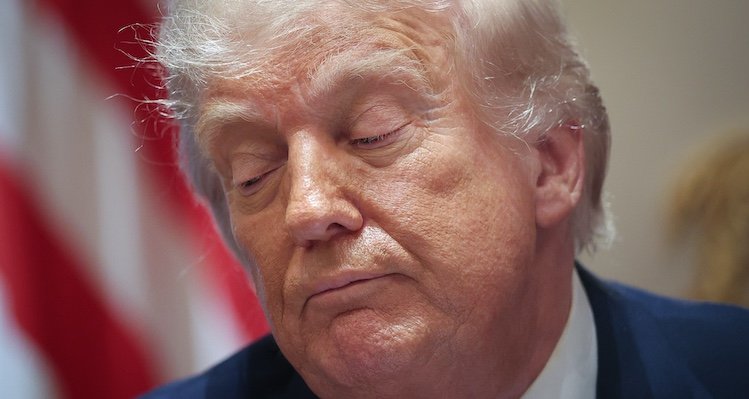

President Trump said something more revealing than he intended it to be. Earlier today, he was contacted by NBC News for comment on the report that Iran had suspended negotiations with the United States. The president claimed not to have heard about this development yet, though he brushed it off.
“It’s an appropriate thing to say, because they’re better negotiators than they are fighters,” he said.
They certainly seem to hold their own against Trump. Today, the president also leaned on Benjamin Netanyahu to ease up Israel’s pursuit of Hezbollah inside Lebanon, especially around Beirut. But that only made the rest of his comments to NBC sound contradictory:
“If they don’t want to talk, that’s OK with me. I think it’s fine. I don’t particularly want to talk either. We talk too much.”
Well if the president doesn’t want to talk to Iran, and he doesn’t want Israel to fight Hezbollah, and he doesn’t want to increase U.S. military pressure on Iran, then the only explanation is that he wants to keep up the Hormuz blockade and wait for it to bleed Iran dry. Yet Trump’s prosecution of this war is unpopular, and if his party loses the Senate in November, his war and his presidency are essentially over, practically speaking and maybe even literally if Democrats muster the numbers to impeach and remove him.
There’s a more immediate problem: Even if the blockade were the entirety of Trump’s strategy, what would he care if Israel helped by weakening Hezbollah? The answer must be: Trump isn’t tired of talking after all.
So Trump’s strategy is to keep talking and use the embargo as leverage to get a better deal. Iran’s strategy isn’t a secret either. It’s to allow Trump to think he’s close to a deal in order to for him to force Israel to stop beating up Iranian forces in Lebanon.
Each side thinks it’s playing the other, while the soldiers still dying are mostly Israelis.
Of course, the antiwar crowd has an answer at the ready: Israel can stop its pursuit of Hezbollah in Lebanon! Except, the reason Israel is in Lebanon is because Israel not being in Lebanon doesn’t prevent Israelis from being killed by Hezbollah.
On a simpler level, here’s what just happened: Iran announced that a specific part of the war—namely, Hezbollah in Lebanon—was of utmost importance to it. In response, Trump conceded that part of the war as a down payment on renewed negotiations, without getting anything in return.
Why would Iran think it’s doing anything other than winning at the moment?
There is another aspect to this refreshing bit of honesty from the Iranians. They have admitted that Hezbollah is Iran and Iran is Hezbollah. Of course, we knew this. But it’s better to have Iran openly admit it in a way that makes it impossible for its numerous American supporters to pretend otherwise.
Thus, we have three powers in Lebanon: Israel, Lebanon, and Iran. Only two of those are arguing for a permanent right to control the country: Lebanon and Iran. So which of those two has a stronger case to control Lebanon?
It’s not a trick question. Iran is confirming, yet again, that the Western narrative of this conflict is the correct one. Iran is an occupying power in Lebanon and elsewhere, and the deaths in Lebanon are indeed Iran’s responsibility.
It is also confirming something else. Any belief that Iran can be merely contained while leaving its threats intact is shortsighted in the extreme. The entire region was blown open by October 7, which was the work of one of Iran’s militias, Hamas. The fact that Iran is asking to preserve the ability to have its proxies repeat the conflagration is proof that the choice before Trump is war now, in which the U.S. has a distinct advantage, or war later, when the enemy has rearmed. The president should choose wisely.
Source:
www.commentary.org



