
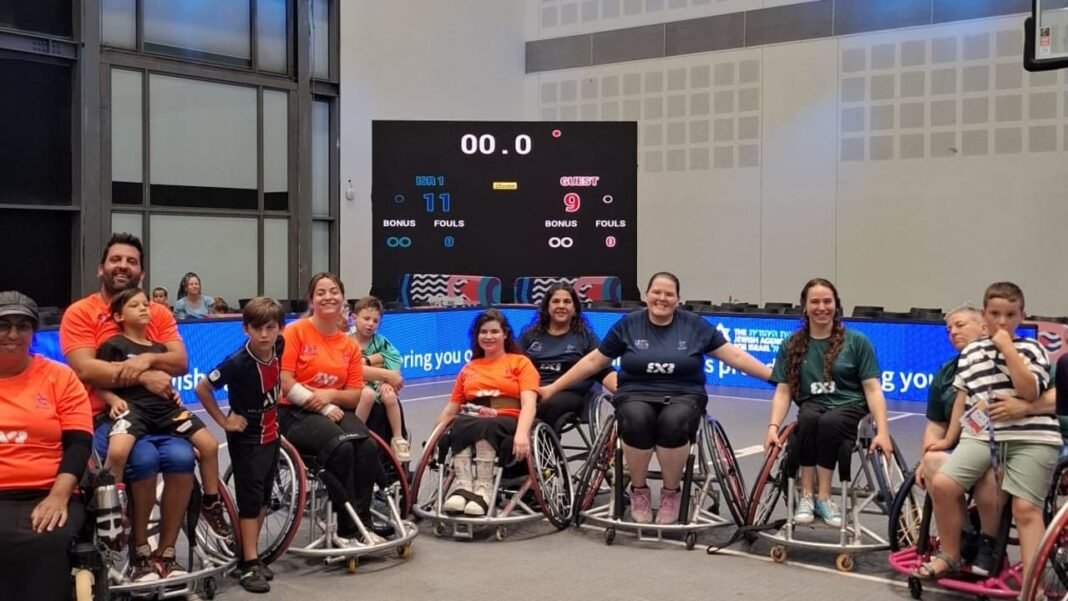

When I first started playing wheelchair sports, I never envisioned winning a medal at the Maccabiah Games. In fact, I don’t think I even envisioned getting from one side of a court to the other without crashing into a wall or, most likely, someone else.
However, yesterday, I donned the bronze medal for 3×3 wheelchair basketball and promptly burst into tears.
The entire experience of competing in the Maccabiah, of walking down that stage during the opening ceremony, of experiencing sportsmanship, solidarity, and love, is something that I can’t fully put into words. But I shall try.
Finding purpose through parasports
Two years ago, I turned up at the Israel ParaSport Center for the sole purpose of interviewing staff about their work with disabled evacuees and Nova survivors. By the end, I had been recruited for para tennis.
I was at first resistant to the idea of playing sports as a disabled player. When I was diagnosed with a tumor in my femur at 16, my main focus was getting out of the wheelchair and learning to walk again.
But no matter how hard I tried over the following years, I couldn’t get my leg to do what I wanted it to do. I was never going to get back my pre-surgery capacity. That, in itself, is a grieving process, one that often takes years to come to terms with.
However, the first time I sat in a sports chair, I felt something in my soul awaken. Having tried to force myself to play sports as an able-bodied person and getting constantly frustrated, I could now run again.
I could move fast and powerfully. I could compete and train and excel. My wheels became my legs. To this day, I can diagnose a problem with my chair as if it were my own foot. We are one and the same.
Then, five months ago, while recreationally shooting some hoops with friends, I was recruited to the Israel national women’s basketball team.
I have since been training in both tennis and basketball. Tennis holds a special place in my heart that cannot be usurped. But being able to play with a team is a special thing.
Winning bronze at the Maccabiah
Yesterday, that team joined forces with the men’s teams from Israel ParaSport Center and from Beit Halochem to play 3×3 basketball in the Maccabiah games. My team – the purple shirt team – took home bronze.
I cried for many reasons when I donned that medal. One, because I have never won anything sportswise in my life. Two, because I was exhausted. And three, because I experienced there a sportsmanship that we, as Israelis, can no longer experience in the global arena.
It was bittersweet.
Sportsmanship beyond the scoreboard
At the opening ceremony, the Israeli delegation was the last to cross the stage, which meant that we had the chance to cheer every country’s delegation before us.
Not only did they cheer and blow kisses and high-five us back, but they chanted Am Yisrael Chai. To them, we weren’t just equals but an aspiration. The dream. The mothership. We swapped shirts and hugged and showed each other dignity, respect, and admiration.
And it was strikingly clear to me that this would not have been the case with non-Jewish players.
The contrast with international competition
Most of my friends from the center compete internationally on a regular basis. I have non-disabled friends who compete in sports too. Their experience of international competitions looks very different from what I saw at the Maccabiah.
It looks like a refusal to shake hands. It looks like not listening to Israel’s national anthem. It looks like boos, jeers, and Palestinian flags. It looks like the Israeli team being sequestered away under a high security presence, like pariahs.
What we have seen from international sports over the last three years goes against the very core of what it means to be a sportsman.
To be a sportsman is to approach your opponent with respect and not treat them differently based on their origin, religion, or nationality. It is to be a gracious winner and a gracious loser.
Why the Maccabiah still matters
It was an overwhelming luxury to experience true sportsmanship among global hearts at the Maccabiah. But it was also a painful reminder of what is no longer true for Jews and Israelis in normal sports.
This is why we need the Maccabiah – to reinvigorate us in a climate of iniquitous antisemitism. To remind us that throwing a ball and swimming a lap are just that – and that sports are not the space for politics or hate.
The most noticeable thing of all at the Maccabiah was Jewish pride. Every single player there was a proud Jew. And I am no different.
When I donned that medal, I donned it as a proud Jewish and Israeli woman.
And while I may not be met with the same love and celebration from my opposing teams in non-Jewish competitions in the future, I endeavor to carry myself with that same Jewish pride regardless of whether I play against friend or foe.
Source:
www.jpost.com



