
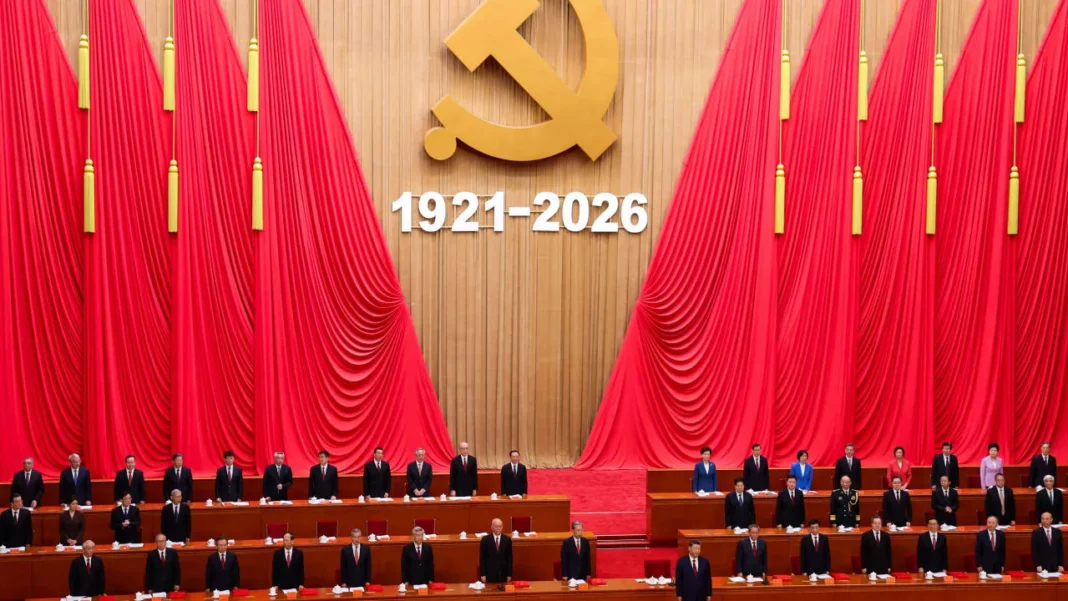

On July 1, 2026, the Communist Party of China (CPC) marks the 105th anniversary of its founding. At the celebration, Chinese President Xi Jinping noted that the CPC has united and led the Chinese people of all ethnic groups in unremitting struggle, writing the most magnificent epic in the thousands of years of Chinese history. A century-old party remains vigorous in its prime. To understand the CPC’s “secret” of success is to better understand China today.
A lasting commitment to ideals and the people
Once the flame of conviction is lit, it never dies. Founded in 1921 with just over 50 members, the CPC emerged at a time when China was torn by war and foreign aggression. From the outset, it adopted the pursuit of socialism and communism as its guiding goal, facing hardship and sacrifice without hesitation. More than a century later, that conviction continues to inspire millions of Party members to overcome challenges and move forward with determination.
Once a mission is embraced, it never wavers. Since its birth, the CPC has made seeking happiness for the Chinese people and rejuvenation for the Chinese nation its founding mission. Under the Party’s leadership, China has transformed itself from an impoverished country into the world’s second-largest economy. GDP has grown from less than $10 billion in the early years of the People’s Republic to $20 trillion today. Per capita GDP has risen from just a few dozen dollars to over $13,000, while life expectancy has increased from 35 to 79 years.
China has also built the world’s largest education, social security, and healthcare systems. Behind these achievements lies the Party’s enduring belief that “the country is the people, and the people are the country.”
Building a strong party to build a strong country
To govern the country, the Party must first govern itself. With 105 million members, the CPC is the world’s largest political party. How does it effectively manage such a vast organization? How does it avoid the historical cycle of rise and decline? The answer lies in the Party’s blueprint for strengthening itself.
A key principle is maintaining the Party’s vitality and integrity through self-reform. Exercising full and rigorous Party self-governance is central to this approach. It is not merely a slogan but a practical commitment.
The Party consciously accepts public oversight. Citizens can report problems to disciplinary authorities through a simple phone call or by scanning a QR code on their mobile phones.
According to a 2025 survey by China’s National Bureau of Statistics, 95.8% of respondents were satisfied with the results of full and rigorous Party self-governance. This willingness to confront problems directly has enabled the century-old Party to remain dynamic and retain the wholehearted support of the people.
Equally important is a strong organizational system. If self-reform keeps the Party fit and healthy, then a robust organizational system gives it the strength and resilience. Today, the CPC has more than five million primary-level Party organizations, ensuring that Party members serve wherever people are found.
During the largest poverty alleviation campaign in human history, more than three million officials were dispatched to work in villages. Since the 18th CPC National Congress in 2012, the average number of people lifted out of poverty each year was roughly equivalent to the entire population of Israel. By 2021, nearly 100 million rural residents had escaped poverty.
This capacity to mobilize resources to accomplish major tasks has become one of China’s greatest institutional strengths.
Chinese modernization: a new path forward
Modernization is a shared aspiration of all nations, but there is no single model. Israeli scholar Yuval Noah Harari has argued that the 20th century was shaped by three major narratives: fascism, communism, and liberalism. Over the past 45 years, however, under the leadership of the CPC, 1.4 billion Chinese people have been writing what could be called a fourth story across China’s 9.6 million square kilometers – the story of Chinese modernization.
Chinese modernization is the fundamental path toward national rejuvenation and a better life for the Chinese people. One important reason for China’s high-quality development has been long-term strategic planning through Five-Year Plans. Since 1953, China has implemented 14 consecutive Five-Year Plans, pursuing development with consistency and determination.
Today, China operates more than 50,000 kilometers of high-speed railway, accounting for over 70% of the global total. Installed power generation capacity has exceeded four billion kilowatts, the highest in the world, while the core industries of the digital economy now contribute more than 10% of GDP.
China’s development benefits not only its own people but also contributes to common development worldwide. This reflects the Chinese cultural values of “harmony without uniformity” and “promoting harmony among all nations,” while distinguishing Chinese modernization from traditional Western models.
As 2026 marks the first year of the 15th Five-Year Plan, China will continue pursuing high-quality development, expanding high-standard opening up, and creating more opportunities for shared prosperity with countries around the world, including Israel.
Dialogue and mutual learning for a shared future
President Xi Jinping has observed that countries around the world are like passengers aboard the same ship who share the same destiny. For the ship to navigate the storm and sail toward a bright future, all passengers must pull together. The thought of throwing anyone overboard is simply not acceptable.
The greatness of a major political party lies not in its size but in its vision. At a time when profound global changes are accelerating, with unilateralism, protectionism, and Cold War mentality resurfacing, the CPC has consistently advocated cooperation instead of zero-sum competition, openness instead of exclusion, and mutual learning among civilizations instead of estrangement. This broad vision has enabled China to avoid the historical pattern that a strong nation must inevitably seek hegemony.
Today, the CPC maintains regular exchanges with more than 700 political parties and organizations in over 170 countries. It has proposed global initiatives on development, on security, on civilization, and on governance, while promoting high-quality Belt and Road cooperation and building practical platforms for international collaboration.
From sharing poverty reduction experience and advancing green development to exchanges on governance and dialogue among young political leaders, the CPC has remained committed to mutual learning with political parties around the world, offering another approach to governance in the 21st century.
A century-long journey opens a new chapter, while the Party’s founding mission remains unchanged. Today, the CPC is leading more than 1.4 billion Chinese people in advancing national rejuvenation through Chinese modernization.
It stands ready to strengthen exchanges with political parties around the world, including those in Israel, deepen mutual learning in Party and state governance, pursue modernization together, and make new contributions to building a community with a shared future for humanity.
The writer is the Chinese ambassador to Israel.
Source:
www.jpost.com



