
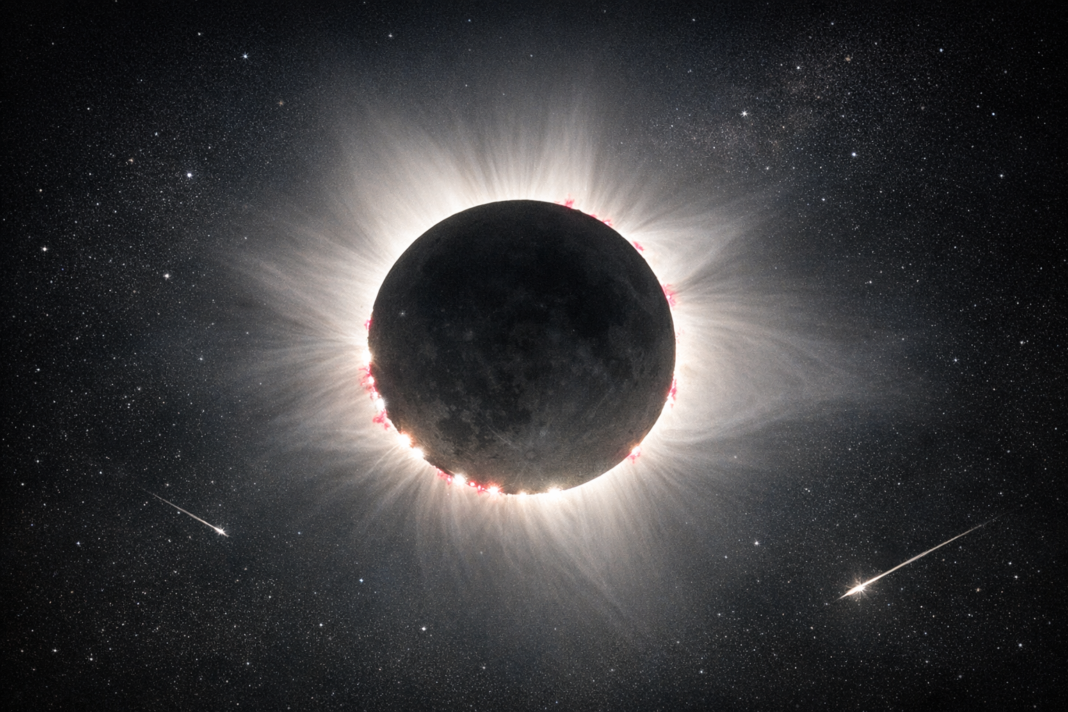

First images show the Moon fully obscuring the Sun during the total solar eclipse observed on Aug. 12, captured by NASA scientists during a live broadcast from Spain. The photographs record roughly 90 seconds of totality when the daytime sky darkened to twilight and the Sun’s outer atmosphere, the corona, became visible as fine, white spikes surrounding the lunar silhouette.
The images include a bright pink prominence projecting from the solar limb, a plasma structure held aloft by magnetic fields rather than a flare, and the characteristic bead-like pattern known as Baily’s Beads visible in the moments just before and after totality. Photographers used solar-filtered telescopes to preserve detail of the corona and the contrast between the eclipsed Sun and the surrounding sky.
The eclipse followed a narrow path of totality that extended from near the North Pole across Greenland, western Iceland and parts of northern Spain, while observers outside that corridor experienced partial coverage. Coverage reached up to about 90% in parts of Europe and was substantially lower, about 10%–25%, for viewers in the northeastern United States and Canada.
The event also coincided with a new Moon, a timing that produces darker night skies and cleared conditions for the night’s meteor activity. Perseid meteor shower forecasts from NASA indicated the potential for up to 75 meteors per hour under dark skies, as the shower peaks shortly after the eclipse and the moonlight is minimal.
Short-term astronomical scheduling includes a deep partial lunar eclipse on Aug. 27–28 that will be visible across much of the Americas, followed by a notable total solar eclipse on Aug. 2, 2027, which is expected to be the longest of the century and will cross southern Spain and northern Africa. The Aug. 12 imagery adds to a sequence of observations that will inform ongoing studies of the corona and solar magnetic phenomena.






