
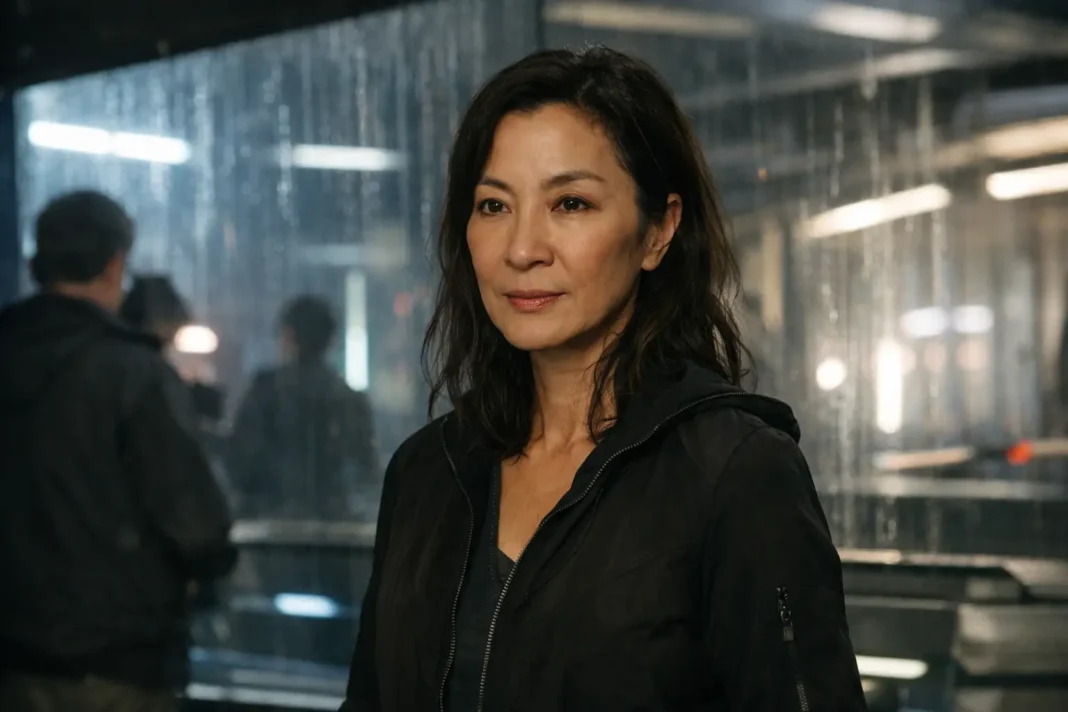

Michelle Yeoh is approaching the world of Blade Runner not as another human survivor in a dystopian future, but as something deliberately other. The Oscar-winning actor, now 64, is part of Blade Runner 2099, the forthcoming science-fiction series connected to Ridley Scott’s 1982 film and its 2017 sequel. For an actor whose screen history spans ballet, martial arts, prestige drama and franchise cinema, the project adds a new variation to a career defined by reinvention.
The invitation came through a letter from Silka Luisa, the creator of the series, whose appeal persuaded Yeoh to consider the role. Once involved, the actor made one condition clear: she did not want to play a human. In a universe built around the tension between people and replicants, that distinction matters. Yeoh’s character, Olwen, emerged from work on how a synthetic being might appear, move and occupy space without falling into the familiar image of a mechanical robot.
Her description of Olwen points to a performance based less on machinery than on controlled ambiguity. The character has a cold, steely gaze, but her movement is not stiff or conventionally robotic. Yeoh has described it as fluid, closer to a dragon or a serpent, suggesting a physical language that fits the franchise’s long-running interest in bodies, memories and manufactured life. For science fiction, those choices are more than visual details: they shape how viewers read power, consciousness and threat.
The role also extends questions that have followed Yeoh through recent stages of her career. Her Academy Award-winning performance in Everything Everywhere All At Once put her at the centre of a story about identity, family and parallel lives, while Blade Runner 2099 turns toward another central question: what makes someone human. Yeoh has framed her preparation around whether humanity is innate or formed through experience, a concern that connects directly with the franchise’s history of replicants seeking recognition beyond their design.
Yeoh’s casting carries additional weight because her career has often challenged narrow expectations placed on Asian women in international cinema. From action roles to James Bond visibility and late-career awards recognition, she has repeatedly moved between genres that once offered limited space for performers like her. With Olwen, she enters one of modern cinema’s most scrutinised fictional worlds while refusing the safest route through it. The result positions Michelle Yeoh not as a guest in the Blade Runner mythology, but as an actor reshaping its central question from within.





