
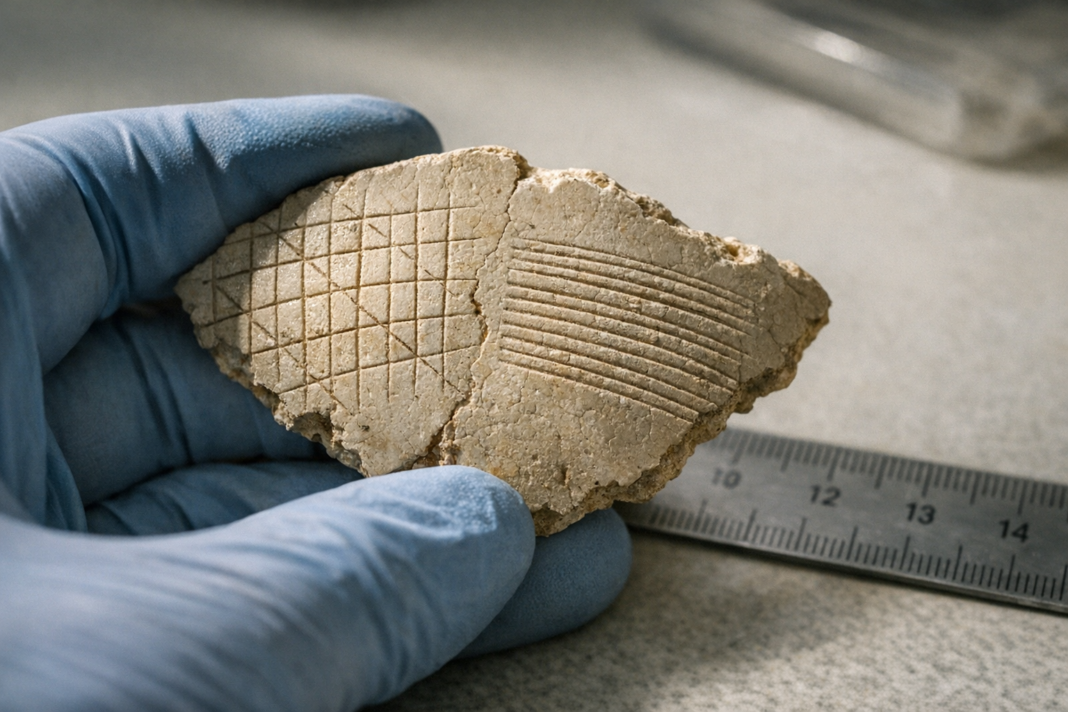

Ancient engravings on ostrich eggshells recovered in southern Africa display recurring grids, parallel lines, right angles and repeated shapes that researchers say are more organized than previously recognized. A careful re-analysis of multiple fragments reveals consistent motifs and alignments that appear to follow repeatable rules rather than random or purely decorative strokes. The patterning is dated to more than 60,000 years ago on the basis of stratigraphic and contextual evidence from the excavation sites.
A team of archaeologists applied systematic recording and comparative pattern analysis to dozens of engraved fragments, quantifying line orientation, spacing and motif recurrence. The results reported in the study identify geometric regularities across separate pieces and stratigraphic contexts, supporting the interpretation that the marks were produced according to deliberate schemes. The authors describe instances where engravers appeared to establish grids and then populate them with repeated elements, implying premeditated design sequences.
Researchers interpret these findings as evidence of advanced visuospatial organization in late Pleistocene tool-using communities. The structured nature of the engravings suggests cognitive processes capable of planning, repetition and the application of consistent conventions to a durable substrate. The study notes that ostrich eggshells, commonly used as containers, provided a stable surface for engraving and that the choice of geometric repertoire demonstrates a level of abstraction in graphic production.
The new analysis extends the record of organized graphic behavior in human prehistory and prompts calls for further comparative work across regions and media. The authors recommend additional microscopic wear studies, experimental engraving trials and broader surveys of contemporaneous material culture to clarify how these engraved systems related to social, practical or mnemonic practices. By documenting repeatable, rule-like patterning, the research contributes measurable data to ongoing investigations of early symbolic and technical capacities in Homo sapiens.






