
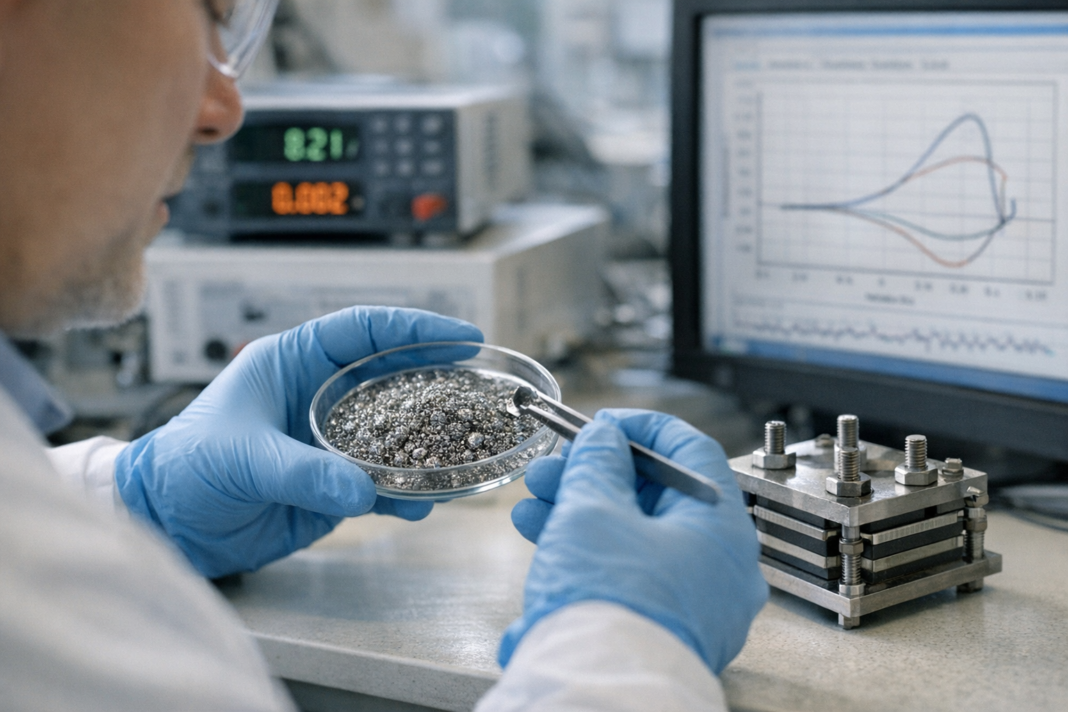

Silver nanocatalysts have been observed to change the location of their principal reactions depending on whether a solid oxide cell is operated to produce electricity or to generate hydrogen. The behavior, reported in recent experimental work, reveals an internal operational switch in the catalyst that shifts active reaction sites in response to the cell’s operating mode.
The observed switching does not alter the catalyst material itself but relocates where the most consequential electrochemical processes take place on the nanoparticle surfaces. That relocation influences local reaction pathways and energy flows inside the cell. By mapping how the reaction loci move under different polarities and operating conditions, researchers can better understand performance limits and loss mechanisms in electrochemical devices.
The finding is especially relevant to devices that can operate in dual modes, such as reversible solid oxide systems that alternate between power generation and fuel production. In those contexts, the switching behavior of silver nanocatalysts can be exploited to optimize each mode separately, tailoring surface structure, particle placement and support materials to favor desired reactions when the cell is producing electricity and a different set when it is producing hydrogen.
Practical implications include improvements in both clean electricity generation and the production of green hydrogen. By designing catalysts that take advantage of the intrinsic switch, engineers may reduce energy losses and increase system-level efficiency, lowering the electricity required for electrochemical hydrogen production and enhancing power output when operating as a fuel cell. Developers of next-generation electrochemical systems can incorporate these insights into materials selection and reactor architecture to achieve targeted performance improvements.
The discovery of this internal switching mechanism provides a new parameter for catalyst design and system optimization in the broader effort to decarbonize energy systems. Integrating knowledge of dynamic reaction-site relocation with scaling efforts and durability testing will be an essential step toward translating the laboratory observation of silver nanocatalysts into commercial gains for clean power and green hydrogen technologies.






