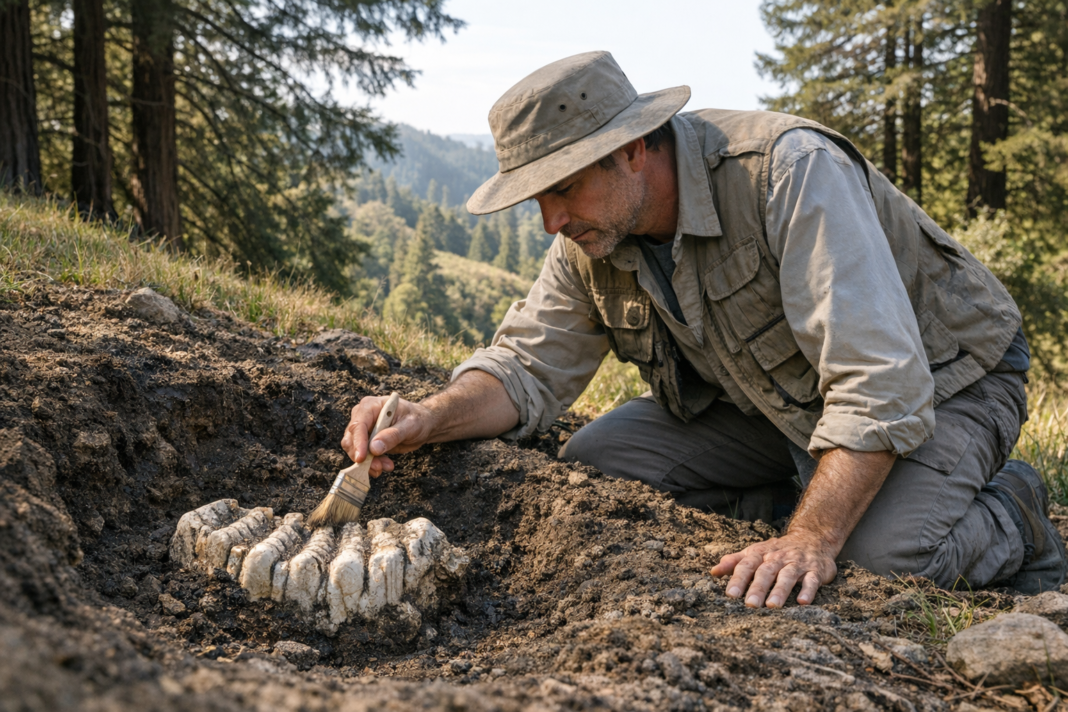

Strange, rock-like object discovered during fieldwork in a nature preserve on the San Francisco Peninsula has been identified as a remarkably complete molar from an adult Pacific mastodon. The fossil emerged from a creek bed this summer during a habitat project and was recovered and reported by Midpeninsula Regional Open Space (Midpen), which manages the preserve in San Mateo County.
Brigid Lynch, a geomorphologist with Balance Hydrologics who found the tooth while surveying, handed the specimen to conservation staff. A preliminary examination by Pacific Paleontology described the molar as unusually well preserved and among the most complete from the local area. Specialists identified it as belonging to the Pacific mastodon and estimated it dates to at least 10,000 years ago, placing it near the end of the Pleistocene epoch.
Wayne Thompson, the consulting paleontologist who examined the fossil, assessed the tooth’s completeness and condition as exceptional for the region. The specimen will undergo laboratory analysis, including radiocarbon dating, after Midpen transferred it to Stanford University’s Doerr School of Sustainability. Researchers plan to establish a precise age for the fossil and document its morphology as part of ongoing efforts to map Ice Age faunal remains in the western United States.
Pacific mastodons were formally recognized as a distinct species in recent years and are known to have inhabited parts of what are now California, Oregon, Mexico and the northern Rockies. Paleontologists note anatomical differences between Pacific and American mastodons, including dental and limb traits, which make finds like this molar valuable for species-level study and for reconstructing past environments.
The discovery also highlights how routine conservation and habitat work can intersect with paleontology: the team had been conducting a project aimed at improving habitat for the threatened California red-legged frog when the fossil appeared. Midpen has indicated it will produce a 3D scan of the tooth for outreach and education while scientific analyses proceed, enabling wider public access to the specimen without risking the original fossil.