
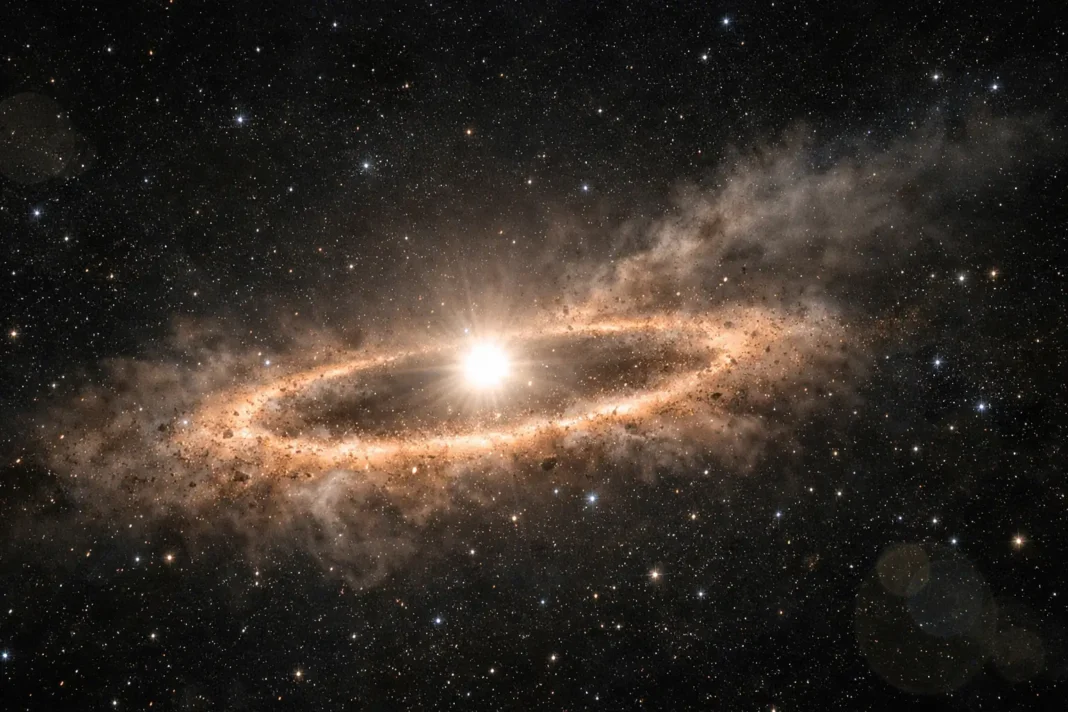

Webb reveals violent interactions in distant planetary systems as NASA‘s James Webb Space Telescope probed 21 rare “extreme debris disks” around young stars. The observations show that the dusty material produced in these systems carries measurable signatures of high-energy impacts between large, planet-sized bodies. Scientists say the data illuminate the kinds of collisions thought to have shaped our own solar system, including the giant impact associated with the Moon’s origin.
The term “extreme debris disk” describes a circumstellar ring loaded with fresh, warm dust generated by catastrophic collisions during the early stages of planetary assembly. By examining the composition and quantity of that dust, astronomers can infer the scale and intensity of the events that created it. In these 21 systems, Webb’s sensitivity to faint, warm material enabled researchers to characterise properties of the ejecta that ground-based telescopes struggle to detect.
Placing these findings alongside models of planetary growth helps scientists compare how often and how violently planets assemble across different environments. The new observations supply empirical constraints on collision energies and debris production, offering a more detailed backdrop for scenarios like the Moon-forming giant impact. Within the wider astronomy field, such constraints are valuable for refining timelines of planet formation and for understanding the diversity of outcomes that follow major impacts.
While the study does not catalogue specific planets or reconstruct individual impact events, it marks a significant step in using dust signatures as a diagnostic tool for planetary collisions. These Webb-driven measurements provide fresh data that can be incorporated into theoretical models and future observational campaigns, helping to situate Earth’s formative episodes in a broader, comparative context of planetary evolution.






