
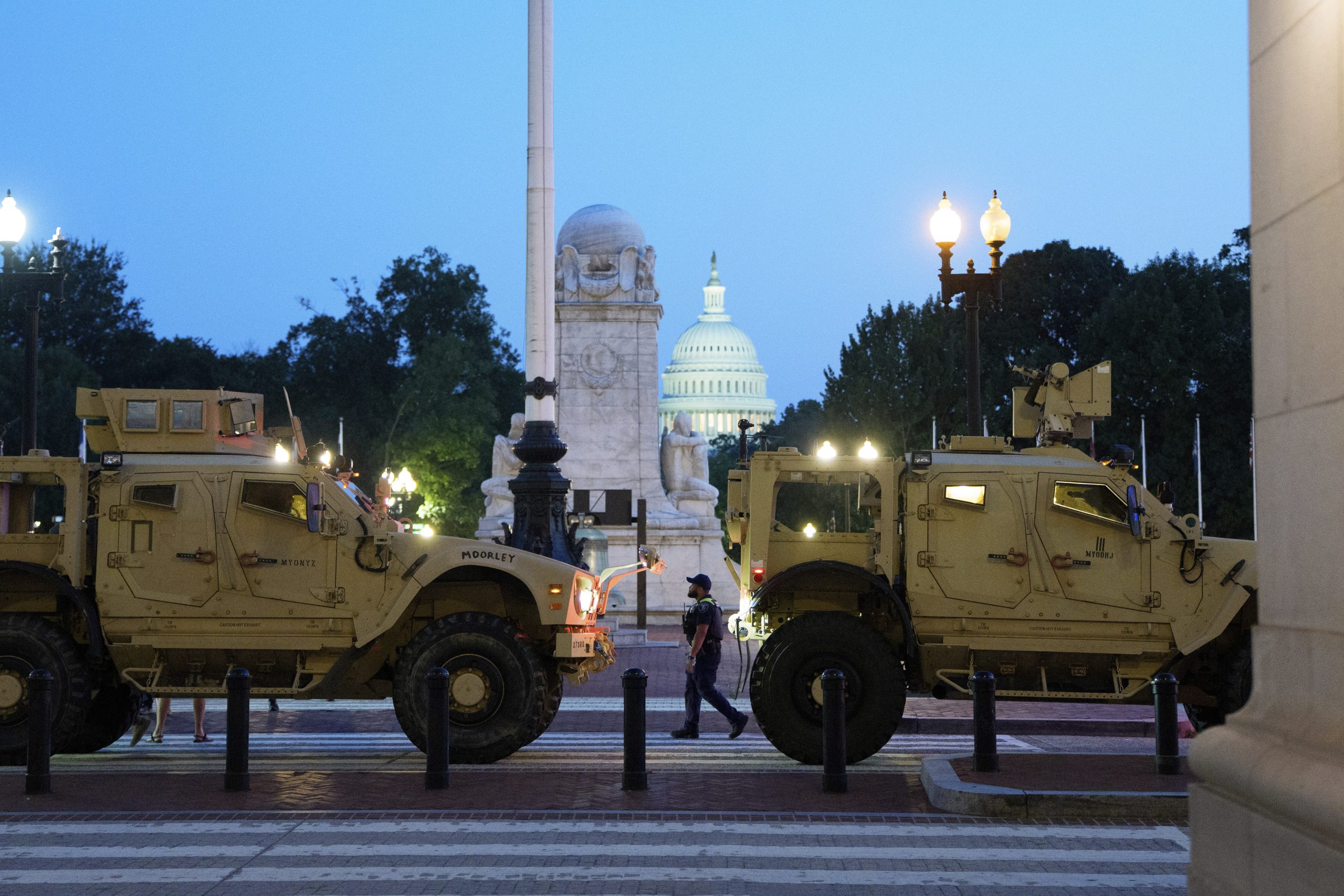

Last week, Donald Trump claimed the authority to deploy the country’s military to the streets of Washington, D.C. to help fight crime. Yet, hard data show it’s not about crime in the nation’s capital. Instead, the evidence points to other, more troubling reasons and aspirations, especially the president’s personal sense of entitlement to power, MAGA’s approach to partisan politics, and an implied threat to public opposition to his exercise of power in the future.
Trump is not the first president to deploy armed soldiers to the streets of Washington. James Madison did it to fight the British military in the War of 1812, and Abraham Lincoln did it throughout the Civil War. Stationing troops in a country’s capital is also routine in military dictatorships, including today those in Libya, Iraq, Sudan, Yemen, and Myanmar facing domestic uprisings, and those in places such as Cuba, Laos, Chad, Botswana, and Burkina Faso that fear future unrest.
More notably, civilian dictatorships today use soldiers in their capitals to keep order and discourage dissent, an unsavory group that includes China, Russia, North Korea, Egypt, Turkey, and Afghanistan.
The United States does not face a foreign army or armed domestic forces that threaten the District of Columbia and our political system. Instead, the Trump administration’s rationale for deploying troops in Washington are the city’s crime statistics from 2023. The claim is wholly fallacious. As Washington Mayor Muriel Bowser and others have noted, the city’s violent crime rate in 2023 was an outlier that was followed by a decline of 35 percent in 2024 and another 26 percent in the first half of 2025.
Violent crime rates are higher in DC than in any state, but those comparisons are also fallacious. Every state contains hundreds of rural communities, towns, and small cities. FBI data show that across the country, those areas have violent crime rates at least 60 percent lower than in cities with populations of 500,000 to 1 million like Washington, with no rural, town, and small city residents.
The proper comparisons for DC are cities of similar size, and the FBI data for 2024 also show that Washington had a lower violent crime rate than Indianapolis, Albuquerque, Memphis, Nashville, or Milwaukee. Washington also had a lower property crime rate in 2024 than Tucson, Indianapolis, Baltimore, Albuquerque, Memphis, or Seattle.
Finally, FBI data show that the homicide rate in the nation’s capital fell 39 percent in 2024 to a rate lower than Indianapolis, Baltimore, Detroit, Nashville, and Milwaukee, and DC’s rate for all violent crime was its lowest in more than 30 years.
If urban crime rates for homicide, all violent offenses, or all property crime were a real basis for President Trump sending in troops, they also justify a long-term military presence in at least 11 other major cities.
Crime has always been an entirely legitimate focus and concern for public policy. City police forces have handled local crime in urban areas since the mid-nineteenth century; and when urban Americans find their police have not been up to the job, they can pay more taxes or float bonds to expand the police’s presence. The federal government also has helped fund municipal police forces since 1968, and the Bill Clinton and Joseph Biden administrations increased that support. If crime were the issue for President Trump, he could have followed their examples instead of cutting federal funding for local police by $500 million in the One Big Beautiful (sic) Bill Act.
As a practical matter, one of President Trump’s points in stationing troops in American cities is a very stark type of partisan politics. The president first sent troops to Los Angeles and now has named Baltimore, New York, Chicago, and San Francisco/Oakland as other place where he also may deploy soldiers. All of them are major cities in solidly Blue states, and all of them have much lower homicide rates than major cities in many solidly Red states.
The city with the country’s highest homicide rate is St. Louis in red Missouri followed by New Orleans in red Louisiana. The 2024 data show also that St. Louis’s homicide rate was twice the rate in Washington, 1.6 times higher than Baltimore’s rate, 2.5 times the rate in Chicago, and nearly 12 times the rate in New York City. Homicide rates in New York and Los Angeles are also lower than those in Indianapolis, Dallas, Atlanta, and Greensboro, all major cities in states Trump carried in 2024 and unmentioned in his threats.
These actions and threats may serve distinct purposes unrelated to crime. A month before the 2024 election, when threats of terrible punishments were a major theme of the Trump-Vance campaign, I wrote in these pages that Niccolo Machiavelli noted long ago that strongman leaders use such threats and acts to consolidate power and authority. Recent events certainly suggest that President Trump sees his threats and use of troops at home as a means of advancing his authority and agenda. It’s equally certain that their deployments have nothing to do with a president’s traditional domestic use of troops to fight a foreign, invading power or defend cities during an armed uprising.
Earlier this year in these pages, I also pointed to the similarities in Trumpism’s view of American politics as a struggle between friends and domestic enemies and the theories of the Nazi philosopher and jurist Carl Schmitt. The president’s extraordinary use of the military in American cities now recalls Schmitt’s analysis and belief that when domestic enemies oppose a leader’s policies, the leader has a right and obligation to claim and exercise emergency powers to suppress them.
Trump’s militarization of the streets of DC isn’t technically illegal, but the distinct odor of authoritarianism is unmistakable.



