
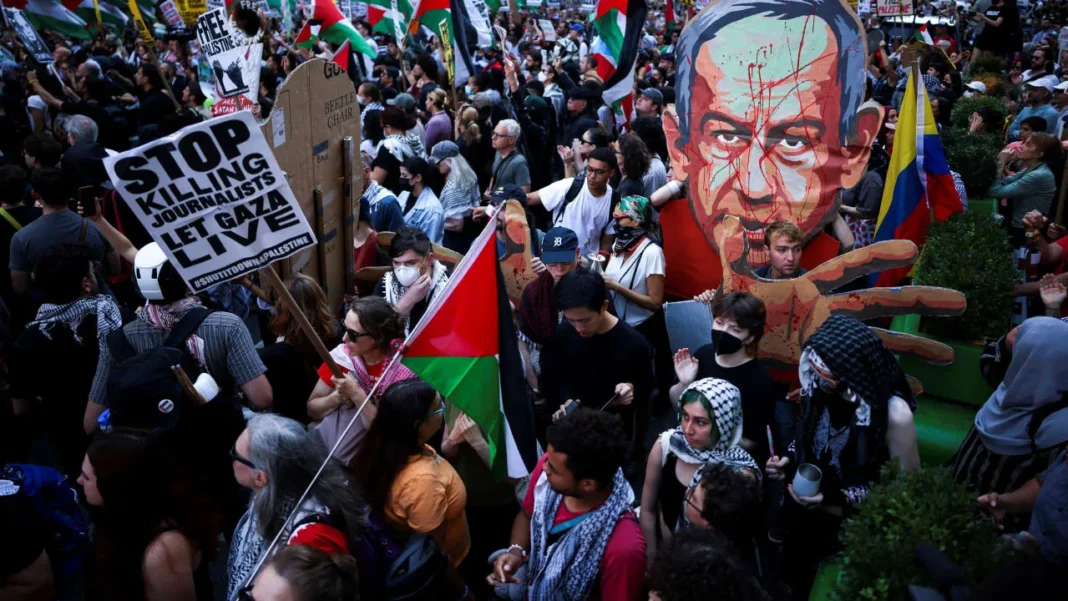

Most Americans support Israel over Hamas, according to a Tuesday Harvard CAPS Harris poll, but almost half of the youth back the Palestinian terrorist organization over the Jewish state.
The results of the April 23-26 online survey of 2, 745 registered American voters showed that 74 % of respondents supported Israel over Hamas, with 86 % of Republicans, 66 % of Democrats, and 68 % of independents.
Younger voters were more likely to support Hamas than older voters, with 54 % of participants aged 18 to 24 and 60 % of those aged 25 to 34 backing Israel. Support for Israel continued to rise to 89% among those aged 65 and older.
The favorability rating of institutions and countries among the respondents saw Israel as more popular than the Palestinian Authority, Hamas, and Iran. 41 % of voters saw Israel favorably, versus 36 % who saw it unfavorably. Only 9 %, 12 %, and 16 % saw Hamas, Iran, and the PA favorably. 59 %, 65 %, and 44 % saw those same countries unfavorably.
Israel’s Prime Minister also fared better than his detractors in a question about foreign leaders and domestic political figures. Benjamin Netanyahu had a net 27 favorability among Americans, and a 34% unfavorability. This made the Israeli leader more popular among Americans than New York City Mayor Zohran Mamdani and political commentators Tucker Carlson and Candace Owens. Owens had a lower unfavorability rating than the others, but that was because far more Americans had no opinion or had never heard of her.
Assessing the motive and character of Hamas
When assessing the motive and character of Hamas, 76% said that there were terrorist organizations like the aforementioned on Israel’s borders, with 70% of Democrats, 83% of Republicans, and 75% of independents sharing the view. The trend of older respondents being more supportive of Israel continued, with 60% of Americans aged 18 to 24 saying that Hamas and Hezbollah were terrorist groups on Israel’s border, rising to 90% among those 65 and up. 43% believed that these groups were trying to destroy Israel, 23 thought they were trying to expand their territory, and 34 perceived the groups as fighting for their rights. A plurality of Democrats, 48%, believed the groups to be fighting to have more rights in their territory, as did voters aged 18 to 44.
When it came to the conflict with one of these organizations, Hezbollah, 81% of respondents said that they supported a long-term peace agreement between Israel and the state in which the Lebanese terrorist organization resided. 76% believed that Hezbollah should be disarmed as a condition of such a peace agreement.
67% of the respondents said that they were following Israel, the US, and Iran’s war closely. One in five voters cited the war as their top concern, following affordability, economy, immigration, and health care. Yet it was also the US President’s weakest approval rating issue, besides the economy and inflation, with only 39 % approving of his conduct on the matter.
The importance of the issue is reinforced by results that indicated that 65% of respondents agreed that Iran was a national security threat to the US, and another 67 % that the Islamic Regime had been a source of instability, terrorism, and war in the region. Seventy four % of survey takers said that it was in the US’s interests to stop Iran from getting nuclear weapons, more important than restraining Chinese and Russian influence or opposing Latin American leaders tied to narco trafficking. Around two-thirds of respondents also believe that the Iranian people do not support the Islamic Regime, and that Iran was cheating on its nuclear deal commitments. However, a slight majority of Democrats, 52 %, believe that Iran was sticking to the deal. Over two-thirds of respondents also believed that Iran was rebuilding its nuclear program, up by seven % from March.
Yet while Iran was seen as a threat, only Fifty two % and 54 % still support military strikes on Iran, and believe them justified, respectively. A Plurality of 43 % think the war with Iran should stop now, while 34 % think the conflict should continue, however long it takes to achieve the US’s objectives. Seventy % of respondents thought that the US was winning the war, though this belief dropped to sixty % among Democrats. A plurality of 35 % believed the conflict is headed in an unclear direction, with another 28 % expecting military escalation, and another 22 % expecting a peaceful resolution.
Over three-quarters of respondents believed, in descending order of importance, that a peaceful resolution required Iran to stop supporting proxies, stop executing protesters, accept Israel’s right to exist, surrender control of the Strait of Hormuz, limit ballistic missile production, and give up Uranium enrichment and supplies. Uranium was the least supported peace condition, though 63 % supported continued counter-blockade action if Iran’s Uranium is not ceded to the US.
57% of participants agree with the blockade, while 79 % believe that Trump’s acceptance of a ceasefire is the correct course of action. While 64% of Americans appeared to believe the Iranian leadership has split into factions, the weakness did not translate into expectations of victory. 60% believed that Trump’s strong stance against Iran would result in it not giving up its nuclear program
The sample of respondents was weighted to align with the demography of the US population, and the survey reportedly had a margin of error of 1.87 with a 95 % confidence level.
Source:
www.jpost.com



