

“Trade over aid.” It’s the new tagline for the policy change we all knew was coming, and is now here: the end of U.S. military “aid” to Israel.
Of course, the “aid” was really money that had to be spent on the domestic U.S. defense industry, so it was a stimulus for the American economy more than anything. And with that stimulus, the U.S. got an insider’s look at the technological developments on the Israeli side.
Now, because it wasn’t merely a cash giveaway, “ending” U.S. aid to Israel can mean one of two things: either actually ending the military-to-military relationship that results in Israel obtaining supplies from American manufacturers, or restructuring the process in a way that is more complex but basically upholds the status quo of mutual cooperation.
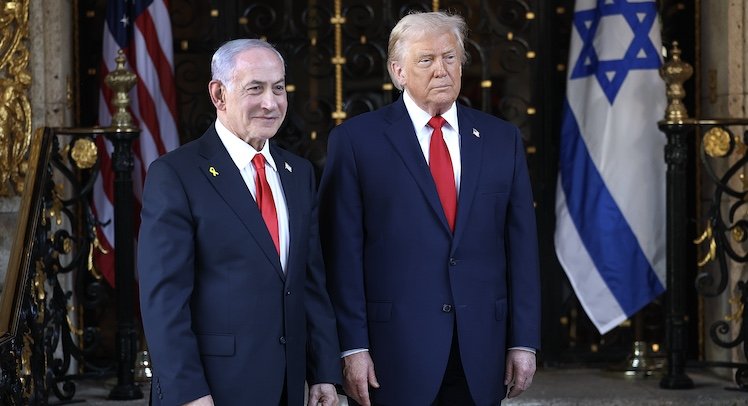
The timing of the phase-out (or restructuring) of the aid matters a great deal, then. Which is why we should not be too surprised that the transition is happening during a time when Benjamin Netanyahu is Israel’s prime minister and Donald Trump is the U.S. president. Both men want to see the relationship sustained, if not deepen even further. Rather than take a chance with a future U.S.-Israel pairing, Trump and Bibi understand that the time to try to cement the contours of the new agreement is now.
Today, Republican Rep. Marlin Stutzman introduced a resolution outlining the new policy approach. He presented a letter of support for the plan from Netanyahu as well. “Israel deeply appreciates the financial component of the military aid the United States has generously provided us over the years,” Netanyahu writes. “The time has now arrived for us to move from aid recipient to partner.”
The resolution itself calls the shift “Netanyahu’s initiative.” The rollout is being handled in a way that distinguishes the idea behind it from the way it is usually framed by critics on both left and right. Democratic Rep. Alexandria Ocasio-Cortez, a leader of the anti-Zionist coalition in Congress, told the Democratic Socialists of America recently that she would vote against aid to Israel: “The Israeli government should be able to finance their own weapons if they seek to arm themselves.” That included defensive weapons such as supplies for the Iron Dome.
Ro Khanna, another obsessive critic of Israel, has said much the same: “Israel is a first world country, and it can pay for the defensive systems it needs.” Rahm Emanuel, former Chicago mayor and chief of staff to President Obama, essentially echoed this formulation: “The days of taxpayers subsidizing Israel militarily are over. No more financial aid.”
In reality, Israel was buying the weapons and other supplies it needed, so this argument was always disingenuous. But it enabled some lawmakers to argue that they were not against Israel’s right to exist or to defend itself while also calling for a break in the U.S.-Israel relationship.
This is in contrast to folks like outgoing Republican Rep. Tom Massie, who makes wild insinuations about Americans subsidizing Israeli abortions, and Democratic Rep. Rashida Tlaib and other members of the “Squad,” who simply yell about the Jewish state’s supposed bloodthirst. Meanwhile, the long-debunked “genocide” lie has gone mainstream in Democratic circles, furthering a trend that could make it virtually impossible for a future Democratic administration to rework the U.S.-Israel relationship in any remotely productive way.
Figures like Tucker Carlson and Marjorie Taylor Greene continue to dishonestly frame the aid issue as a cudgel against Israel and against Trump. Eliminating this talking point without eliminating the aid, then, has given Trump reason to pursue a restructuring under his own watch.
Netanyahu has long felt similarly, but he also has supported restructuring the aid in a way that doesn’t hamstring Israeli leaders during wartime or stifle domestic Israeli production at a time when the state needs a larger degree of independence from the whims of Western politicians easily bullied by Hamasnik constituents armed with Iranian talking points. As Netanyahu told CBS last month, “let’s start now and do it over the next decade, over the next 10 years, but I want to start now. I don’t want to wait for the next Congress. I want to start now.”
And it starts now, with Stutzman’s resolution. The details will come later, but the general framework will put more emphasis on trade and mutual cooperation on various projects. That will also likely insulate much of it from sabotage by anti-Israel members of Congress at a time when Democrats are nominating the most extreme anti-Zionist crop of candidates in memory.
The question now becomes: Will this satisfy all those who claim that American subsidy is the problem with Israel aid? Or will they find other reasons to bash the plan and move the goalposts in their continuing quest to undo America’s alliances?
Source:
www.commentary.org



