
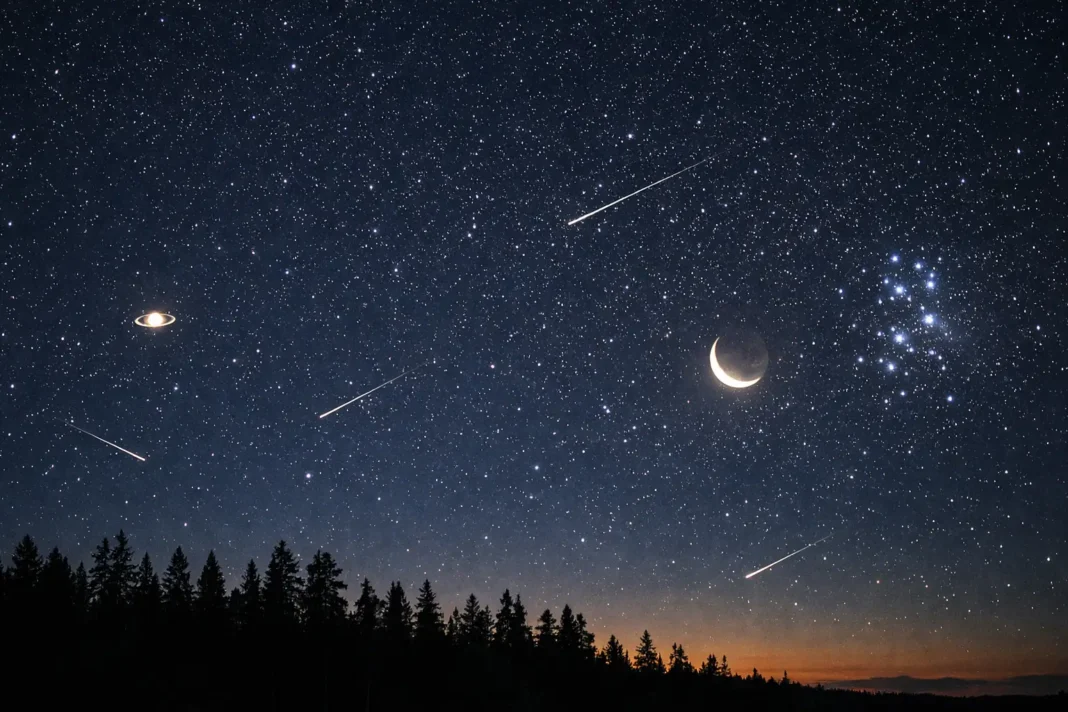

Watch October skies for a trio of notable celestial sights this month. Saturn reaches opposition, making the ringed planet one of the brightest objects in the night and visible for much of the night as Earth lies between it and the Sun. The planet’s high apparent brightness and full-night visibility present good opportunities for both casual observers and amateur astronomers using small telescopes or binoculars to study its rings and brightest moons.
Alongside Saturn, observers can expect activity from the Orionid meteor stream, a shower produced by debris shed long ago by Halley’s Comet. Orionids are known for swift, often bright meteors that can produce impressive streaks across the sky. Moonlight this month may wash out the faintest trails, so observers seeking the best tally of meteors should plan for periods when the Moon is below the horizon.
The Moon will also pass near the Pleiades open cluster, offering a photogenic conjunction for those with wide-field cameras or binoculars. The relative proximity of the lunar glow can both enhance and hinder the view: it creates striking framed images of the cluster while reducing the visibility of its faintest stars. Skywatchers in dark locations will see the most stars, but even those in suburban areas can enjoy the pairing as an easy-to-find feature of the predawn or early-evening sky.
Practical viewing advice: choose a site away from strong artificial light, arrive before the predicted pre-dawn peak hours to catch the best of the Orionids, and allow eyes to adapt to the dark. Naked-eye observations are usually sufficient for meteor counts, while binoculars or a small telescope improve views of Saturn and the Pleiades. For observing tools, charts and up-to-date conditions, consult resources such as NASA or local astronomy clubs and observatories, which frequently publish schedules and viewing tips tailored to regional conditions.






