
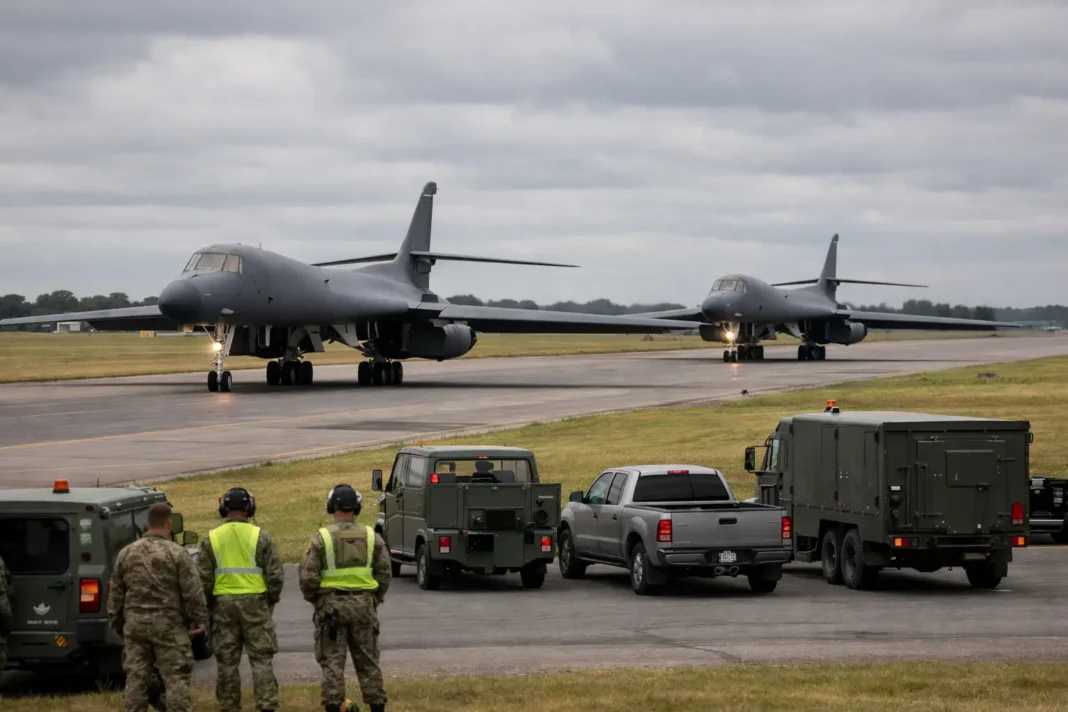

Donald Trump said a “threat” was the reason Washington pulled long-range B1 bombers from RAF Fairford, and the Pentagon has confirmed the aircraft were flown back to their home stations in the United States. The president’s assertion and the military confirmation together set out the core facts: a public statement attributing the move to a security concern, and an official acknowledgement that the deployed aircraft have been withdrawn.
The Pentagon’s statement did not elaborate on the precise nature of the reported threat or on the timing of departures. The affected machines were B-1 strategic bombers, aircraft operated by the US Air Force for long-range missions. Their presence at RAF Fairford, a base in England, has been part of routine rotational deployments that bring US heavy bombers to European bases on a temporary basis for training, readiness and interoperability activities with partners.
The B-1 Lancer is a variable-sweep wing bomber designed for high-speed, long-range operations; its deployments to forward bases are typically framed as exercises or demonstrations of strategic reach. In this instance, the withdrawal and the differing public accounts from the White House and the Defence Department concentrate attention on the operational decision and its explanation. Observers seeking fuller detail will be attentive to follow-up disclosures from US authorities about the circumstances that prompted the movement.
Beyond the immediate operational facts, the episode may carry implications for coordination between political leaders and military command, and for transparency around temporary overseas deployments. Officials have provided a concise account so far: a presidential statement citing a threat and a Pentagon confirmation of the return of assets to US stations. How allies and other stakeholders interpret those statements will depend on any further information released by US government entities in the coming days.





