HomeWorld NewsAt Least 68 Dead After High-Speed Train Collision in Spain

At Least 68 Dead After High-Speed Train Collision in Spain

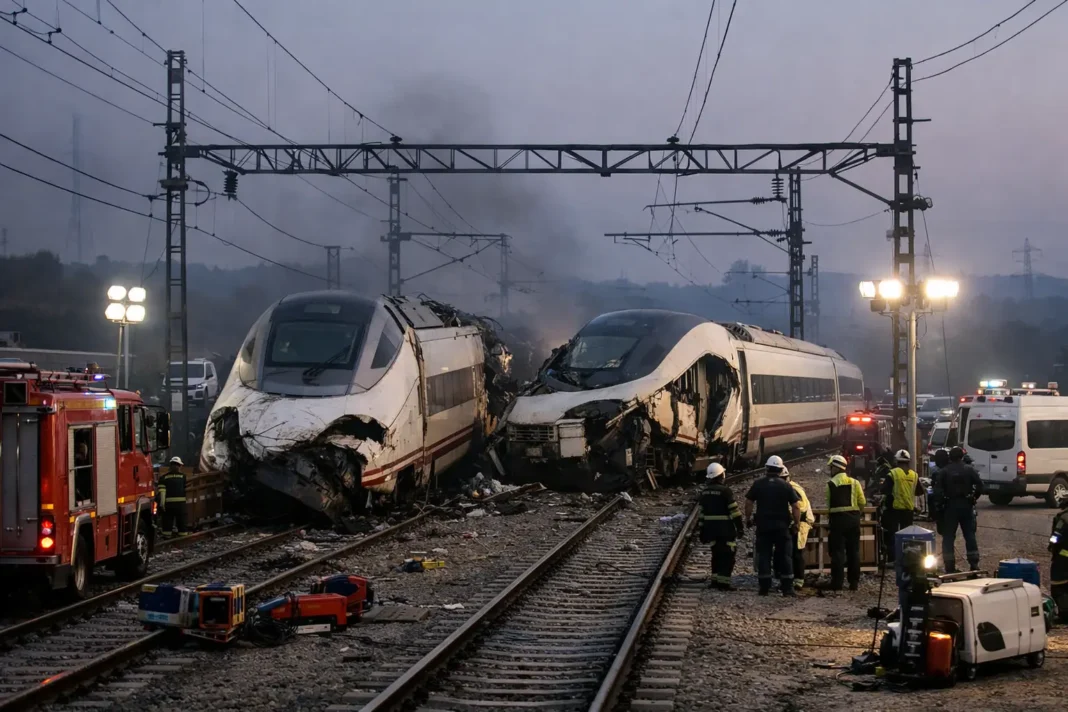
A high-speed train collision in Spain has killed at least 68 people, after a moving train struck another train that had stopped further along the same track. The transport minister described the cause as an “inexplicable” error, a formulation that immediately places attention on how two trains came to occupy the same line in such dangerous conditions.

The confirmed death toll makes the crash one of the gravest rail disasters involving a high-speed service in the country. The information available points to a collision rather than a derailment: one train was stationary ahead, while the other continued on the track until impact. That detail is central to the first questions facing investigators, because modern rail networks depend on signalling, communications and operating procedures designed to prevent precisely this type of event.

The Spanish transport ministry, part of the official government structure overseeing national transport policy, will face scrutiny over the circumstances that led to the crash. The ministry’s institutional information is available through the Ministerio de Transportes y Movilidad Sostenible. At this stage, the only public explanation attributed to the minister is the reference to an error that remains unexplained. No further verified details have been provided about the sequence of decisions, technical failures or operational factors that may have contributed.

The accident is likely to intensify public attention on rail safety, especially on high-speed routes where stopping distances, traffic control and real-time communication are vital. Collisions involving a stationary train raise questions about track occupancy systems, driver alerts and the chain of command during disruptions. Determining whether the failure was human, technical or procedural will be essential before any firm conclusions can be drawn.

For passengers and families, the immediate consequence is a disaster with a heavy human cost and many unanswered questions. For Spain’s rail authorities, the priority now is to establish a verified account of what happened and why the safeguards in place did not prevent the impact. Until investigators identify the failure behind the “inexplicable” error cited by the transport minister, the focus will remain on accountability, transparency and the measures needed to prevent another fatal collision.


Advertisementspot_imgspot_img

Hot this week

Estevao’s Chelsea Wait Highlights the Pressure Inside a Crowded Attack

Estevao is struggling for Chelsea minutes as Pedro Neto’s form and attacking competition limit his role under Xabi Alonso.

China’s Pressures Raise Questions Over Power, Growth and Succession

China’s political continuity, economic slowdown and demographic strain are drawing closer international scrutiny.

Fleetwood Stun Arsenal on Penalties to Reach Carabao Cup Quarter-Finals

League Two Fleetwood Town eliminated Premier League champions Arsenal on penalties to reach the Carabao Cup quarter-finals.

Genetics May Explain Why Low-Dose Aspirin Is Linked to Lower Dementia Risk in Some Older Adults

Low-dose aspirin was linked to lower dementia risk only in older adults with a specific genetic profile, raising precision prevention questions.

Fleetwood’s fearless cup night sends Arsenal out on penalties

Fleetwood beat Arsenal on penalties despite an 83-place gap, earning a Carabao Cup quarter-final place and a landmark night.

Hamilton Draws a Line on Racing Into the 2030s

Lewis Hamilton says he is “built differently” while again ruling out extending his Formula 1 career into the 2030s.

Patrick Stewart’s Picard Turned Star Trek’s Future Into a Moral Promise

Patrick Stewart, who died at 86, made Jean-Luc Picard a defining figure of humane science fiction and television leadership.

Study Links Popular Sugar Substitutes to Quicker Cognitive Decline

A study of nearly 13,000 adults found higher use of artificial sweeteners was associated with faster decline in memory and thinking.

Critical minerals turn mining into a test of power, trust and sovereignty

US-China competition for critical minerals is forcing resource-rich countries and mining firms to balance capital, sovereignty and public consent.

Bronze Age Sword Emerges From Italian Lake With Its Edge Intact

A 3,300-year-old bronze sword recovered from Lake Mezzano in Italy sheds light on prehistoric ritual, status and Mediterranean networks.

Healey’s First Budget Puts Energy Relief at the Centre

Healey’s first Budget includes £100 energy bill support and a bank tax, as opposition parties argue the plan lacks ambition.

Estevao’s Chelsea Wait Highlights the Pressure Inside a Crowded Attack

Estevao is struggling for Chelsea minutes as Pedro Neto’s form and attacking competition limit his role under Xabi Alonso.
Advertisementspot_img

Related Articles
