
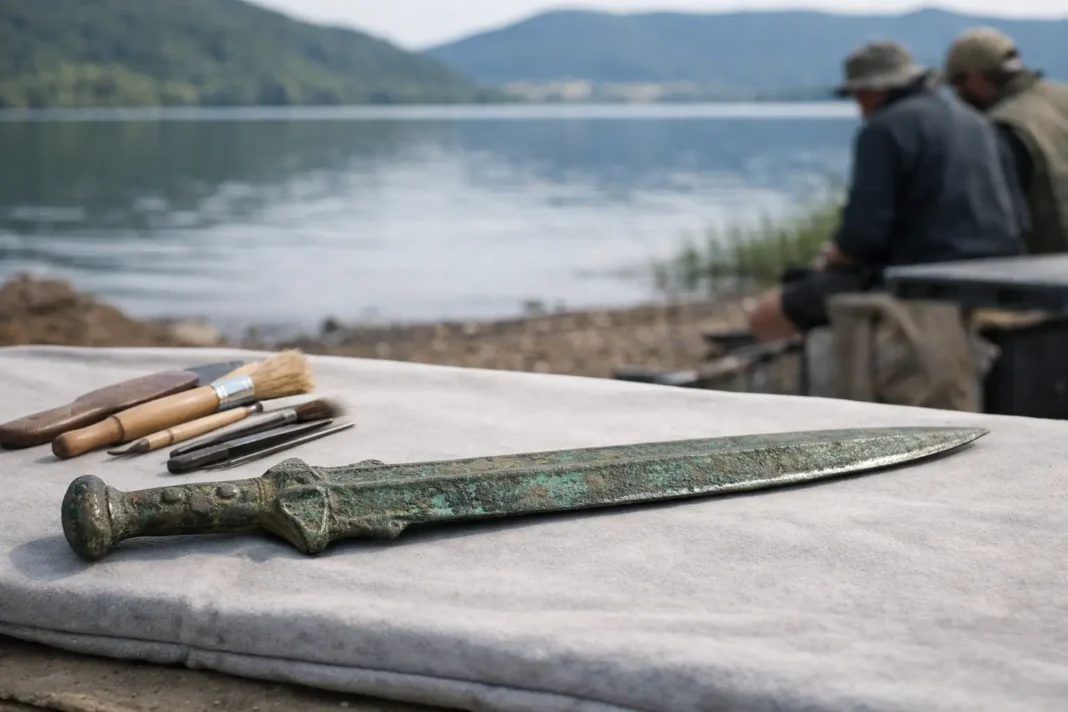

A bronze sword recovered from the waters of Lake Mezzano in central Italy has offered archaeologists a rare glimpse into a society that flourished long before the rise of the Etruscans and Romans. The weapon, dated to the Late Bronze Age, around the 14th to 13th centuries B.C., remains notably well preserved, including a sharp edge after roughly 3,300 years underwater.
The find was made in a volcanic crater lake about 60 miles, or 100 kilometers, northwest of Rome. The Superintendence of Archaeology, Fine Arts and Landscape for the Province of Viterbo and Southern Etruria described the discovery as exceptional. It is the third sword of this type found in Lake Mezzano over the past half century, strengthening the site’s importance for the study of prehistoric central Italy.
Lake Mezzano was not an isolated environment in the Late Bronze Age. Archaeological work has identified remains of pile dwellings, or stilt houses, once built in the area now covered by the lake. Recent investigations also brought to light a broader group of objects, including intact vases, axes, arrowheads, daggers, spearheads, pins and a bronze razor, forming a material record of daily life, craft and social organization around the settlement.
The sword was found close to the bronze razor, a detail that may connect the objects to a person of elevated status, possibly an elite warrior. Archaeologists also consider another interpretation: the placement of valuable metal objects in water may reflect a ritual practice known across Bronze Age Europe. Weapons, ornaments and other prestige goods were often deposited in lakes, rivers or wetlands, sometimes as offerings or as acts with symbolic meaning rather than practical disposal.
During the 13th century B.C., communities in central Italy were part of exchange networks linked to the wider Mediterranean. In that setting, bronze weapons were more than tools of combat; they could express rank, identity and authority. The Mezzano discoveries add evidence to a period that remains less familiar than later Etruscan and Roman history, and further research at the lake is expected to clarify how these communities lived, traded and marked power through objects.






