
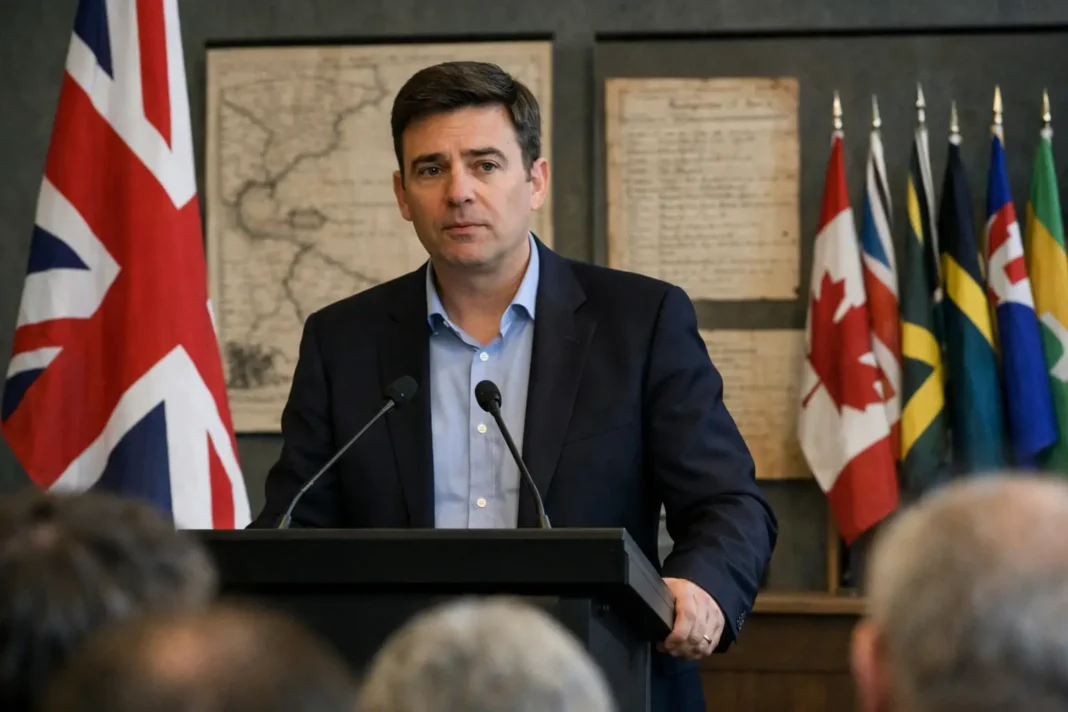

Britain’s slavery debate has been given renewed political weight after Andy Burnham argued that today’s public should not be required to fund financial reparations for the crimes of the slave trade, while insisting the country must confront the full complexity of its history. His intervention places emphasis on acknowledgement, education and future cooperation rather than direct payments, a position likely to shape discussion around slavery, national memory and the United Kingdom’s relationship with the Commonwealth.
Burnham’s position rejects financial compensation as the appropriate response to historic injustice, but does not minimise Britain’s role in the traffic of enslaved people. He has signalled openness to calls for a formal apology for Britain’s involvement in the slave trade, while arguing that prosperity should be pursued through partnership with Commonwealth countries. The distinction matters politically: it separates a moral reckoning with the past from a reparations model that remains contested in Britain and across parts of the Caribbean and Africa.
The historical reference at the centre of Burnham’s argument is Manchester, a city with a divided legacy. On 28 October 1787, the abolitionist Thomas Clarkson addressed a large congregation at Manchester Cathedral, condemning the brutality of the slave trade and describing the suffering of enslaved people. After the sermon, thousands in Manchester signed a petition against slavery. Yet the same city’s cotton economy was deeply connected to labour extracted from enslaved people, exposing the contradiction between abolitionist activism and industrial wealth.
The issue carries particular resonance during Black History Month, when public institutions, schools and communities revisit the experiences and contributions of Black people while examining how slavery shaped modern Britain. Burnham’s remarks underline a wider national tension: Britain was home to campaigners who helped drive abolition, but it was also a participant in the trade in human beings. That dual history continues to influence debates over monuments, curricula, civic apologies and Britain’s ties with nations whose societies were marked by colonial exploitation.
For the government, the challenge is to turn historical acknowledgement into practical policy without presenting financial reparations as the central solution. Burnham’s emphasis on working with the Commonwealth frames the response around shared development and long-term cooperation, rather than individual liability for past crimes. The approach may not satisfy advocates who see reparations as a necessary form of justice, but it makes clear that the question of Britain’s slavery legacy is no longer confined to history; it remains a live political issue in the present.





