
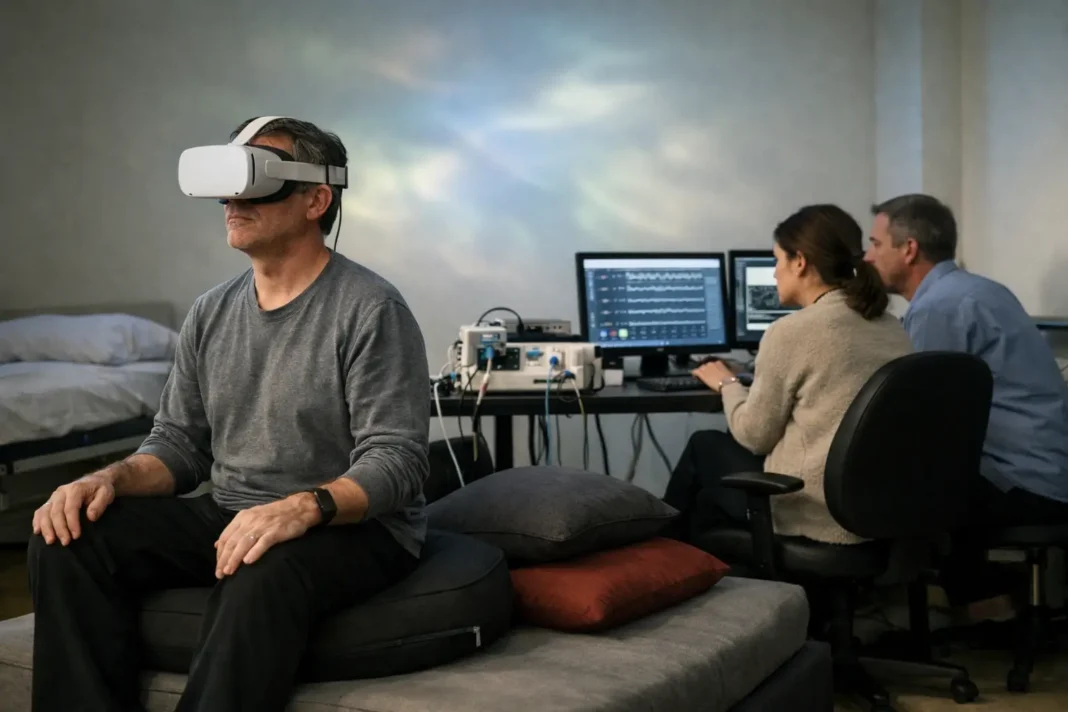

Lucid dreams may be more trainable than previously assumed, after a small study found that unusual virtual reality scenarios combined with meditation increased participants’ ability to recognize when they were dreaming. The research, published on Sept. 28 in Frontiers in Psychology, examined lucid dreaming, a state in which sleepers are aware they are dreaming and may sometimes influence what happens next.
The study was led by researchers at the University of Trento in Italy, including neuroscientist Nicola De Pisapia and doctoral researcher Andrea Signorelli. Participants were university students who underwent training twice a week for one month. The protocol combined meditation, intended to sharpen awareness of current thoughts and perceptions, with immersive VR scenes designed to feel dreamlike. When students encountered impossible or bizarre events in the simulation, such as sudden scene changes or objects behaving unnaturally, they practiced “reality checks” by asking whether the experience was real or a dream.
Reality checks have long been used in neuroscience research on dreams, but their effectiveness has been inconsistent because waking life often lacks the strange qualities common in dreams. By using VR to create controlled moments of unreality, the researchers sought to make the exercise more similar to the conditions in which lucid dreams occur. After each training session period, participants kept morning dream diaries and completed daily questionnaires recording the dreams they remembered and whether any had been lucid.
The group trained with meditation and dreamlike VR reported lucid dreams four times more often than a comparison group that practiced reality checks without meditation or VR. A separate control group used realistic rather than dreamlike VR environments; those participants were more than eight times less likely to report lucid dreams than the main training group. The findings suggest that the content of the VR experience, not merely the use of immersive technology, may have played an important role. Daniel Morris, a cognitive neuroscientist at Northwestern University who was not involved in the research, has noted that lucid dreaming could be relevant for people troubled by nightmares because it may help them reshape distressing dream experiences.
The study remains preliminary. It involved only 38 participants, and neither control group included meditation, making it difficult to separate the effects of mindfulness practice from those of dreamlike VR. The researchers are now conducting follow-up work without the meditation component to test whether immersive scenarios are the central factor. Future studies may also examine whether personalized VR simulations could help people recognize recurring dream patterns, with possible applications for nightmares, anxiety or post-traumatic stress disorder. For now, the results add a cautious but notable line of evidence to research on sleep, dreams and the ways waking training may influence the sleeping mind.





