
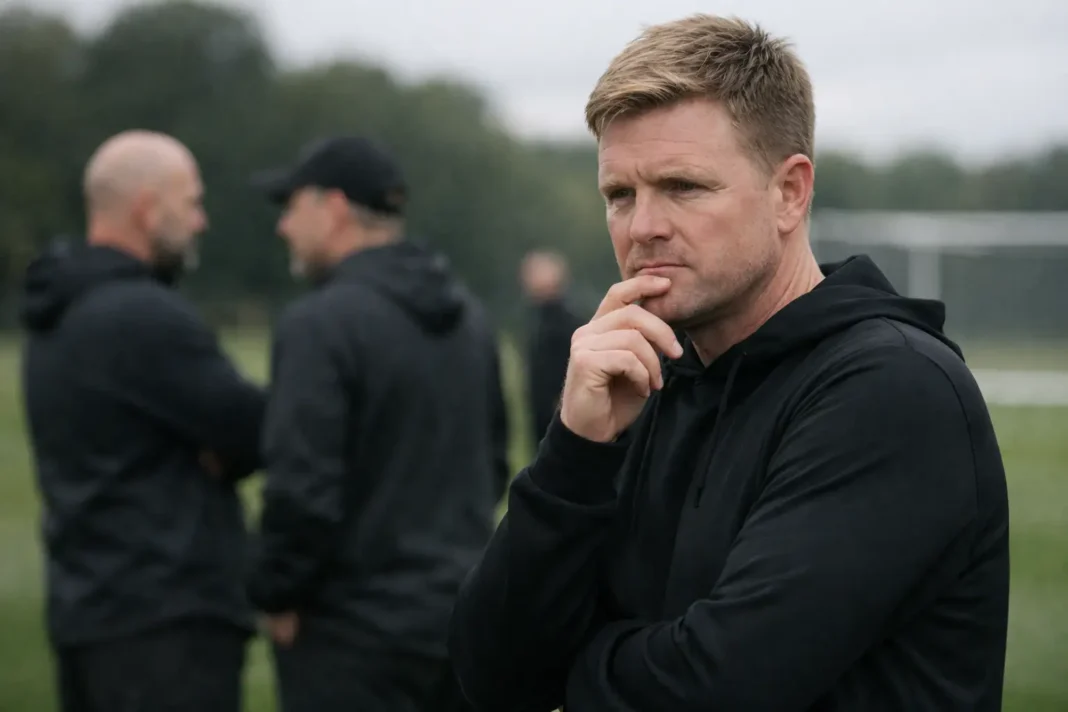

Eddie Howe’s possible move into the Manchester United conversation has opened a wider debate than a simple managerial rumour. For Manchester United, any appointment would have to answer questions about identity, squad development and the demands of a club where short-term pressure rarely leaves room for gradual construction. For Eddie Howe, the issue is just as significant: whether a step into Old Trafford’s environment would strengthen the work that has defined his career or place it under a level of scrutiny that changes the conditions entirely.
Howe’s appeal is clear. His teams have generally been associated with coaching clarity, aggressive organisation and an emphasis on improving players through daily work rather than relying solely on market solutions. His rise with Bournemouth established his reputation as a manager capable of building structures over time, while his work at Newcastle United showed he could operate at greater scale, including the club’s return to the Champions League. In a Premier League landscape shaped by pressing, intensity and positional detail, those qualities would be central to any argument in his favour.
The challenge is that Manchester United is not only a technical project. The club’s managerial role carries commercial visibility, constant tactical debate and immediate judgement on selection, transfers and results. A coach such as Howe would need more than a clear playing model; he would require a recruitment framework that fits that model, a squad prepared for the physical demands of his football and institutional patience when performances fluctuate. Without those conditions, the same methods that have brought stability elsewhere could be judged before they have fully taken hold.
From Howe’s perspective, the calculation would involve timing as much as ambition. Newcastle United has provided him with a platform to shape a team, develop relationships inside the club and compete at a high level in English football. Moving to United would bring a larger global stage and the chance to influence one of the sport’s most followed institutions, but it would also reduce the margin for gradual progress. At Old Trafford, style, results and authority are examined together, often from the first run of difficult fixtures.
The link therefore highlights a decision that would be strategic rather than symbolic. Howe could offer United a coach with a defined training-ground identity and evidence of player development, but the appointment would only make sense if the club were prepared to support that approach consistently. Until there is an official move from the parties involved, the discussion remains centred on fit: not whether Howe is a capable manager, but whether his strengths match the realities of one of football’s most demanding jobs.






