
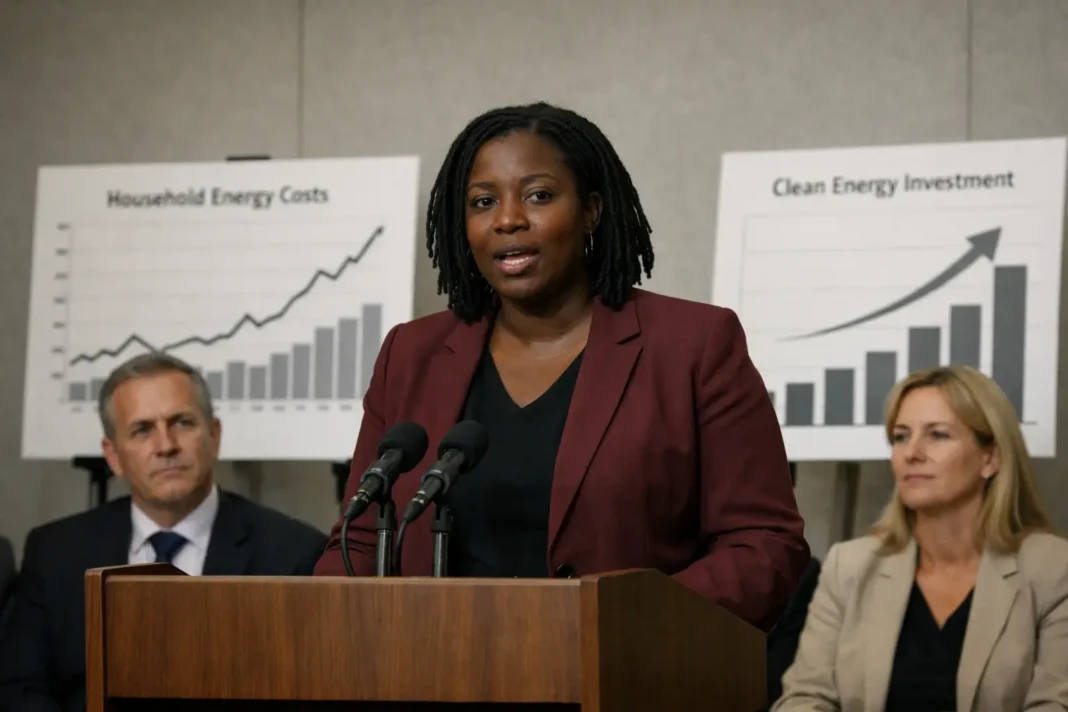

Cutting household energy costs has been placed at the heart of the government’s climate agenda by Fahnbulleh, who has made clear that action on bills is her overriding priority. The energy secretary’s position reflects a central challenge for policymakers: maintaining momentum on emissions reduction while ensuring that the transition is not seen by households as an additional financial burden.
The message links two issues often treated separately in political debate: energy costs and climate action. Fahnbulleh’s argument is that public backing for environmental measures depends on whether people feel they can afford the changes being asked of them. In that framing, lower bills are not only a cost-of-living objective but also a condition for sustaining consent around long-term climate policy.
The intervention comes as governments face pressure to prove that decarbonisation can deliver practical benefits for consumers, not only future environmental gains. Energy policy now sits at the intersection of household finances, industrial planning and climate commitments. The Department for Energy Security and Net Zero has a role in shaping that balance, with affordability becoming a political test for any strategy designed to reduce reliance on high-cost and high-emission energy systems.
Fahnbulleh’s emphasis also underlines the risk facing climate policy when voters associate environmental action with rising expenses. Support for change can weaken if the immediate costs are visible and the benefits appear distant. By presenting bill reduction as the priority, she is seeking to align the transition with everyday concerns, making the case that climate measures must be felt in homes as economic protection as well as environmental progress.
The approach does not remove the complexity of the policy choices ahead. Decisions on energy infrastructure, market design and consumer protection all carry consequences for prices and public confidence. But Fahnbulleh’s focus sets a clear benchmark for the government’s energy agenda: climate action is more likely to endure if it is paired with credible action on affordability.






