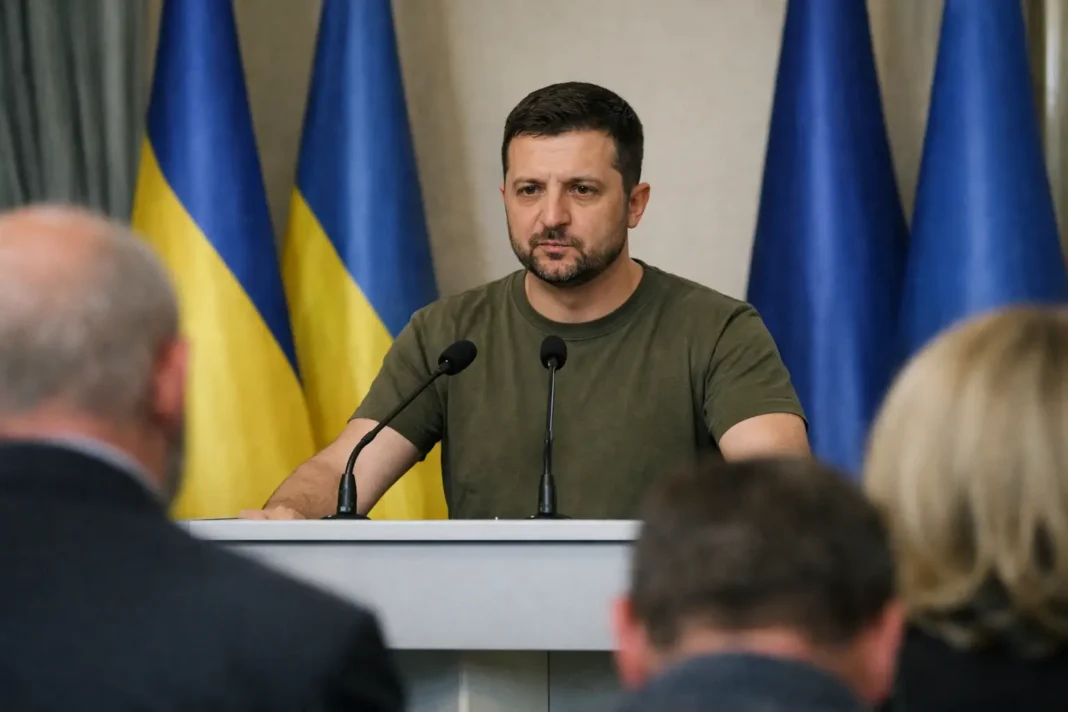

Volodymyr Zelensky has said the United States raised the possibility of Ukraine giving up the Donbas region in exchange for membership in NATO, a claim that Washington has not confirmed. The Ukrainian president’s remarks place one of the most sensitive questions in the war — territory versus long-term security guarantees — at the centre of renewed diplomatic attention, even as no formal proposal has been publicly acknowledged by the US government.
The comment is significant because Donbas, made up of the Donetsk and Luhansk regions, has been a focal point of the conflict for a decade and remains central to Moscow’s territorial objectives. Russia has occupied parts of eastern Ukraine since 2014 and widened its assault with the full-scale invasion launched in 2022. For Kyiv, conceding territory is not only a military issue but a constitutional and political red line repeatedly tied to national sovereignty.
A US official told the BBC that “many ideas continue to be discussed,” while not confirming Zelensky’s account. That response leaves the status of the idea unclear: it may reflect exploratory conversations, diplomatic testing, or one of several scenarios under review as allies consider possible pathways to end the war. No public statement from the White House has established such a formula as US policy.
The issue also exposes a structural dilemma for the alliance. NATO membership would bring Ukraine under the collective defence commitments that define the bloc, including the principle that an attack on one ally is treated as an attack on all. Extending that protection to a country at war has long been viewed by several member states as a step carrying major escalation risks. At the same time, Kyiv argues that only binding security guarantees can prevent future Russian attacks and make any settlement durable.
For Ukraine’s partners, the discussion reflects the shrinking space between battlefield realities and political commitments. Western governments continue to support Kyiv militarily and diplomatically, while avoiding measures that could draw NATO directly into the conflict. Zelensky’s remarks underline how any negotiation over Ukraine’s future security architecture is likely to face the same unresolved question: whether peace can be pursued without rewarding territorial conquest, and whether Ukraine can be protected without immediately bringing the alliance into direct confrontation with Russia.