


President of Columbia University Dr. Nemat (Minouche) Shafik testifies during a House hearing about antisemitism on college campuses, on April 17, 2024. Photo by Getty Images

By Jacob Kornbluh
April 17, 2024
A confidential letter obtained by the Forward shows that investigations have been opened over the conduct of several Columbia University professors accused of making antisemitic and anti-Israel comments in the aftermath of Hamas’ Oct 7 attacks.
The letter expands on the testimony of the university’s president, who was grilled on Capitol Hill Wednesday over a pair of professors, one accused of celebrating Hamas Oct. 7 attacks on Israel and another accused of making bigoted generalizations about Israeli students.
What had President Nemat “Minouche” Shafik done about it, pressed Rep. Elise Stefanikthe Republican whose interrogations of the presidents of Harvard and the University of Pennsylvania over antisemitism late last year led to their resignations.

This time, Shafik was in the hot seat at a hearing of the House Committee on Education & the Workforce. But she would not reveal the extent to which Columbia had dealt with the incidents Stefanik wanted her to elaborate on.
What Shafik declined to disclose at the hearing is that investigations have been opened into both of the professors Stefanik asked about — and others. A letter Columbia officials submitted to the House committee, which was marked confidential and obtained by the Forward, shows outside investigators are handling the inquiries.
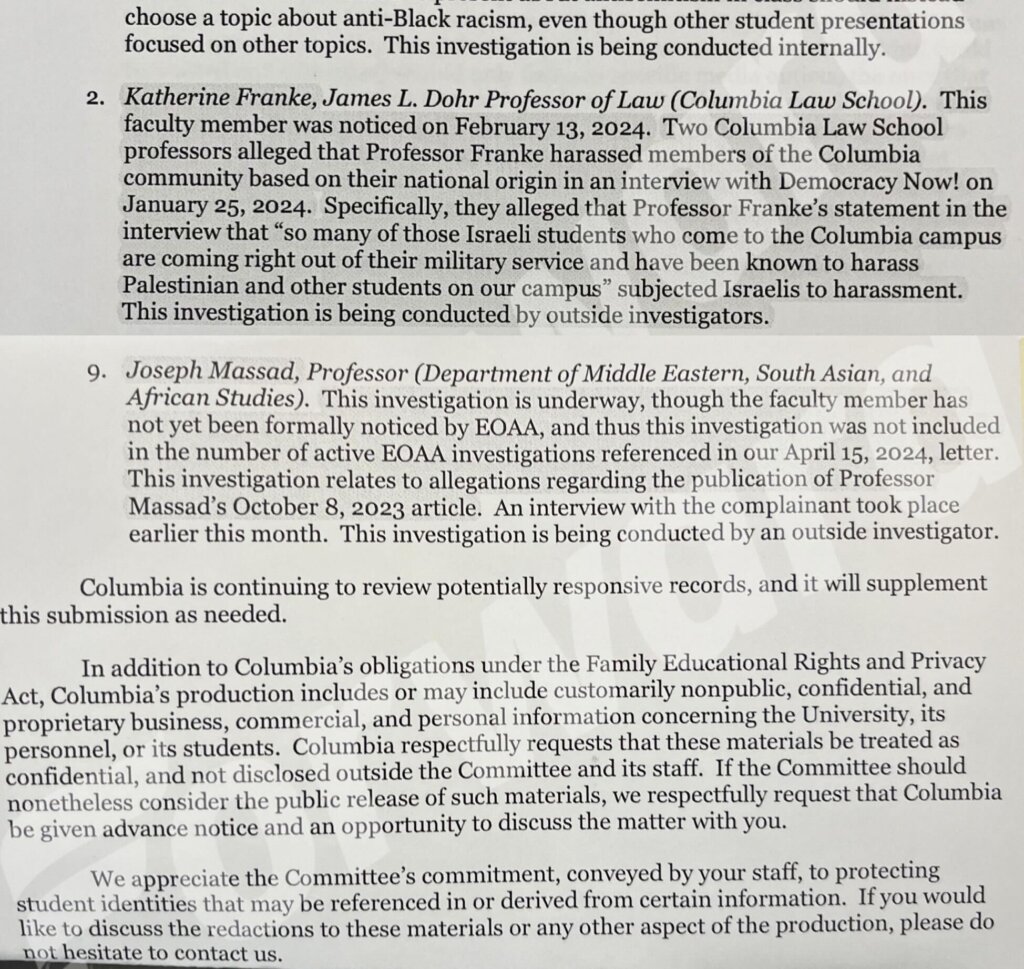
The letter also states that several other professors are also facing internal investigations over allegedly antisemitic remarks.
Earlier in the hearing Shafik had said that Joseph Massad, a professor of modern Arab politics and intellectual history, “had been spoken to” and told that his “language was unacceptable” after he was accused of praising the Hamas attacks.
Stefanik also wanted to know how Shafik had dealt with Katherine Franke, a law professor and a staunch critic of Israel, who has been accused of smearing Israeli students at Columbia.
It was only later in the hearing, when questioned by a Democrat, that Shafik commented on the investigations. From the letter Columbia submitted to the committee, it seems that she may have been concerned about breaching confidentiality.
Congresswoman Hayes: The committee was told yesterday that Professor Massad is under investigation Can you confirm this?
Dr. Shafik: I would like to confirm that in writing.
Congresswoman Jahana Hayes: Can you clarify that he no longer holds a leadership position?
Dr. Shafik:… pic.twitter.com/gOmfNsUP3z
— Aviva Klompas (@AvivaKlompas) April 17, 2024
A spokesperson for Stefanik didn’t immediately respond to whether or not the congresswoman was aware of the document before she questioned Shafik.
Massad, of Palestinian Christian descent, heads Columbia’s academic review committee. Shafik seems to have agreed with Stefanik during the hearing that he should be removed as chair. Massad was the subject of a petition that called for his removal from the faculty over an article he wrote in which he referred to Hamas attack on Israel on Oct. 7 as “remarkable” and “awesome” and a resistance to “Israeli settler-colonialism and racism toward the Palestinians.”
Shafik testified with others from Columbia, including David Greenwald, the co-chair of its board of trustees, and law and economics professor David Schizer. The panel was asked the same question Stefanik asked the presidents of Harvard, MIT and the University in December: whether calling for the genocide of Jews violated the university’s code of conduct?
“Yes it does,” they all responded to Rep. Suzanne Bonamici, a Democrat from Oregon.
Former Harvard President Claudine Gay and former University of Pennsylvania President Liz Magill declined to give the straight “yes or no” answer to the question that Stefanik demanded when they came before the committee.
I hope you appreciated this article. Before you go, I’d like to ask you to please support the Forward’s award-winning journalism this Passover.
In this age of misinformation, our work is needed like never before. We report on the news that matters most to American Jews, driven by truth, not ideology.
At a time when newsrooms are closing or cutting back, the Forward has removed its paywall. That means for the first time in our 126-year history, Forward journalism is free to everyone, everywhere. With an ongoing war, rising antisemitism, and a flood of disinformation that may affect the upcoming election, we believe that free and open access to Jewish journalism is imperative.
Readers like you make it all possible. Right now, we’re in the middle of our Passover Pledge Drive and we still need 300 people to step up and make a gift to sustain our trustworthy, independent journalism.
Make a gift of any size and become a Forward member today. You’ll support our mission to tell the American Jewish story fully and fairly.
— Rachel Fishman Feddersen, Publisher and CEO
Join our mission to tell the Jewish story fully and fairly.
Only 300 more gifts needed by April 30



