
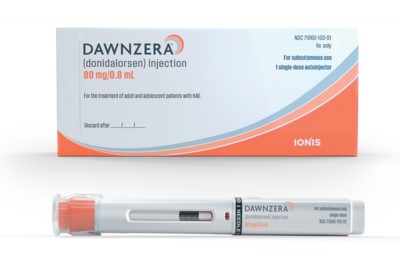

As with most rare diseases, the market for hereditary angioedema drugs is small. It’s also relatively crowded, served by several well-established products and two new therapies approved earlier this summer. An injection from Ionis Pharmaceuticals is joining the list, and while the biotech company plans to capture new patients, it also aims to grow sales by getting patients to switch over from other products. Ionis has the clinical data to support this strategy.
The FDA’s approval of donidalorsen, brand name Dawnzera, makes this Ionis drug the first genetic medicine for hereditary angioedema, or HAE, an inherited disorder that leads to swelling attacks throughout the body. These attacks come without warning and can become fatal when they close off a patient’s airway. The FDA’s Thursday approval of the Ionis drug covers prevention of HAE swelling attacks in patients age 12 and older.
An estimated 7,000 people in the U.S. have HAE, which stems from the inherited deficiency or dysfunction of C1 esterase. This protein regulates other proteins associated with swelling and inflammation. Swelling comes from uncontrolled activation of the kallikrein-kinin system. While some of the currently available HAE drugs block a protein called kallikrein, Ionis goes even earlier in this pathway by going after prekallikrein (PKK), a protein that’s a precursor of kallikrein.
Dawnzera is an antisense oligonucleotide designed to bind to PKK messenger RNA, reducing production of this protein in the liver, where it’s made. The drug, administered as a subcutaneous injection every four weeks or every eight weeks, is the first and only RNA-targeted therapy for HAE. In a 24-week Phase 3 trial, dosing of the study drug every four weeks led to an average 81% reduction in HAE attacks compared to placebo. In the one-year open-label extension study, Dawnzera reduced attacks by an average of 94% across both four-week and eight-week dosing. In this study, Ionis reported that 93% of participants achieved well-controlled disease as measured by a test to assess HAE episodes.
Takeda Pharmaceutical’s lanadelumab, brand name Takhzyro, dominates the HAE prophylaxis market. This antibody kallikrein inhibitor is approved for patients age 2 and older, administered as a subcutaneous injection every two weeks, though dosing may be extended to every four weeks for some patients. BioCryst Pharmaceuticals markets Orladeyo, a once-daily oral small molecule kallikrein inhibitor approved for HAE prophylaxis in patients age 12 and older. CSL Behring takes a different approach with garadacimab, brand name Andembry, a once-monthly antibody inhibitor of a protein called factor XIIa that won FDA approval in June.
Acute treatments for HAE include the C1 esterase inhibitors Ruconest, from Pharming Group, and Berinert, from CSL Behring. Takeda’s acute HAE drugs are the kallikrein inhibitor Kalbitor and the bradykinin inhibitor Firazyr. The newest acute HAE therapy is KalVista Pharmaceuticals’ Ekterly, an oral small molecule kallikrein inhibitor approved by the FDA last month.
Ionis’s open-label extension study for Dawnzera included a cohort of patients who switched to the study drug from a different HAE prophylactic treatment. Results showed the HAE attack rate fell by an average 62% from prior prophylactic treatment. Furthermore, 93% of participants achieved well-controlled disease. The full results were published in July in The Journal of Allergy and Clinical Immunology in Practice.
Speaking during a conference call Thursday, Kyle Jenne, executive vice president, chief global product strategy officer for Ionis, characterized HAE prophylaxis as a “switch market.” Data show that about 20% of patients move between therapies, regardless of whether it’s an injectable or oral drug. Jenne also cited results from an Ionis-sponsored Harris Poll of HAE patients showing that 9 out of 10 patients would be interested in trying a new prophylactic therapy.
“There’s a lot of motivation and a lot of dissatisfaction from patients that are currently on existing treatments,” Jenne said. “We expect that over time, patients will be switching and we believe that Dawnzera is an excellent choice for these patients based on the profile that we’ve outlined.”
Beyond the efficacy data, Dawnzera offers patients greater convenience. The drug may be self-administered at a patient’s home with an injection pen, Jenne said. Having a longer dosing interval will also make a difference for some patients. While Ionis expects most patients will start with dosing every four weeks, it will be up to a physician to determine whether to extend dosing to every eight weeks.
William Blair analyst Myles Minter sees Dawnzera as a highly competitive in the HAE prophylaxis market. According to Ionis estimates, 75% of HAE patients currently receive HAE prophylactic treatment; most of them take Takeda’s Takhzyro.
“Market research indicating 20% of HAE patients switch to alternative treatments annually indicates an unmet need, as well as a clear opportunity for Ionis to capture market share with Dawnzera’s differentiated, less frequent dosing and at-home auto-injector dosing,” Minter said in a note sent to investors. “Additionally, the switch study conducted by Ionis indicates that patients who try Dawnzera prefer it over their prior treatment option, strongly indicative of a sticky profile.”
Dawnzera’s list price is $57,462 per dose; about $747,000 annually for every four week dosing. Ionis projects this product could achieve $500 million in peak sales. Otsuka Pharmaceutical licensed the rights to commercialize this drug in Europe in a 2023 deal.
Dawnzera is an important part of Ionis’s strategy to grow revenue from sales of its own products. For much of its history, Ionis partnered with larger companies that took responsibility for later-stage development and commercialization of its oligonucleotide drugs. Ionis’s top source of commercial revenue is royalties from Spinraza, the spinal muscular atrophy drug that is marketed by partner Biogen. Ionis reported $216 million in Spinraza royalty revenue in 2024.
The first drug that Ionis commercialized on its own was Tryngolza, a treatment for the rare metabolic disorder familial chylomicronemia syndrome that the FDA approved in late 2024. For the first half of 2025, Ionis reported $25.5 million in Tryngolza revenue.
Photo by Ionis Pharmaceuticals



