
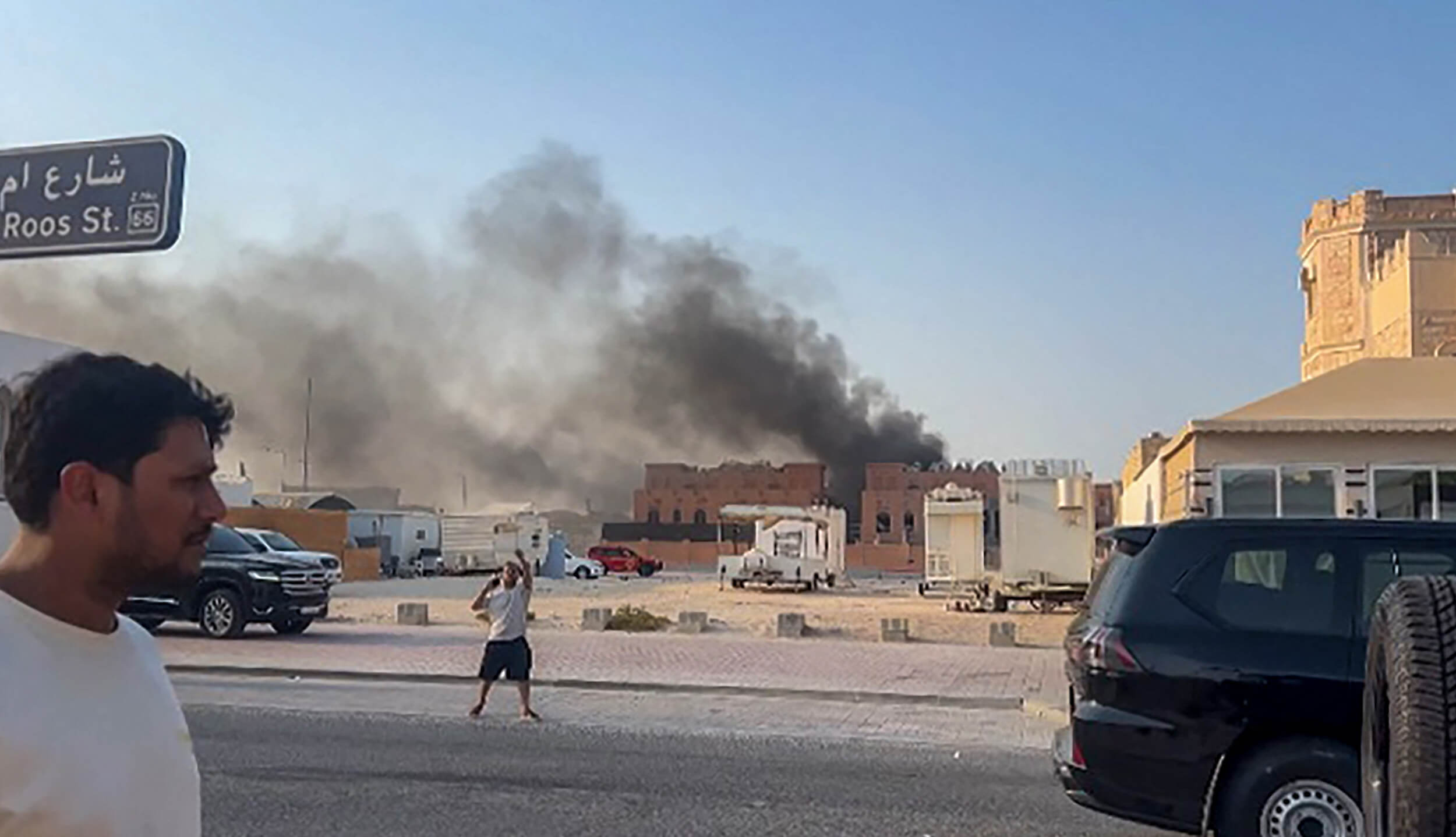

A frame grab taken from AFPTV footage shows smoke billowing after explosions in Qatar’s capital Doha on Sept. 9. An Israeli military official told AFP that the military had carried out air strikes in an operation targeting senior leaders of Hamas. Photo by Jacqueline Penney / AFPTV / AFP / Getty Images

Columnist
And Perry
September 9, 2025
Israel’s Tuesday strike in Doha, Qatar, which targeted Hamas’ senior leadership, marks a moment of extraordinary drama in the Middle East. The decision to send Israeli jets some 1,800 kilometers across the Arabian peninsula into the heart of Qatar’s capital is breathtaking in its implications, no matter the results.
Those results could mark a strategic breakthrough — or a breakdown of any hope for a negotiated end to the war.
In many ways, the strike was an almost unthinkable move, tantamount to an act of war against a country that, while not an Israeli enemy, is certainly not an ally. It was apparently conducted without the approval of the United States: “Unilaterally bombing inside Qatar, a sovereign nation and close ally of the United States that is working very hard in bravely taking risks with us to broker peace, does not advance Israel or America’s goals,” said President Donald Trump’s press secretary, Karoline Leavitt.

If Israel has successfully eliminated the Hamas leaders it targeted — senior figures including Khalil al-Hayya, Khaled Mashaal, Mohammed Darwish and Mousa Abu Marzouk, who were reportedly meeting to discuss the latest American-Israel ceasefire proposal — it can claim a win. Hamas has been an implacable enemy; eliminating them is a longstanding Israeli goal; and neutralizing the leadership abroad would leave the group rudderless, reducing its ability to command, recruit and fundraise.
But even if the strike was successful, the risks remain immense. Doha’s rulers cannot easily shrug this provocation off. Their legitimacy across the Arab world already depends on maintaining a fragile balance of contradictions. To be humiliated by an Israeli strike in their capital could force them into a harder line against Israel, and perhaps even against the U.S.
Qatar — a small, oil-rich Gulf country — has long been a paradox. The tiny emirate, which is fabulously wealthy and home to the world’s third-largest reserves of natural gas, has long played a double game. It’s formally a U.S. ally, host to the largest American military base in the Middle East. But it’s also the chief patron of Hamas, host to that group’s political leadership, and a benefactor as well to other Islamist movements such as the Muslim Brotherhood.
Throughout the nearly two years of the Israel-Hamas war, it has positioned itself as a crucial mediator. But it’s also long been the subject of mistrust from powerful regional neighbors, including Saudi Arabia, the United Arab Emirates and Egypt.
And its relationship with Israel itself is more nuanced than many realize. Qatar has quietly kept channels open to Jerusalem; it notably permitted Israeli journalists and fans to enter its borders for the 2022 World Cup. Its cash infusions to Gaza, while controversial, were for years coordinated with Israel in hopes of keeping the enclave calm.
And just weeks ago, Qatar joined the Arab League in demanding that Hamas disarm — a remarkable departure from its traditional indulgence of the group.
The logistical complexity of the attack underscores the scale of Israel’s wager. The strike would have required extended-range aircraft and precise coordination to avoid mishaps. Israeli planes almost certainly had to traverse Saudi airspace — a privilege Riyadh does not grant lightly. (Saudi Arabia, the UAE and other Arab countries all condemned the strike, although it’s reasonable to assume their leaders would quietly celebrate the demise of jihadists who threaten them no less than Israel.)
That implies either a stunning breach of regional defenses or some level of tacit cooperation. Either way, the risks were staggering: Navigational errors, air defense confrontations, or an accidental strike on civilian targets could have turned this into a debacle.
All of this means that Qatar’s response to today’s attack will have to be extraordinarily deftly calculated to avoid rippling consequences across the Middle East. Israel is gambling that they’ll be able to strike that balance.
The audacity of that gamble raises the question of whether Qatar might have even quietly agreed to the strike; one could almost envision them deciding that getting the Hamas leadership out of the way might put an end to a headache. But the Trump administration’s response suggests that outlandish possibility is far from reality: “The president views Qatar as a strong ally and friend of the United States, and feels very badly about the location of this attack,” Leavitt said.
Seen that way, the most likely interpretation of this shocking move is that Israel decided that an act so brazen might finally break Hamas’ will, with the hope that if its leaders abroad realize that no place is safe, they may decide their only hope of survival is to cut a deal. Such an outcome would be transformative. It would deliver to the Palestinian people the single greatest favor anyone could bestow: liberation from a movement that has brought only suffering and ruin.
On the other hand, killing the very Hamas leaders whom Israel has been pressing to accept terms that amount to surrender — disarmament, exile for its leaders, and political eclipse — could mark a death knell for ongoing negotiations for the end of the war and the release of all hostages, a point that some of those hostages’ families are already making. And if Doha opts for a strong retaliation — rather than the diplomatic resolution for which Israel is almost certainly hoping — Israel will find itself contending with a widening conflict that it just made exponentially more complicated.
Ultimately, the raid on Doha encapsulates the dilemmas of Israel’s war with Hamas. Victory requires daring, but every bold stroke risks setting off chain reactions that could make matters worse. Israel has rolled the dice; now we must see how they land.




