

Ellen Arthur, a 79-year-old retired family lawyer in Lexington, Va., has decades of experience digging up personal records for her clients. But surfacing a century-old baptismal ledger kept by a Catholic church in Montreal, where her mother was born, was a first.
That dusty old record is what Ms. Arthur is leaning on to seek Canadian citizenship for her two adult sons.
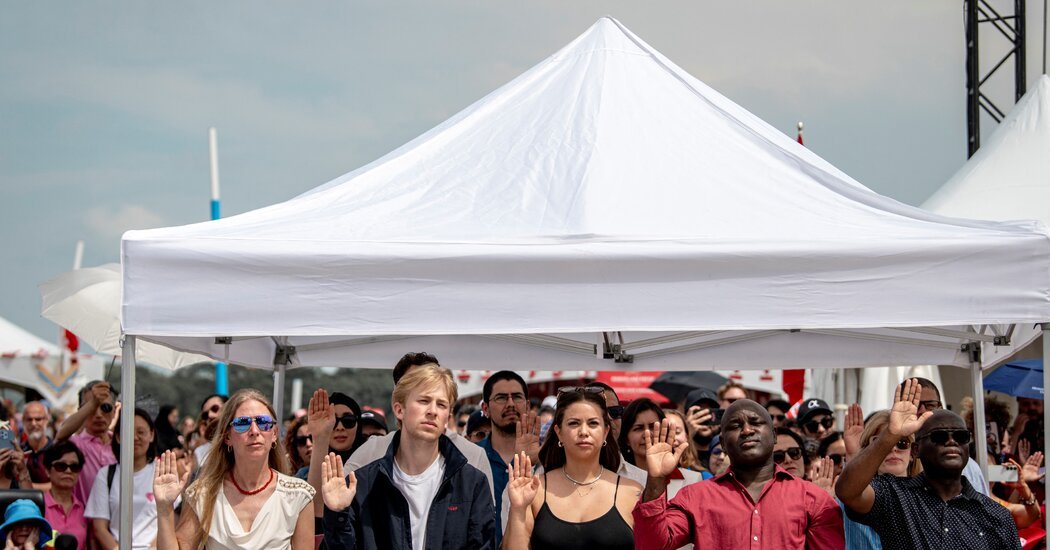
They are among thousands of Americans using a new stipulation in Canada’s citizenship rules that came into effect in December, under which people who can prove a direct Canada-born ancestor — a grandparent, great-grandparent, or someone even further back — can officially become Canadian.
Ms. Arthur had already been eligible for citizenship as the daughter of a Canada-born Canadian, but had not pursued it. Under the old policy, known as the first-generation rule, her sons would not have been able to inherit citizenship because neither she, nor they, were born in Canada.
Now, the access to being Canadian can theoretically stretch generations back, if one can prove they are a direct descendant of someone born in Canada.
And while the process is bureaucratic and Ms. Arthur’s case has been stalled by clerical and administrative hiccups, it is already attracting hopeful Canadians, most from the United States.
The number of successful applications by U.S. nationals for Canadian citizenship by descent rose by nearly 50 percent in January compared with January 2025, to 2,470 from 1,715, according to data from the Canadian immigration ministry. It was the first month for which data was available since the new rules came into effect.
The changes came as a result of a legal campaign by a small number of families living abroad who were unable to pass down Canadian citizenship because of the first-generation stipulation. Following a court ruling, Canada expanded citizenship to the descendants of Canadians born outside the country before Dec. 15, 2025.
For children born or adopted abroad after Dec. 15 by a foreign-born Canadian parent, the parent needs to have lived in Canada for at least three years before the child’s birth or adoption, to be able to pass the citizenship to them.
The change could extend Canadian citizenship to “potentially millions of people around the world, many of whom have never lived in Canada and may have only a distant ancestral tie to it,” said Rick Lamanna, a Toronto-based partner at Fragomen, a global immigration and relocation company.
The new policy, he added, stood in contrast both to those of other advanced economies seeking to limit immigration, and to the Canada’s own significant tightening of other immigration routes.
In the last two years, Canada has slashed the numbers of foreign students, temporary workers and the number of permanent residents. That has already resulted in Canada’s population shrinking.
The policy expanding who can qualify for Canadian citizenship also stands in stark contrast to the evolving discourse about who should be American in the United States, where President Trump wants to see even birthright citizenship curtailed.
Among developed economies, Canada now has one of the most inclusive rules on passing down citizenship generation to generation.
Until 2024, Italy offered citizenship by descent without any generational limit, a path many Americans utilized, but it has since limited citizenship to people with an Italian parent or grandparent.
Only a handful of other countries have in recent years broadened their citizenship to people with more distant ancestry, including Portugal and Slovakia, but with some limitations.
The burden of proof to pursue this new route to becoming Canadian is still significant, a spokesman for the Canadian immigration ministry said, particularly since it could require deep archival research and recovering documents that could be more than a century old.
“While these recent changes extended access to Canadian citizenship by descent, having distant Canadian ancestry alone does not make someone automatically eligible,” said Matthew Krupovich, a spokesman for the immigration ministry.
Documents that meet the bar for the Canadian authorities can include birth certificates, citizenship or naturalization certificates, or other official records showing family relationships and citizenship status, but not information gleaned from genetic testing.
There is early evidence that the new rules are already spurring higher demand for historical records. The Nova Scotia Archives, for example, has seen a sharp increase in requests for official copies of historical records, from about 260 requests in all of 2024 to about 1,500 in just the first three months of 2026, said John Macleod, a manager at the archives.
Still, the numbers for the first few weeks since the changes have gone into effect also highlight that most people fail to secure citizenship. Between Dec. 15 and Jan. 31, about 6,280 applications for proof of citizenship were processed by the Canadian authorities. Of those, 1,480 were confirmed as citizens by descent under the new rules, the immigration ministry said.
The motivation behind pursuing Canadian citizenship varies from person to person. For Ms. Arthur, the political situation in the United States has made her feel she does not recognize her country any more.
“The standards and values that I thought we held — equality for all, regardless of color, race, sex — that’s gone,” Ms. Arthur said. “I want my sons to have that option, to move to Canada if this country continues to turn in a fascist direction,” she added.
Ms. Arthur feels she may be too old to move at her age, but wants her children to be able to avail themselves of it. “I’m really trying to pave the way for them,” she said.
For others, becoming Canadian is more about reconnecting to roots.
Roughly 900,000 French Canadians left Quebec between 1840 and 1930 for work opportunities during New England’s rapid industrialization.
In the mid 1700s, some 10,000 French settlers, called Acadians, in Canada’s Atlantic provinces were expelled for refusing to take an oath of allegiance to Britain.
That is how the ancestors of Michelle Beauregard-Castoro, 55, ended up in Louisiana.
Ms. Beauregard-Castoro, a disaster relief consultant who now lives in Bay St. Louis, Miss., felt deeply connected to Canada in the process of unearthing her family’s history.
“The connection was broken 300 years ago and it’s time to bring it back together,” she said.
She often wonders what her family would be like if her ancestors were not expelled by the British.
“I feel like it’s important to have the family back in Canada,” she said, “and if that’s through a passport for me, so be it.”
Matina Stevis-Gridneff
Canada Bureau Chief
If you qualified to become Canadian under the new rules, would you consider it and why? What would be the drawbacks, apart from the administrative efforts you’d need to go through? Eager to hear your thoughts!
Read all comments
Source:
www.nytimes.com



