


Amid the excitement surrounding tech and high-growth sectors, infrastructure is rarely considered one of the most potent investment plays. Yet, according to Navot Bar, CEO and co-founder of Keystone Infra, a publicly traded infrastructure investment company in Israel, and a member of the prestigious TA-90 index on the Tel Aviv Stock Exchange, it is a rapidly growing field that has produced excellent results.
“Keystone Infra is an infrastructure powerhouse for national infrastructure, based on public-private partnerships (PPP) between government entities and private companies to finance, build, and operate public infrastructure,” he explained. These types of partnerships, said Bar, provide very long-term, predictable cash flow with little or no volatility. One common form of such an agreement is the Build-Operate-Transfer (BOT), used for revenue-based infrastructure projects, such as toll roads, bridges, and power plants. The private company is awarded the concession to build and operate the facility, and collects user fees for a set number of years to recover its investment and make a profit.
Since its founding in 2019, Keystone Infra has expanded into several areas of vital national infrastructure in Israel, including transportation, energy, renewable energy, data centers, telecommunications, and water, in partnership with Israel’s national government. Said Bar, “Since it utilizes conventional technology, the operational risk is very low. The beauty of Keystone Infra Ltd. is that it’s publicly traded and offers an attractive risk-reward profile, with very low risk given its reliance on old-school, dependable technology. The reward is very attractive because there is certainty of a long-term cash flow.”
Historically, Bar pointed out, investment in national infrastructure projects in Israel, which run into the billions of shekels, was limited to large pension funds, insurance funds, and major infrastructure companies. “Keystone Infra is a new animal that came to the public market, and said that we are going to do everything with public money. Today, anyone can invest in Keystone Infra —one doesn’t need billions to gain exposure to these kinds of assets. By investing in Keystone Infra stock, one can gain access to a diversified portfolio across multiple sectors, all of which benefit from the same underlying strengths and characteristics. In many ways, Keystone Infra functions like an exchange-traded fund (ETF) that holds a basket of assets offering broad exposure to a diversified portfolio through a single investment.”
Keystone Infra , said Bar, has a unique, three-layer method. “What makes Keystone Infra Ltd. stand out,” he explained, “is that we are not focused only on buying and holding operating assets that already generate income — although we do have a very strong base of those assets. These projects produce stable cash flow, backed by long-term agreements with the government and other partners, which allows us to forecast revenue many years into the future. Today, Keystone Infra receives roughly NIS 300 million annually from its subsidiaries and infrastructure projects. The company is also supported by a robust capital structure, with a loan-to-value ratio of just 26% — a foundation that allows Keystone Infra Ltd. to pursue new acquisitions without an immediate capital raise.
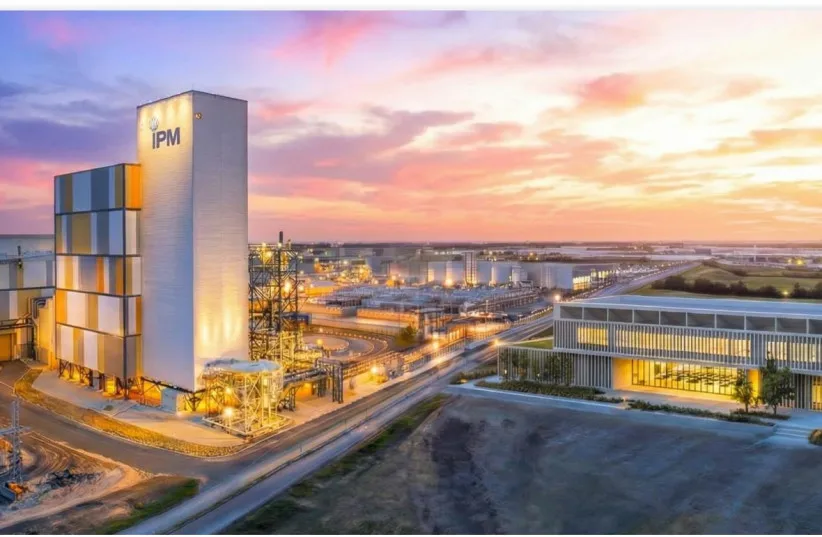
“The second layer is that we actively work to improve every asset we own. There is not a single investment in our portfolio that we are not constantly trying to make more efficient and more profitable. Infrastructure assets that may seem fixed — such as power plants or transportation systems — can often generate additional value through smarter management and operational improvements. For example, we can sometimes increase profitability by changing our customer profile, selling electricity directly to private-sector clients rather than only to the government. In transportation projects, improving bus routes and efficiency can increase ridership and revenue. Over time, markets, regulations, and demand patterns evolve, and if one adapts to those changes effectively, one can continue extracting more value from existing assets.”
The third layer, said Bar, involves developing projects from the ground up instead of purchasing mature, income-producing assets. One example he mentioned is the Sorek power plant project near Rehovot, where the company won a government tender to build and operate a new power station for 25 years. “Projects at this stage involve greater risk — because you still need to build, finance, and fully develop them — but they also offer significantly higher potential returns. By the time most investors buy into mature infrastructure assets, much of the early risk has already been removed, which naturally lowers the potential upside.
“Our overall model is built on these complementary layers: stable income-producing assets that generate reliable cash flow today; ongoing optimization of those assets to increase value over time; and early-stage development projects that can deliver much higher returns in the future. Together, this creates a balanced portfolio — one that provides dependable cash flow in the present while also building long-term growth for the years ahead.”
What are the greatest infrastructure challenges confronting Israel today? “Even though the country has developed rapidly since 1948,” said Bar, “we still have a major lack of infrastructure. That is because Israel is one of the last Western countries that is still growing in population.” In addition, maintaining existing infrastructure also requires investment, he pointed out.
“If I had to point to the most critical infrastructure challenge in Israel today, it would clearly be transportation. Traffic congestion has become a constant reality across the country, at almost every hour of the day. A few years ago, people assumed that if they avoided rush hour, the roads would be clear. Today, it hardly matters whether it’s early morning, midday, or late at night — traffic jams are everywhere.”
The obvious long-term solution, in Bar’s view, is improving public transportation and convincing people to shift away from relying solely on private cars. To achieve that, he said, the government needs to continue investing heavily in buses, trains, and dedicated public transportation lanes, making public transit faster and more efficient than driving private vehicles.
The second major challenge is energy and electricity generation. Power demand is constantly increasing, driven not only by Israel’s population growth, but also by the long timelines required to build new power plants. That creates a major planning challenge: regulators need to anticipate demand many years in advance. But predicting the future is never simple. For example, regulators a decade ago could not fully foresee the massive rise of data centers — facilities that consume enormous amounts of electricity around the clock and create an entirely new level of energy demand. Infrastructure planning requires making long-term decisions today for realities that may look completely different ten years from now, he stated.
Keystone Infra enjoyed record profits in 2025 across all of its key financial metrics and is uniquely positioned to bridge Israel’s infrastructure gap by investing in high-demand, supply-constrained sectors and combining stable, income-generating assets with in-house development capabilities.
Bar will be speaking at the Jerusalem Post Annual Conference, to be held in New York on June 1, about investment opportunities with Keystone Infra. “We believe we offer one of the strongest ways to invest in Israeli infrastructure — not only because we are helping build the country’s long-term infrastructure backbone, but also because we deliver strong investment performance alongside it. For anyone seeking exposure to Israeli infrastructure, a strong economy and currency, and a high-performing publicly traded investment, Keystone Infra provides that opportunity.”
This article was written in cooperation with Keystone Infra.
Source:
www.jpost.com



