

For decades, the government of India, home to one of the world’s largest Muslim populations, has set the cost of air travel incurred every year by the hajj, the pilgrimage to Mecca that every able-bodied Muslim is expected to make at least once.
Now those prices are being rocked by the volatility in global energy markets caused by the war in Iran.
On Tuesday, the Indian government body that organizes hajj trips for its citizens and negotiates airfares with airlines announced that it was charging pilgrims an additional 10,000 rupees, roughly $105, for this year’s trip, citing the “prevailing situation in the Middle East.”
Global prices of jet fuel have risen by more than 70 percent since the first U.S.-Israeli attacks on Iran on Feb. 28, according to the Platts Jet Fuel Price Index. Prompting its decision, the Haj Committee of India said in a statement, were “pressing requests from airlines” to increase the base fare by more than $400.
Despite government officials emphasizing that the increase falls short of the airlines’ asking price, political and religious leaders in the country have decried the decision as imposing unfair burdens on pilgrims for whom the hajj, which this year costs up to $4,300, represents a significant expense.
“It really affects the poor Muslims,” said Maulana Yasoob Abbas, general secretary of the All India Shia Personal Law Board, a Muslim advocacy group. He added that many would-be pilgrims who work as day laborers or auto-rickshaw drivers must save for a lifetime in order to afford to go on the hajj.
Asaduddin Owaisi, the leader of a political party based in Southern India, called for the increase to be withdrawn.
“This is just exploitation and nothing else,” Mr. Owaisi said in a social media post on Thursday.
In the past, like many countries with sizable Muslim populations, India provided hajj subsidies for pilgrims until abolishing them in 2018. The government nonetheless continues to negotiate with airlines to set fixed airfares for pilgrims traveling on its package. Last year, 122,422 pilgrims made the hajj from India, according to government data.
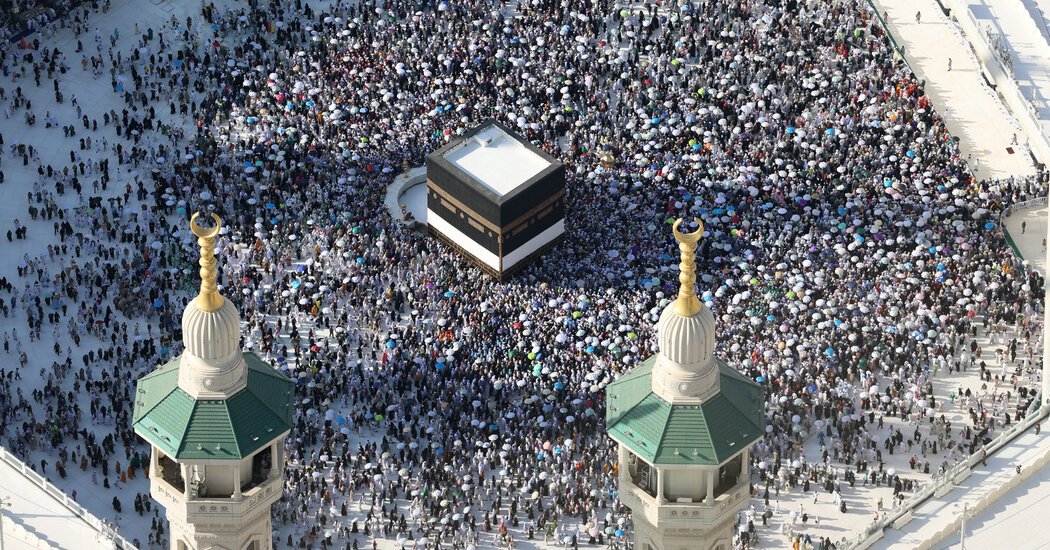
As one of Islam’s five pillars — the core practices that define the Muslim faith — the hajj is a holy trip to Mecca, Saudi Arabia, that takes places once a year during a specific period of the Islamic calendar. This year’s hajj, the exact dates of which are determined by official sightings of the moon in Saudi Arabia, is expected to fall around late May.
Careful cross-border coordination is required every year to ensure that the pilgrimage, one of the largest human gatherings in the world, goes off without a hitch. At its zenith, almost 2 million pilgrims will pack into a site where the Prophet Muhammad is believed to have delivered his last sermon. To manage overcrowding, Saudi Arabia imposes annual caps on the number of pilgrims each country can send.
Salma Parveen, 45, who lives in Lucknow, a city in northern India, said she was planning to be among them this year until hearing about the government’s price increase, which is almost equal to her monthly wage as a cafeteria cook at a university.
“I had started collecting money for a few years now,” she said. “It’s not subsidized anymore but now this hike is an additional burden for me. For this year, I have canceled my trip.”
Even in countries that have decided not to raise the price of their hajj trips, such as Indonesia, the rising price of jet fuel has nonetheless presented dilemmas for government coffers. The country is the largest Muslim nation in the world and has a hajj quota of 221,000 visitors a year, the largest.
President Prabowo Subianto of Indonesia has made it clear that the country’s pilgrims will not have to shoulder additional costs for this year’s hajj.
At a parliamentary hearing last month, Mochamad Irfan Yusuf, the minister who oversees pilgrimages to Mecca, said the Indonesian government was weighing options to absorb the roughly $103 million in added costs this year’s hajj would incur, primarily from increases requested by airlines.
Muktita Suhartono contributed reporting from Jakarta, Indonesia.
Source:
www.nytimes.com



