


Last week produced two separate stories that, at first glance, had little to do with one another.
One played out in Washington. The other unfolded in New York.
In Washington, 103 House Democrats – 48% of the caucus – voted in favor of a House amendment to eliminate all US military aid to Israel. Another 10 abstained.
Rep. Pat Ryan (D-New York) immediately followed that vote by declaring on X/Twitter that he no longer wanted support from the American Israel Public Affairs Committee.
By Friday, AIPAC obliged, quietly removing fundraising links for Ryan and 14 other representatives it had previously endorsed for reelection in November who backed the amendment.
Meanwhile, in New York, Mayor Zohran Mamdani reiterated in a New York Times interview on Saturday a campaign pledge that Prime Minister Benjamin Netanyahu should be arrested if he comes to the city in September for the annual UN General Assembly.
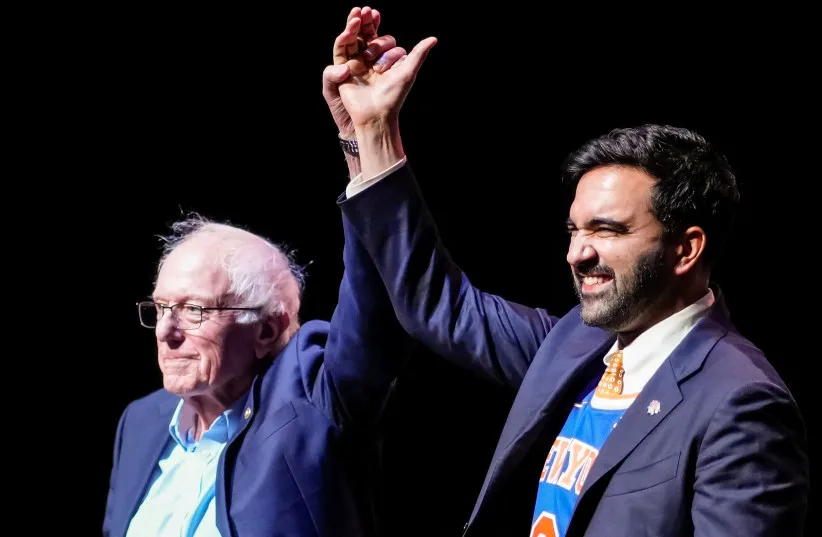
Different actors. Different arenas. Yet both stories point to the same underlying development: The political incentives surrounding Israel inside significant parts of today’s Democratic Party are changing dramatically.
The real story is not that there are more anti-Israel Democrats. That has been evident for years. Nor is it that nearly half of the Democratic caucus favors ending military aid to Israel, including seven of the House’s 20 Jewish Democrats.
Rather, it is that positions which only recently carried political risk now increasingly carry political reward.
Political incentives are simple. Politicians ask themselves whether supporting Israel helps them raise money, strengthens their standing within the party, protects them from primary challenges, and improves their chances in the general election.
For decades, the answer to those questions was overwhelmingly yes. Supporting Israel was widely viewed – as an AIPAC motto once succinctly put it – as both good policy and good politics.
Increasingly, however, that calculation is changing – at least in progressive Democratic districts.
Opposing Netanyahu, and by extension distancing oneself from Israel, energizes activists. Breaking publicly with AIPAC earns progressive credibility. Calling for an end to military aid helps establish progressive bona fides. Remaining closely aligned with Israel, by contrast, can invite a well-funded primary challenge from the Left.
Ryan receives nearly $800,000 from AIPAC, yet spurns support
Ryan’s conduct illustrates the point.
According to a Washington Examiner report, Ryan has received nearly $800,000 in campaign contributions through AIPAC since 2022. Yet after voting to eliminate military aid, he didn’t simply cast his vote and move on. He announced that he no longer wanted AIPAC’s support and later said he intended to return the money.
Whether Ryan ultimately returns the money is largely irrelevant. His message was directed less at AIPAC than at progressive Democratic activists. It was intended to demonstrate that he was willing to break publicly with AIPAC and end military aid to Israel, and that – even though he represents a district where Jews make up roughly 10% of the electorate, including the Satmar village of Kiryas Joel – he sees little political downside in doing so.
Mamdani’s comments belong in the same category. He undoubtedly knows that, as mayor of New York City, he has no authority to arrest Netanyahu.
Like Ryan’s declaration, his statement functions primarily as political theater. It signals ideological alignment with his core constituency and reflects a calculation that – even though his electorate is even more heavily Jewish than Ryan’s – there is little political cost to taking such a position. On the contrary, he appears to believe it is politically advantageous.
That is why former US ambassador to Israel Dan Shapiro’s response on X to Mamdani’s statement missed the mark.
Any attempt to arrest Netanyahu would merely strengthen the prime minister politically back home, Shapiro argued.
“A message to Mayor Mamdani: Netanyahu is fighting for his political life,” he wrote. “Many Israelis are sick of him and hope to vote him out. The only possible outcome of a fruitless attempt to arrest him in NYC would be to give him a political boost at home.”
That may well be true. But Shapiro was viewing the issue through the prism of Israeli politics.
Mamdani is looking through an entirely different prism: domestic American politics. His audience is not Israeli voters deciding Netanyahu’s future, but rather progressive Democrats who will determine his own fate and how far he travels in national Democratic Party politics.
The same applies to Ryan.
Mamdani doubles down after winning office
Neither politician apologized for taking a position many Democrats once would have considered politically toxic. Ryan advertised it. Mamdani doubled down on it after winning office rather than moderating his rhetoric.
Both are experienced politicians with a finely tuned sense of their public’s mood. Their actions show that in growing parts of the Democratic Party, distancing oneself from Israel is now believed to be an electoral asset, not a liability.
That is part of a much broader transformation.
Israel is less a foreign-policy issue in America these days and more a marker of political identity inside the Democratic Party. Supporting Israel increasingly identifies a politician with the party establishment. Demonstrating distance from Israel increasingly establishes progressive credibility.
As the comedian Bill Maher quipped last year, anti-Israel politics has become today’s Che Guevara T-shirt.
Attacking Netanyahu earns applause. Rejecting AIPAC wins admiration in progressive circles. Voting against military aid carries relatively little political cost in some deep-blue districts and may even yield political rewards.
None of last week’s events changed US policy toward Israel.
Mamdani cannot arrest Netanyahu. Ryan is not setting American foreign policy. The amendment to eliminate military aid lost by an overwhelming margin and had no realistic chance of passing. While 48% of the Democrats voted for the measure, 72% of the 435-member House thought otherwise and voted against it.
But that misses the larger point: Political theater often foreshadows political change.
In the midst of the 2020 Democratic primary campaign, candidate Bernie Sanders’s decision to boycott the upcoming AIPAC policy conference was widely dismissed as little more than electioneering, with limited broader political significance. At the time, attending the conference was almost obligatory for politicians with national ambitions.
Today, one suspects that many Democratic lawmakers would make the opposite calculation.
That is why last week’s developments matter.
Not because they alter American policy today, but because they reveal what many Democratic politicians now believe their voters want. And when enough politicians reach that conclusion, policy eventually follows.
Source:
www.jpost.com






