HomeScienceDonated NFL Brains Show High CTE Pathology, but Experts Caution on Interpretation

Donated NFL Brains Show High CTE Pathology, but Experts Caution on Interpretation

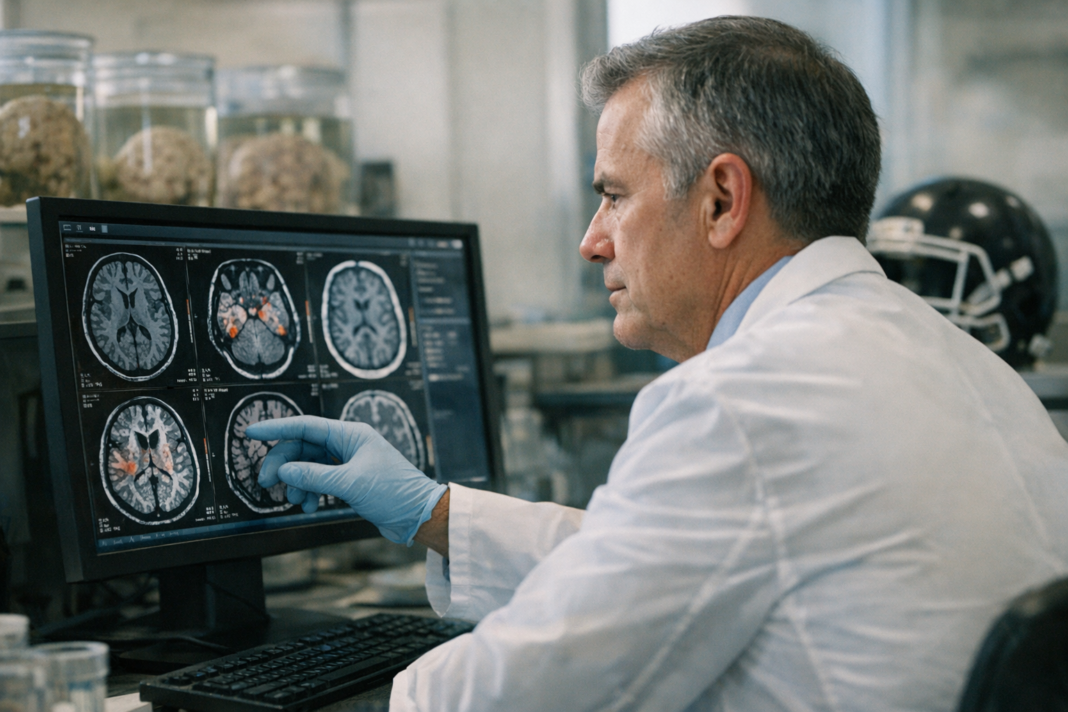
New research on donated brain tissue from former professional players has reignited discussion about chronic traumatic encephalopathy (CTE) and its prevalence. A study published Aug. 25 in The BMJ examined 338 brains donated by players who died between 2008 and 2021. Within that donor sample, more than 93% showed pathological signs associated with CTE and roughly 30% met criteria for stage IV, the most advanced category identified by neuropathologists.

The authors used the donor sample to estimate possible CTE prevalence across 1,712 former players who died in the same interval, producing a very wide range of estimates. For the entire period the study reported a possible prevalence between about 18.5% and 98.7%; focusing on the period with the most donations (2016–2021) yielded a narrower—but still broad—range of 24.5% to 97.7%. The analysis also found that not all brains with CTE pathology had documented clinical dementia: about 60% of cases with CTE-related changes had a dementia diagnosis, while around 90% of stage IV cases did.

Thayne Munce, director of the Jayhawk Athletic Performance Laboratory at the University of Kansas, who was not involved in the work, emphasized limits that affect interpretation. Donor samples can be biased if people with symptoms are more likely to donate, and the cohort studied largely reflects athletes who played several decades ago. Changes in equipment, rules, practice patterns and formal concussion management mean those historical rates do not necessarily describe risks for current football players, Munce noted in an interview about the study.

The study underscores two distinct findings: neuropathology consistent with CTE can be common among selected brain donors, and the presence of pathological markers does not always map directly onto clinical symptoms. That distinction matters for players, families and clinicians weighing concerns about memory, mood and behavior. Experts also point to ongoing efforts to reduce exposure to repetitive head impacts—through rule changes, helmet standards and limits on contact in practice—as relevant to the question of contemporary risk.

Looking ahead, researchers highlight priorities that follow from the study: reducing sample bias in brain-banking work, improving tools to assess cumulative head-impact exposure in living athletes, and developing diagnostics that could identify neurodegenerative changes before death. Those steps would help clarify how historical findings relate to youth, collegiate and modern professional play and guide evidence-based steps to limit long-term harm from repetitive head impacts and concussion.


Advertisementspot_imgspot_img

Hot this week

Canada imposes dollar-for-dollar tariffs on U.S. goods, up to 50%

Canada unveils dollar-for-dollar retaliatory tariffs on U.S. products, reaching 50%, affecting sectors from steel to cosmetics.

Desert ‘Shark Graveyard’ in Egypt Unearths Evidence of Ancient Seas

Fossil shark teeth from seven species found on Egypt's Abu-Tartur Plateau reveal a nutrient-rich Late Cretaceous sea and prompt further fieldwork.

Good Good Golf Withdraws from PGA Tour Sponsorship After Controversial Video

Good Good Golf pulls out of a PGA Tour event sponsorship after a promotional video for a new Callaway driver provoked controversy.

Inside the courtroom as Duane “Keffe D” Davis is found guilty in Tupac Shakur case

A BBC presenter recounts the atmosphere in court after Duane "Keffe D" Davis was found guilty in the killing of Tupac Shakur.

England’s Devolution Rush: Cities Surge Ahead While Other Areas Lag

A fast-moving devolution programme hands new powers to cities and mayors, but uneven readiness risks a patchwork of governance across England.

Updated ‘super flu’ vaccine begins rollout as NHS recovers from busiest summer

An updated influenza vaccine targeting the Super-K strain is being rolled out as the NHS reorganises after a very busy summer.

Shein’s Hong Kong Debut Sees Shares Fall After Years-Long Listing Hunt

Shein's shares dropped in their Hong Kong market debut after years of attempts to list in New York and London, marking a pivotal moment for the fast-fashion group.

Inside the courtroom as Duane “Keffe D” Davis is found guilty in Tupac Shakur case

A BBC presenter recounts the atmosphere in court after Duane "Keffe D" Davis was found guilty in the killing of Tupac Shakur.

When Wearable Cameras Fail the Law: How Social Pressure Is Shaping Smart Glasses

Reports of harassment linked to smart glasses expose legal limits; designers, regulators and public reactions will shape their future.

Osaka channels Allen Iverson’s streetwear at US Open debut

Naomi Osaka paid homage to Allen Iverson with a streetwear-inspired look for her US Open debut, highlighting sport-to-fashion crossover.

Tschabalala Self to occupy Fourth Plinth with striding woman after racist vandalism

Tschabalala Self unveils Lady in Blue on the Fourth Plinth after a previous sculpture in the UK was racially vandalised.

Roman Telescope Begins L2 Voyage to Map Dark Cosmos and Hunt Distant Worlds

NASA's Roman Space Telescope departs for L2 to survey dark matter, dark energy and exoplanets with unprecedented speed and data volume.

Access to AI Is Not the Same as Better Work: Why Tools Alone Won’t Upgrade Skills

Giving employees AI tools does not automatically improve skills or outcomes; firms must redesign training, metrics and workflows to realise benefits.
Advertisementspot_img

Related Articles
