
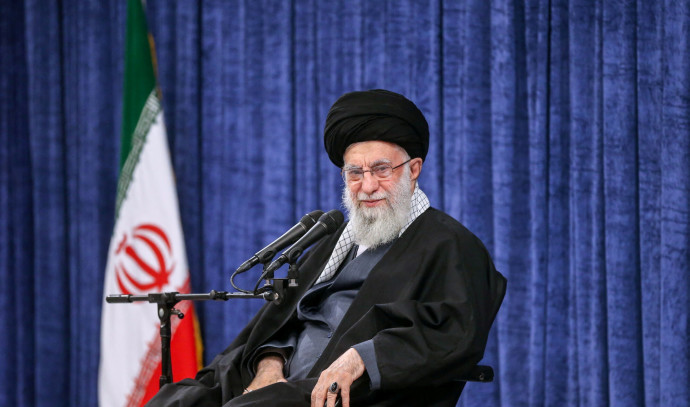

Children often fold paper boats and float them in water, where they remain afloat until disturbed by waves. Similarly, Khamenei has kept his regime afloat for years through bluffing, grandstanding, and a facade of sanctity.
Yet, the reality reveals that the Islamic Republic’s paper tiger is soaked and on the verge of collapse. Behind the propaganda machine of the regime and its Western-affiliated reformist lobby lies a truth contrary to its claims of strength and resilience.
The regime’s current efforts are focused on military exercises and maneuvers, designed to project an image of invincibility in the media.
Today also marks the fifth anniversary of the IRGC’s heinous crime of shooting down the Ukrainian passenger plane (January 8, 2002), an act following the death of Qasem Soleimani, the notorious Islamic terrorist commander of the Quds Force (January 3, 2020).
Iranians have come to realize that as long as the Shiite mullahs and their centers of power persist, the nation’s problems will remain unsolvable. As Persian poetry teaches, heroes break idols; similarly, this grotesque idol of the regime, which has sucked the lifeblood of Iranian society like a leech, must also be shattered. The Shiite mullahs have been a scourge on Iran’s fertile land, preventing peace, humanity, and the rule of law.
Israel’s unique perspective
In the modern 21st century, perhaps no country understands the mullahs’ regime as deeply and accurately as Israel. During my research as a counterterrorism analyst in the Middle East, I have engaged professionally and socially with many experts in American, British, and Israeli intelligence agencies.
Few possess the keen insight into the propaganda of the mullahs and Khamenei’s cunning as my colleagues in the counterterrorism centers of Israeli military and Mossad. They remind me of General Patton, who defeated Rommel because he read his book. Similarly, Israel has read the “book of the mullahs,” and its intelligence agencies, particularly Mossad, understand how they think. Alas, the US and Europe lack this understanding and fail to recognize the tricks and deceptions of the Islamic Republic’s regime.
Some American officials even accept speaking fees to participate in promotional events for pro-Khomeinist groups like the MEK, oblivious to their fraudulent nature. These individuals, tied to the 1979’s Islamic-Marxist revolt, have no constructive solutions or credibility within Iranian society. Western intelligence agencies often overlook that groups like the MEK, Kurdish separatists, and other participants in the 1979 uprising have consistently failed in their policies, strategies, and actions, earning them no legitimacy among Iranians.
For instance, since the visit of Prince Reza Pahlavi—an influential and capable opposition leader—to Israel (June 2023), many masks have fallen. Most 1979 revolutionaries received their terrorist training in Palestine. However, Israel’s intelligence agencies understand that working with honest, patriotic, and peace-loving individuals offers hope for a future Iran. Such collaboration ensures that after the potential collapse of Khamenei’s regime, Iran’s national talents can be harnessed, not squandered on violent, leftist ideologues filled with resentment and animosity.
The destructive ideological fervor of Khamenei and the IRGC is evident in their recent military maneuvers, ostensibly to intimidate Israel. Yet, the Iranian people see through this charade, recognizing that the regime, like a snowball under the summer sun, is melting away. It holds neither credibility nor popularity within Iran or the region. Israel’s devastating strikes have severely weakened the regime’s defenses, while Netanyahu’s direct messages to the Iranian people are met with admiration akin to that of a national hero.
Stay updated with the latest news!
Subscribe to The Jerusalem Post Newsletter
The criminal ayatollahs’ dictatorship in Iran is deteriorating, with its own media acknowledging the dire state of the regime. A member of the Assembly of Experts recently admitted, “The Islamic Republic’s time is up,” and declared that “Iran is ready to explode.”
The return of Trump, combined with Israel’s partnership and Europe awakening from 46 years of complacency, has created a nightmare scenario for the regime. Meanwhile, the regime’s US-based lobbyists have been writing op-eds in Democrat-aligned media, advising Trump to re-engage in diplomacy with the terrorist-loving mullahs—essentially asking the world to repeat its past mistakes without understanding the regime’s playbook.
No one appears willing to ask if the Iranian people want regime change to escape decades of misery since 1979. Meanwhile, those who ordered assassinations of figures like Netanyahu and Trump now engage in futile and absurd strategies, revealing their disconnection from reality
Now, they absurdly try to teach chess to a gorilla or put lipstick on a pig—actions as futile as their grasp of reality. The mullahs’ very essence is inseparable from terrorism, chaos, sabotage, and deceit. Any attempt at diplomacy or dialogue with such entities only serves to legitimize their terror-driven agenda.
Ultimately, Khamenei’s paper boat faces rising waves, drenched and crumbled. The regime’s bluffs about daily military drills and countdowns to destroy Israel are no longer taken seriously.
The stark reality of the Islamic Republic has become clear: after the destruction of its Islamic terror networks and Israel’s dismantling of its defense systems, the regime clings to its last two cards—inciting its remaining transnational terror proxies (like the Houthis, Hashd al-Shaabi, and PKK) or declaring its nuclear capability.
Yet, despite its desperate propaganda campaigns, Iranian public opinion remains firmly against the regime, paralyzing its efforts. The regime’s missile attacks against Israel have exposed its military weakness as hollow bravado.
This is a regime willing to endure any humiliation to cling to power but unashamed of committing atrocities to maintain its grip. However, this time, its efforts are futile—wet powder cannot ignite. Perhaps the global community, awakened in the 21st century, will rise against Khomeinism and Islamic terrorism, just as it opposed apartheid and communism in the 20th century. The world could once again see a time when the US and Israel have embassies in Tehran, rekindling connections with Iran’s rich culture, history, and civilization, reminiscent of the era of the late Shah of Iran, Mohammad Reza Pahlavi.
Failing this, even the Arab nations of the Persian Gulf may finally realize the futility of placing hope in corrupt regime-affiliated reformists, as they too face the looming specter of instability should the Islamic Republic persist.




