
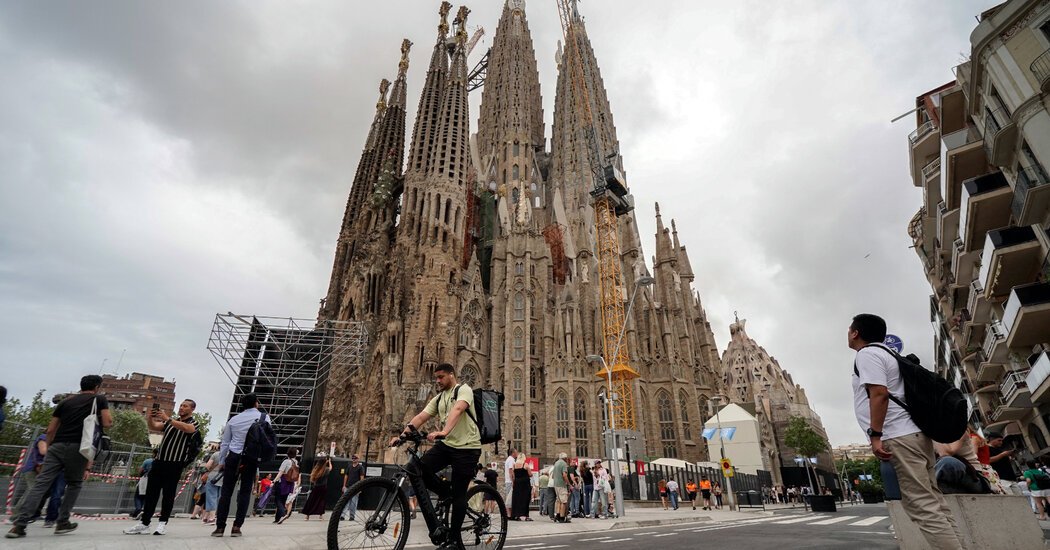

On June 10, 1926, Antoni Gaudí, the architectural visionary who designed Barcelona’s spectacular and still unfinished Sagrada Familia basilica, died after being struck by a tram. A century later, one of the architects trying to complete its construction is terrified of being run over by the city’s bicycle delivery riders.
“They’re scarier,” said Mauricio Cortés, an architect who worked on the basilica’s newly finished central tower, which Pope Leo XIV will bless in Barcelona on Wednesday.
Leo, the third pope to visit the church, will come to inaugurate the tower and honor Gaudí, an observant Roman Catholic once called “God’s architect.” Topped by a five-story glass-and-ceramic cross, the tower has made the Sagrada Familia the tallest church in the world.
The pope’s presence will temporarily turn the building and the packed nearby neighborhoods into the axis around which the Catholic world turns.
Yet when the pope leaves, the Sagrada Familia and the surrounding streets will morph once more into a lightning rod for more quotidian concerns about the soul of Barcelona. Residents complain of a city congested — not only with too many delivery riders, but also with too many tourists taking up too many apartments, with too little room to house the people who grew up here.
The Sagrada Familia is at the heart of those concerns, attracting the tourists who drive up prices, as well as threatening the displacement of nearby residents whose homes may be destroyed to enable the basilica’s construction. That puts the church at the intersection of national partisan politics, questions of regional identity, and local anxieties about overtourism, housing shortages and forced displacement that run even deeper than concerns about colliding with delivery bikes.
“The situation around here is horrific,” said Salvador Barroso, a representative of the Association of Those Affected by the Sagrada Familia, who lives in a building across from the church that could be demolished to make room for the building’s possible expansion. He said many of his neighbors planned to hang black ribbons out of their windows during the pope’s visit on Wednesday to protest the “injustice” of displacement in a city with skyrocketing rents and diminishing housing inventory.
“I don’t see how a good Christian could accept it,” Mr. Barroso said.
The Sagrada Familia foundation, which owns and operates the church and reaps its ticket sales, argues that Gaudí planned a walkway to connect the church’s still unfinished “Glory Facade,” which will be its main entrance, to the street several yards below. It is possible that entire city blocks will need to be cleared for the project, forcing the displacement of hundreds of families.
Esteve Camps, leader of the foundation’s construction board, has said that the church will “not back down on this plan,” and he has also noted, “We are following Gaudí’s plan to the letter.”
But residents say that there is no evidence that Gaudí, whose original models and drawings were destroyed by anarchists during the Spanish Civil War, planned for the staircase. They point to a Spanish government statement saying as much when the buildings went up in the 1970s.
Barcelona’s City Council will ultimately decide if the expansion goes ahead or not, and the city has said that the foundation will have to shoulder the costs of any eventual relocations. Local media reported that the city government and the neighborhood association met this month to discuss the possible displacement.
More generally, city officials giddily talk about the Sagrada Familia as a global destination that they envision as a Taj Mahal of Europe.
Yet to Mr. Barroso and his neighbors, the church’s more than five million visitors — coupled with the buskers and tchotchke shops they attract — have already ruined the neighborhood.
On the eve of Leo’s visit, the building opposite the facade displayed a poster showing buildings being stomped on by a boot in the shape of the Sagrada Familia. One woman who bought her apartment there in 1980 — and raised her children in the building — said that she remembered when there were only a handful of workers at the church and she could hear a single hammer on the stone. But since the Olympics held in Barcelona in 1992 accelerated the city’s resurgence, she said, the Sagrada Familia had become an increasingly noisy neighbor.
Others worried it had become an aggressive one, too.
“They can kick us out because of the Sagrada Familia issues,” said Pedro Deane, 39, a chef from Argentina who sublet in the threatened building. He said that a clause of his lease stipulated that he could be evicted with four months’ notice because of the church’s construction. But he took it in stride: “The church has been here longer than the building. Sometimes it’s easier to just go with the flow.”
Another resident, Daria Lapina, a 32-year-old English teacher from Moscow, said that she felt bad for the families who might be moved out. “They have a housing crisis here and you are going to relocate hundreds of families?” she said. “How are you going to do that?”
There’s unlikely to be any respite from the construction anytime soon. According to Mr. Cortés, the architect, the towers over the facade could still take another decade to finish. Mr. Cortés has been working on the project for 20 years, he noted, compared to Gaudí’s 40. “Halfway there,” he said.
The Sagrada Familia has essentially been under construction for 144 years, and has become “a church that never ends,” said Archbishop Joan Planellas of Tarragona, a city near Barcelona.
It is also a never-ending theater for Spanish politics. During the Spanish Civil War construction slowed and the church was vandalized by leftist arsonists.
Pedro Sánchez, Spain’s left-leaning prime minister, has vowed to attend the Mass to be celebrated by Leo at the basilica, even though he is a professed atheist who has often distanced himself from the Catholic church.
His right-wing opponents have mocked him for doing so, accusing Mr. Sánchez — whose allies are embroiled in corruption scandals that imperil his political survival — of trying to bolster his image by showing he is close to the popular pope.
When the Mass begins on Wednesday evening, all of the country’s polarized forces will have to sit together in the same pews.
But even with a king and a pope and a prime minister in attendance, the church would steal the show, Archbishop Planellas said.
Leo will hold Mass surrounded by elaborate facades that resemble a coral reef made from biblical figures, allegorical scenes, angelic musicians, stone roses, rosaries and Roman soldiers (one of which has six toes). Inside, multicolor light shoots from the stained-glass windows, casting prisms onto stone columns that look like trees, the trunks of which branch into arches under a canopy of geometric stars.
“This event at the Sagrada Familia is something more than inaugurating a tower,” Archbishop Planellas said. It honors “an entire construction to elevate the spirit,” he added.
Across the street, however, Mr. Barroso still hoped that the pope, who has often emphasized economic injustice, might see all the black ribbons on his way to the church and ask himself, “What is this all about?”
Source:
www.nytimes.com



