
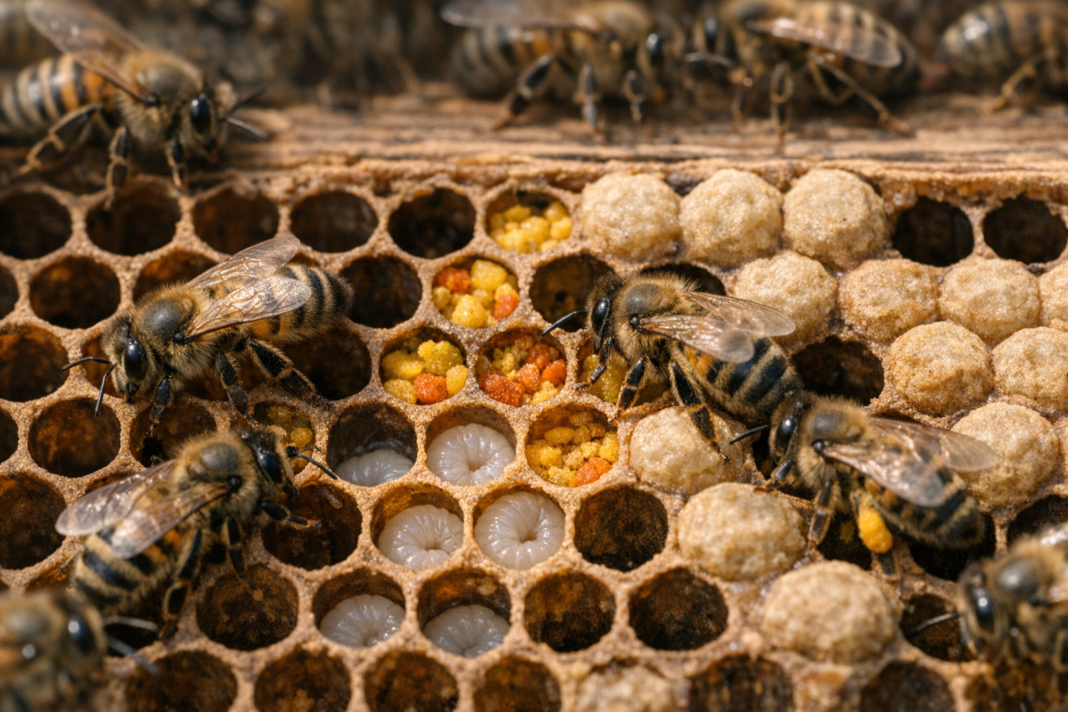

Honeybees reveal a previously overlooked layer of colony nutrition: workers can sense when forage carries an improper balance of essential nutrients and alter feeding behaviour to prevent harmful excesses. Observations indicate that adult bees do not simply pass pollen to larvae unchanged; instead they transform and ration foraged material so that brood receive a more even mix of proteins, lipids and other micronutrients.
Careful study of worker activity shows that individual foragers and nurse bees modulate both intake and processing. Researchers watching hives report that when incoming loads of floral pollen are skewed toward particular nutrient profiles, workers reduce direct feeding from those sources and blend or treat stores before sharing them with the brood. Worker interventions include selective allocation of pollen, mixing items gathered from different plants, and depositing material in comb cells where it undergoes biochemical changes over time.
The result is a household reserve that is markedly different from raw forage. Stored provisions used for larval rearing are more balanced than single-source pollen, suggesting that the hive functions as an active nutritional processor rather than a passive repository. This capability allows colonies to buffer larvae against spikes in particular dietary components that, if consumed in isolation, might impair development. The behaviour also highlights the role of worker decision-making in maintaining colony health and optimizing brood growth across variable floral landscapes.
These findings carry practical relevance for apiculture and habitat planning. Recognising that colonies manipulate and equalise nutrients internally shifts how scientists and beekeepers should evaluate forage value: measures that treat pollen only as isolated samples may underestimate the hive’s capacity to correct imbalances. The evidence reinforces the importance of floral diversity near apiaries to provide complementary nutrient sources and supports management approaches that consider not just quantity but the nutritional breadth of available plants. Above all, the work exposes a refined, collective strategy by which a social insect secures a reliable, balanced diet for its next generation.





