
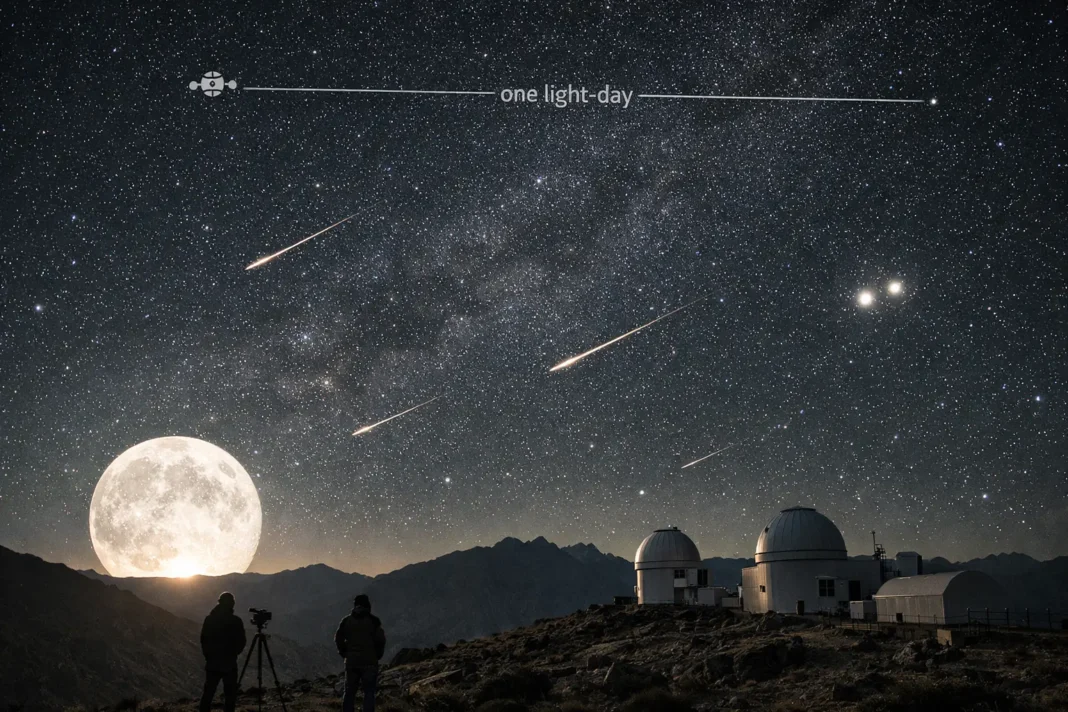

November’s night sky is offering an unusually rich sequence of celestial sights, combining bright meteor activity, the apparent pairing of Mars and Jupiter, and a supermoon. For observers, the month brings together several events that can be appreciated without specialist equipment, making it a notable period for public interest in astronomy and skywatching.
Meteor showers are among the most accessible events in the calendar because their brightest streaks, sometimes called fireballs, can be seen with the naked eye when viewing conditions allow. These flashes occur when small fragments of space debris enter Earth’s atmosphere and burn brightly for a brief moment. Their appearance is unpredictable, but a month with active meteor displays can reward patient observers away from heavy light pollution. The close visual pairing of Mars and Jupiter adds another point of interest, although the two planets remain separated by vast distances in space; the effect is a line-of-sight alignment as seen from Earth.
The supermoon gives November’s sky a second kind of spectacle. The term is commonly used for a full moon that occurs when the Moon is relatively close to Earth in its orbit, making it appear slightly larger and brighter than usual. Such events often draw attention even in urban areas, where the Moon remains visible despite artificial light. For science communicators, the combination of meteors, planets and a prominent full moon creates a useful opportunity to explain how different celestial phenomena depend on separate mechanisms: atmospheric entry, planetary motion and the Moon’s changing distance from Earth.
Beyond the view from the ground, November also carries significance for deep-space exploration. NASA’s Voyager 1 has become the first spacecraft to reach a distance of one light-day from Earth, a milestone that highlights the scale of human-made exploration beyond the planets. A light-day is the distance light travels in 24 hours, and using that unit for a spacecraft underlines how far the mission has moved into interstellar space.
The contrast is striking: while meteors, planets and the Moon create a changing display above Earth, Voyager 1 marks progress on a scale far beyond ordinary night-sky observation. Together, these events connect everyday skywatching with the wider story of space science, from phenomena visible overhead to a spacecraft still extending humanity’s reach into the distant dark.





