
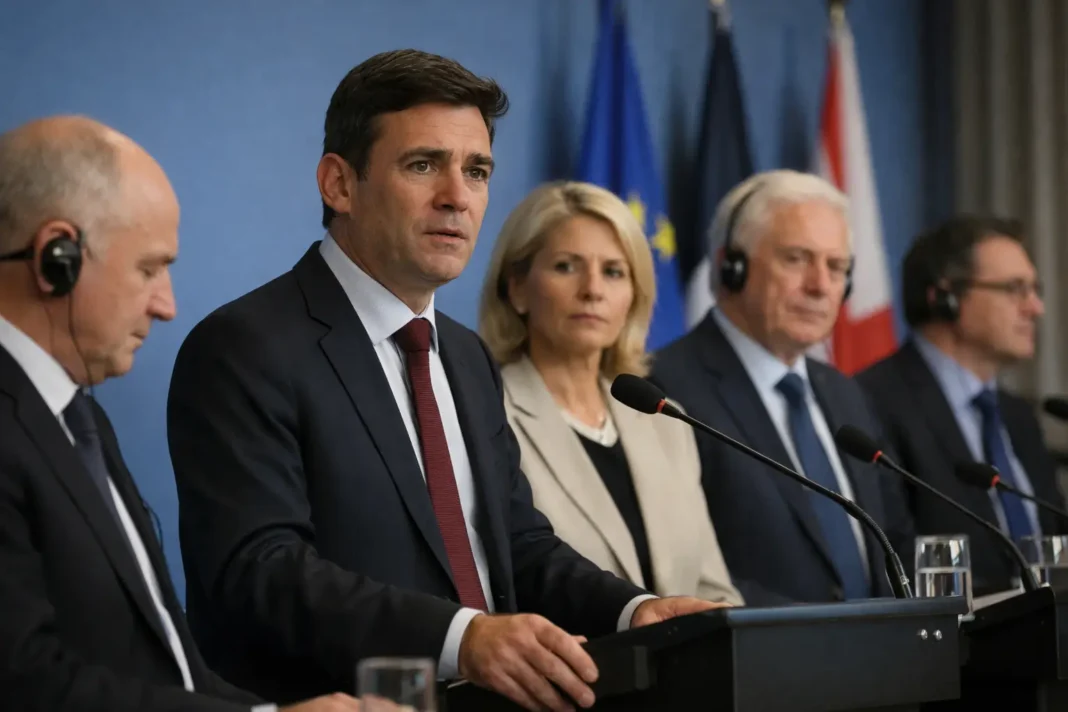

Prime Minister Andy Burnham will use this week’s UK-EU summit in Brussels to present a package of agreements aimed at improving trade and economic cooperation between Britain and the bloc. The meeting, scheduled for 20 November, marks his first direct encounter with senior European Union figures since entering office four months ago and places Brexit back at the centre of British politics.
The summit is expected to open a broader phase in the government’s European policy. Beyond the immediate technical agreements, Burnham has indicated that he wants to launch a national conversation on a closer political and economic relationship with the European Union. That process could carry significant consequences for the Labour Party, whose position on Europe has been shaped in recent years by clear limits on any return to EU structures.
In a speech on Monday night, Burnham signalled that Labour’s next election manifesto could move away from those red lines and may even include a proposal to apply for EU membership. Such a shift would represent a major change in the party’s post-Brexit stance and would reopen one of the most divisive constitutional and economic questions in the United Kingdom. It would also require the government to balance enthusiasm among pro-European voters with caution among those wary of revisiting the 2016 referendum debate.
The immediate importance of the Brussels meeting lies in whether the announced agreements deliver visible improvements for businesses and public debate at home. Trade friction, regulatory barriers and reduced influence in European forums have remained central themes in Britain’s post-Brexit discussion. A credible package could strengthen the case for deeper cooperation; a modest outcome, presented too ambitiously, could make it harder for the prime minister to build support for a longer-term reset.
Burnham’s European strategy therefore depends on sequencing as much as ambition. The Brussels summit offers a platform to demonstrate practical progress before asking the country to consider a more far-reaching relationship with the EU. If the government can connect technical agreements to tangible economic benefits, it may create space for a wider political debate. If expectations run ahead of results, the renewed momentum around Britain’s European future could quickly become harder to sustain.






