
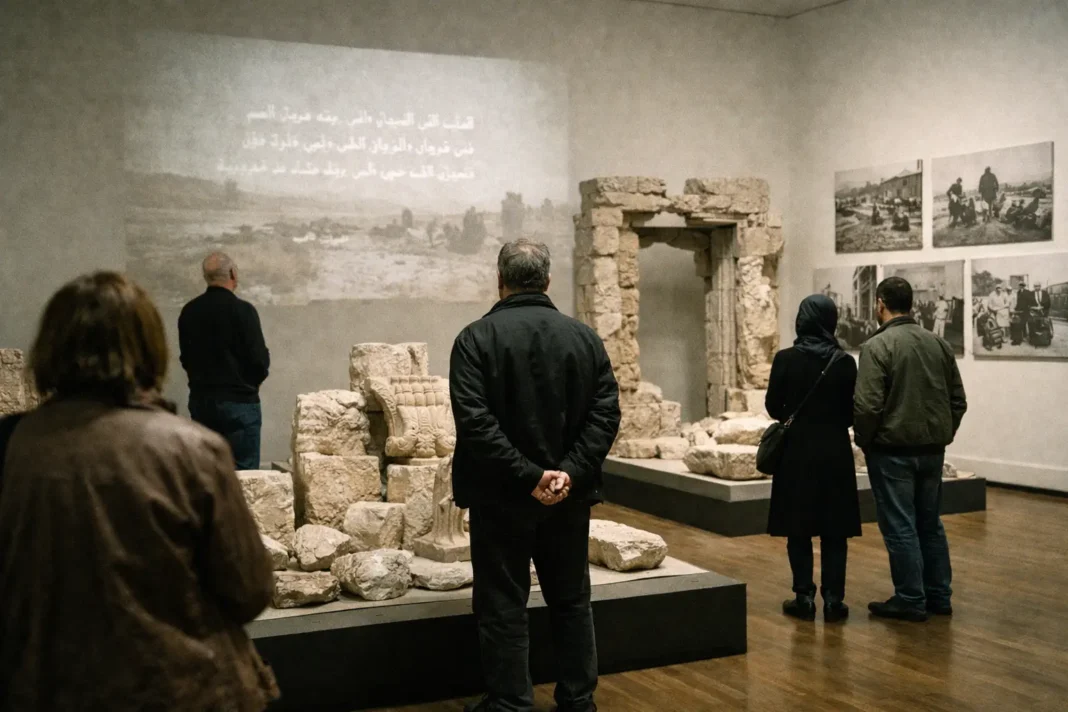

At IMMA in Dublin, an exhibition centred on Palestinian art brings together works that confront history through material, language and images of destruction. A Sea for Borrowed Time, presented at the Irish Museum of Modern Art, gathers artists from across the Levant in a show shaped by memory, exile and the cultural afterlife of political violence. Its atmosphere is not confined to mourning: anger, restraint and defiance coexist throughout the works on view.
One of the exhibition’s key points of entry is a 2006 work by Simone Fattal, who painted Arabic script on slabs of basalt. The stones carry the names of places linked to massacres in the region since 1948, including Deir Yassin, Jenin, Qana and Sabra. Running through those names is a line by Etel Adnan: “In our lands of drought the rain forever is made of bullets.” The choice of basalt gives the work a physical density that reinforces its subject: a natural material formed by volcanic force becomes a surface for recording human catastrophe.
The reference to Sabra connects the exhibition to one of the defining traumas of the early 1980s in Lebanon. The massacre was carried out in 1982 by a Lebanese Christian Phalangist militia during the occupation of Beirut by Israeli forces. It also shaped the poem Praise for the High Shadow by Mahmoud Darwish, from which the exhibition takes its title. Darwish, writing in exile in Beirut, used the sea as an image of Palestinian dispersal and remembrance, linking communities spread across the eastern Mediterranean with the homeland from which they had been separated.
The exhibition extends that literary and historical framework through visual works that include photocollages of bulldozed airports and other images of interrupted movement. Rather than presenting history as a fixed archive, the artists place it inside structures of migration, memory and urban loss. The result is an exhibition in which displacement is not treated only as a political condition, but also as a cultural and imaginative force. At IMMA, these works position Palestinian experience within a wider Levantine and global conversation, where local trauma remains inseparable from shared histories of exile, violence and survival.





