
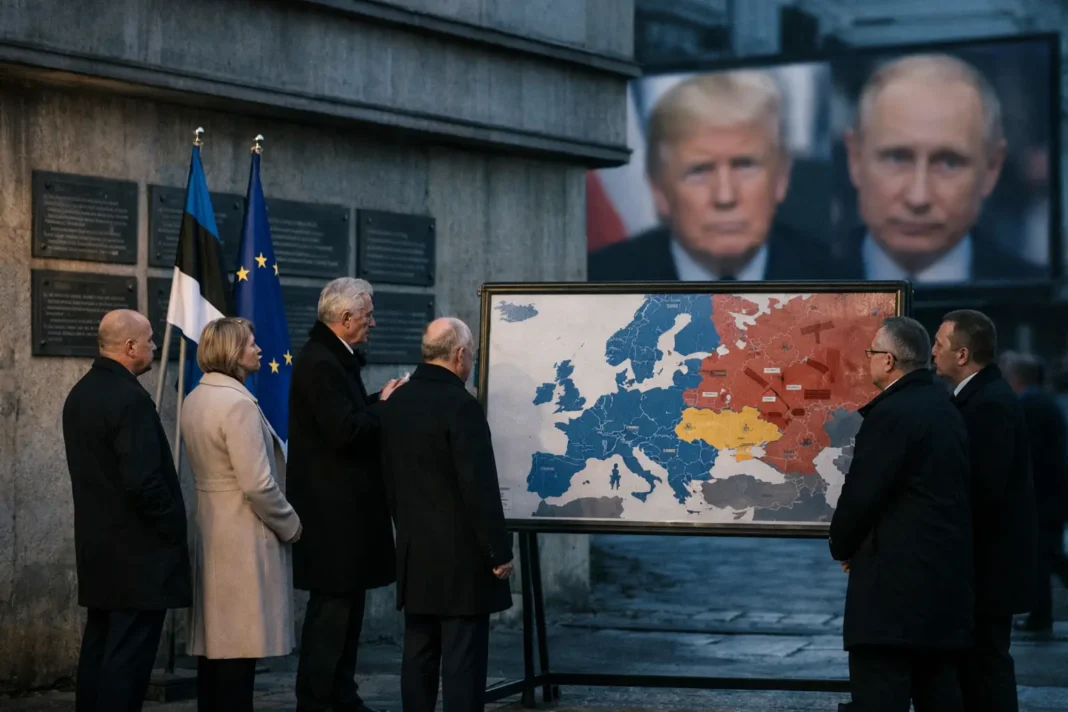

Europe’s security debate is increasingly shaped by two linked pressures: the war on Ukraine’s frontline and the political choices being made inside Western democracies. The prospect of closer alignment between Donald Trump and Vladimir Putin has sharpened concern across the continent, particularly in countries that have direct historical experience of Russian domination. For them, European security is not an abstract policy field but a question tied to borders, sovereignty and national survival.
In Tallinn, the headquarters of the Estonian Government carries that history in stone. On the facade of Stenbock House, the prime minister’s office, a plaque commemorates ten Estonian heads of government killed by Soviet forces after the USSR invaded Estonia in 1940. The country then spent 51 years under Soviet occupation before restoring independence in 1991. Today, with a population of about 1.4 million, Estonia remains acutely aware of the strategic imbalance with its much larger neighbour.
That memory explains why the Baltic states view the outcome of Russia’s war against Ukraine as central to their own security. Estonia is a member of the NATO alliance and the European Union, but its political culture is marked by the belief that deterrence depends on clarity, unity and sustained support for Kyiv. Any weakening of Western resolve is seen not only as a setback for Ukraine, but as a signal that could affect the calculations of Moscow.
The political risk for Europe is that security policy is also being contested at the ballot box. Parties and movements sympathetic to strongman leadership, sceptical of military aid to Ukraine or hostile to European integration have gained ground in several countries. Their rise does not automatically translate into a single foreign policy line, but it complicates consensus at a time when long-term decisions on defence spending, sanctions and alliance commitments are required.
Estonia’s commemorative plaque gives a concrete form to a broader European anxiety: the continent’s future may be shaped simultaneously by military developments in Ukraine and by electoral shifts inside democratic states. For governments on Europe’s eastern flank, the lesson of the twentieth century remains immediate. Sovereignty can be lost when external force meets internal division, and the cost is measured over generations.





