
Cold War fallout has given marine scientists an unexpected tool for studying the lives of orcas and sperm whales. Radioactive carbon released during mid-20th-century nuclear weapons testing entered the oceans and became locked into the teeth of long-lived marine mammals. In a study published on Oct. 1 in Frontiers in Marine Science, researchers found that this chemical signal may identify the oldest male orca yet recorded.
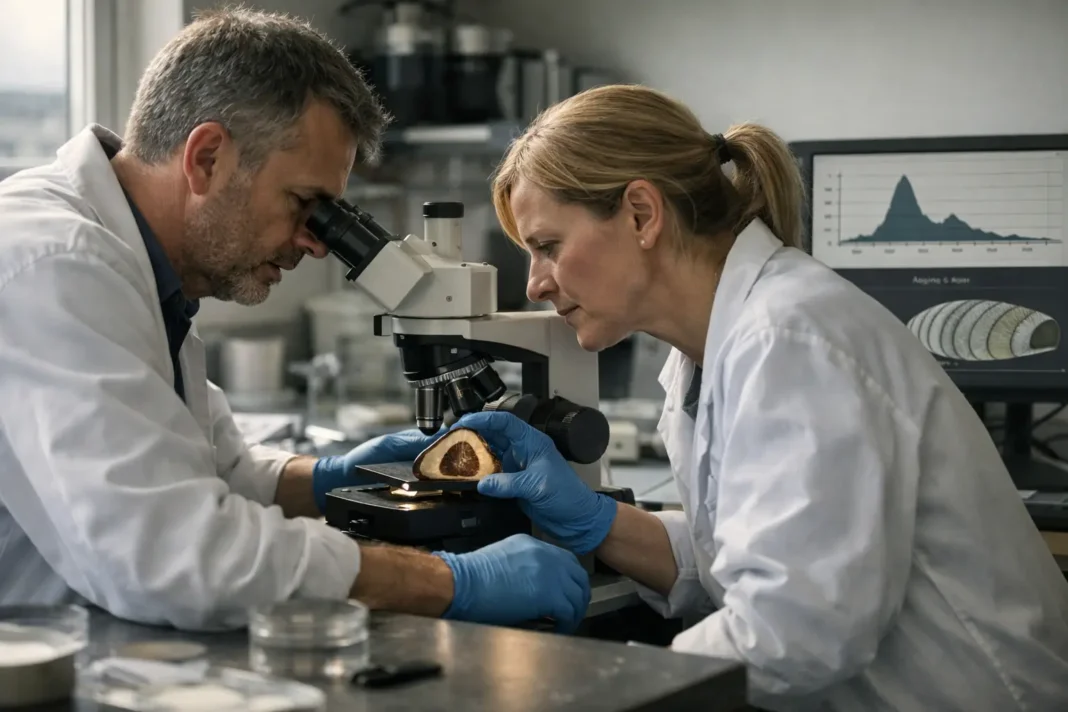
The work, led by Kieran Tierney of the Scottish Universities Environmental Research Centre, examined teeth from three orcas stranded in Scotland between 1995 and 2016, along with two sperm whales that stranded in the 1990s. Whale teeth form layered bands that are commonly treated as annual growth markers, similar to tree rings. By comparing those bands with radiocarbon levels, the team tested whether dental ageing matched the environmental record left by nuclear testing.
The sperm whale samples supported the method: their tooth layers aligned with the radiocarbon pattern, placing the animals in their 20s and 40s at death. One male orca also produced consistent results, suggesting it died in its early 20s. A second male, known as KW2, produced a more striking result. The tooth bands indicated an age in the 50s, but the radiocarbon signal showed the animal was at least 65 when it stranded on Uist, in western Scotland, in 2015. Male orcas are generally estimated to live up to about 50 to 60 years, though firm limits are difficult to establish in wild populations.
The discrepancy does not give scientists an exact birthday for KW2, but it raises questions about how tooth growth changes in older orcas. One possibility discussed by the researchers is that late-life growth bands may become compressed or that teeth may eventually have limited space to record new layers clearly. The study also examined Lulu, a female from Scotland’s West Coast Community, but her radiocarbon profile was harder to interpret because it appeared influenced by historic nuclear discharges from the Irish Sea rather than by the weapons-testing signal alone.
Lulu’s case underlines why the findings matter beyond age records. The West Coast Community is a genetically distinct group of Scottish orcas that has not produced calves during decades of monitoring and is now believed to consist of only two surviving males. Stable isotope analysis in the study also suggested dietary differences, with Lulu showing a greater reliance on marine mammals while the males appeared to have eaten more fish. For scientists studying marine mammals, the results add a new line of evidence that orca life histories around Scotland may differ from the better-known populations of the North Pacific.