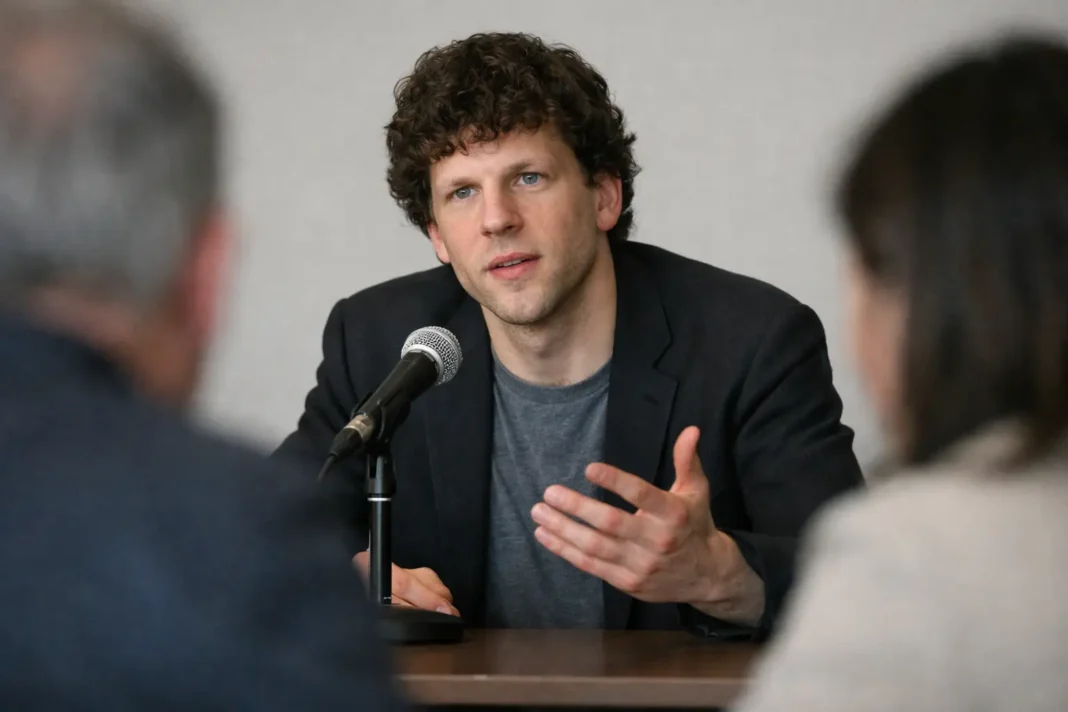

Jesse Eisenberg’s latest remarks have added an unexpected note to the publicity surrounding his new film, The Debut. The actor and director has described his own work as containing "no sexuality" and has linked his ability to write undisturbed in a public library during the day to the way he believes he is perceived by audiences. The comments fit a public image long associated with discomfort, precision and self-analysis rather than conventional Hollywood glamour.
The point was not presented as a complaint about fame, but as a characteristic observation from a performer whose screen presence has often relied on nervous energy and intellectual unease. Jesse Eisenberg has built a career across independent and mainstream cinema, moving between acting, writing and directing. His remarks about being able to work in a library without interruption underline a contrast with the more visible forms of celebrity that often dominate film promotion.
The Debut is arriving with additional attention because of Julianne Moore, who is identified with the project and whose involvement brings awards-season visibility to the film. The promotional cycle has therefore placed Eisenberg’s personality back in focus as much as the work itself. In an industry where interviews frequently reinforce polished personas, his comments stand out because they lean into awkwardness and self-deprecation rather than a carefully managed image of desirability.
The discussion also points to a broader shift in how film culture receives public figures. Not every actor-director is marketed through glamour, and Eisenberg’s appeal has often rested on an identifiable tension between intelligence, insecurity and comic timing. His statement about sexuality in his films may invite debate about tone and authorship, but it also frames his work within a register that favors restraint, discomfort and dialogue over overt sensuality.
For audiences, the remarks are unlikely to define The Debut on their own. They do, however, shape the conversation around it, giving the film a promotional context tied to authorship and persona rather than plot details or spectacle. As the release approaches, Eisenberg’s press appearances remain part of the story: measured, unusual and closely watched by a public increasingly attentive to how filmmakers explain the distance between their private habits and their screen worlds.