
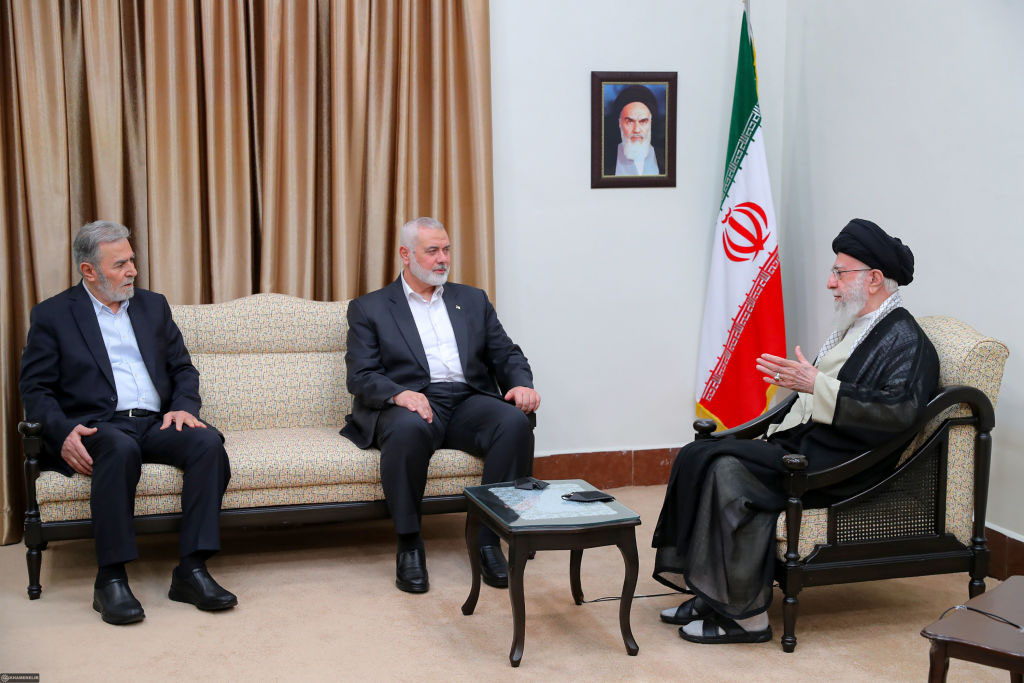

In April, when Iran fired about 300 drones and missiles at Israel, it was feared that it was the first step to an all-out war in the Middle East. That did not happen. But as the war in Gaza continues, Hezbollah and Israel trade fire as Israel was forced to evacuate more than 60,000 residents from the North.
The recent assassinations of two key Palestinian leaders by Israel —Hamas’ top military and political leaders, Mohammed Deif, and Ismail Haniyeh, respectively — is unprecedented.
Some were surprised that Israel would be able to kill Haniyeh on Iranian soil, as it required on the ground-levelintelligence.
“By choosing to hit him inside Iran, Israel was able to deliver a message both to Hamas terrorists as well as to the head of the octopus, Iran’s regime, who is funding every single proxy that is fighting Israel,” Lisa Daftari, editor of The Foreign Desk and Middle East expert, said.
Iran’s supreme leader Ayatollah Ali Khamenei has ordered a strike against Israel. It is unclear exactly what the country will do, or what level of attack would result in an all-out war
“It wouldn’t be surprising to see Tehran insert itself personally here with a retaliatory strike against Israel to show that it will fight back when it is attacked,” Daftari said. “The Islamic Republic was humiliated and as much as it does not want to directly enter the war or escalate matters, it also cannot go without responding to what it deems a direct attack on its soil.”
Iranian citizens have shown no interest in a war with Israel.
In Lebanon, Hezbollah is the de facto ruler of the south with a large arsenal it could use against Israel. It is not known if the show of strength by Israel will cause Iran to have a limited . and back down or a large attack. It is also unclear if the show of force will derail a possible deal for Israeli hostages.
“Hamas had almost 10 months to make a deal until now and did not,” Daftari said. “The fact that Haniyeh is no longer here doesn’t signal an end to talks but perhaps the use of military might in taking out key Hamas players will incentivize (Hamas leader Yahya) Sinwar to sit down and consider what he can get out of a deal before there is no longer an opportunity to have one.”
“Hamas had almost 10 months to make a deal until now and did not. The fact that Haniyeh is no longer here doesn’t signal an end to talks but perhaps the use of military might in taking out key Hamas players will incentivize (Hamas leader Yahya) Sinwar to sit down and consider what he can get out of a deal before there is no longer an opportunity to have one.”- Lisa Daftari
Daftari said the West should recruit “freedom seeking voices” inside Lebanon and Iran and, America and its allies should “support these voices and these movements, there would be a better opportunity to halt the growth and confidence of the Islamic Republic and its terror proxies throughout the region.”
While Israeli Prime Minister Benjamin Netanyahu has received criticism, both for failing to prevent the attacks of Oct. 7 and for not being able to negotiate a second hostage deal, Daftari said Israel took a calculated risk to keep a promise of eliminating enemies of Israel. Did America know what Israel would do in Tehran?
“The U.S. has already come out to say that they did not have any involvement in the hit,” Daftari said. “Generally speaking, there is significant collaboration and intelligence sharing between Israel and the United States. There are times in which they go in together and other times when Israel has to go at it alone. The fact that both the United States and Israel are staying quiet on this might mean that Israel took the risk independently to hit Haniyeh on Iranian soil hoping that it would not tip the scale too much in terms of escalation.”
In an emergency meeting at the United Nations, enemies of Israel blasted the country and some referred to Israel’s actions as “genocide” without mentioning the attacks of Oct. 7 or the culpability of Hamas.
Jonathan Miller, Israel’s deputy permanent representative to the United Nations rebuked them.
“This meeting has been called for by the world’s Number One sponsor of terrorism, responsible for the most horrifying barbarism across the region and the globe, the Islamic Republic of Iran,” Miller said at the UN. “Iran has used its proxies, Hamas the Houthis and the Hezbollah, to target Israel and our citizens from every direction …”
Miller said rather than calls for both sides to restrain themselves, killing of terrorists should be met with relief, in the same way the West reacted to the death of 9/11 mastermind Osama Bin Laden. He said Hezbollah has fired more than 6,500 rockets hundreds of drones and more than 1,000 anti-tank missiles killing dozens of Israeli soldiers and civilians.
“The state of Israel will not stand idly by,” he said. “We will continue to defend ourselves and our citizens…”




