

One month into the war, and Yoel Zilberman wants to talk about wheat. “The whole world has changed before our eyes,” says the founder and CEO of HaShomer HaChadash. “And what the country is seeing now, we at HaShomer identified even before the war as very dramatic vulnerabilities. Now they’ve become critical.”
For Zilberman, the battlefield stretches far beyond Israel. It runs through supply chains, fertilizers, and global food systems. “There was a report about farmers in the United States debating whether to plant corn and wheat,” he says. “Not because they don’t want to, but because they’re not sure the inputs will be there. Pesticides, fertilizers, everything depends on oil.” If that sounds abstract, he makes it concrete: “If global food production drops the first thing every country will do is take care of itself.”
That logic is already reshaping geopolitics, but the real crisis, he argues, is less visible. “People think about fuel for tractors,” he says. “They don’t realize fertilizers themselves are made from oil. All the chemicals are oil-based, and while governments understand this as existential, the average citizen doesn’t.” “It’s a butterfly effect,” he adds. “And it’s part of what I would call a global war dynamic.”
From there, Zilberman turns closer to home, toward a question that feels both ancient and newly urgent: what does it actually mean for a country to sustain itself? To answer that, Zilberman revives A.D. Gordon’s old idea that a society unable to provide for its own basic needs cannot truly stand on its own. “Food is not just economics,” he says. “It’s national security.” He recalled how Israel had already navigated something similar in the early 2000s water crisis, which ended not with dependence but with innovation. “There were real discussions about importing water from Turkey,” he says. “Instead, Israel built its desalination plants, and today, 70% of Israelis drink desalinated water, and we now have a water surplus even in drought years.”
Food, he suggests, is now approaching a similar inflection point, and the assumption that imports will always be available, as some might suggest, strikes him as dangerously naive. “History doesn’t come with guarantees,” he says. “When it really counts, every country looks out for itself.”
That principle, for him, is not theoretical. Most of Israel’s agriculture is on the borders, and the presence of farmers in these areas, he argues, is not incidental. “It’s a form of defense. The army rotates, but the farmer stays.” Zilberman knows this firsthand, as his own cattle herd grazes in the fields of the north, a place where routine and risk blur into one another. “You’re there all year,” he says. “Winter, summer, whatever happens – you’re there.”
Actions over words
When the war began, that exposure became impossible to ignore. One of the first gaps his organization identified was almost shockingly basic: farmers, often working in open fields, simply had nowhere to take cover. “So we moved fast,” he says. “We brought in mobile shelters, dozens of them, directly into the fields.” The speed of that response became something of a template, and HaShomer HaChadash built a kind of decentralized, highly responsive network across the country, one that operates somewhere between civil society and emergency infrastructure.
When rockets struck places like Zarzir and Haifa, volunteers were on the scene almost immediately. “We don’t wait,” Zilberman says. “One of our people is there, coordinating with the municipality, with Home Front Command, mapping what’s needed.” The efficiency has not gone unnoticed.
Residents, still reeling from the shock of impact, often find themselves met by teams already organizing evacuations, clearing debris, and offering help that feels both practical and immediate. “People are amazed at how quickly it happens,” Zilberman says proudly. “And more than that – they feel it. They understand that someone showed up for them.”
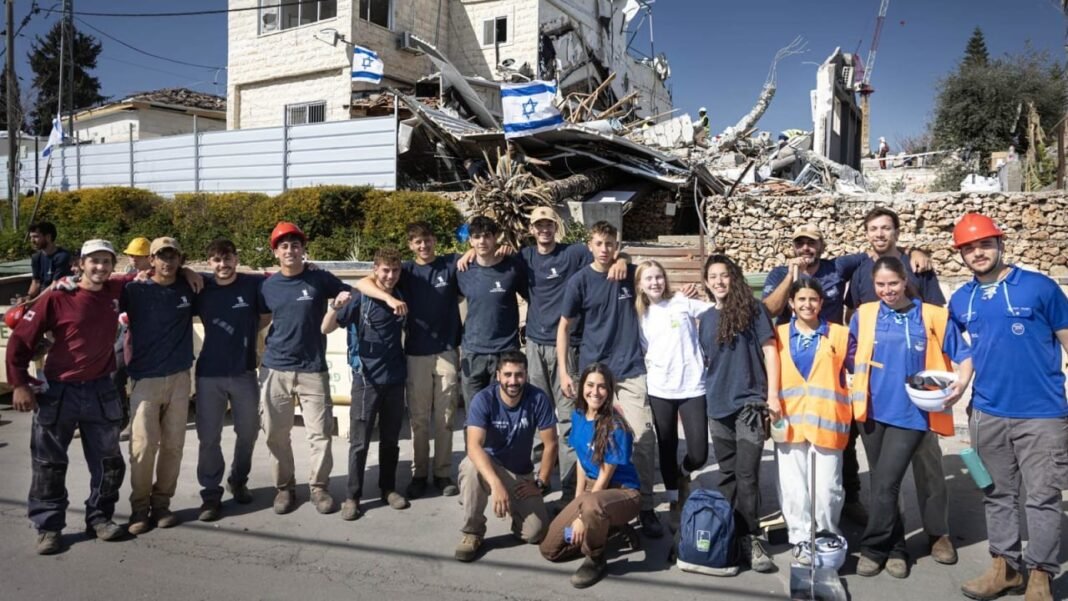
At scale, the numbers are striking: more than 400,000 volunteers mobilized since the start of the war; over 4,000 damaged homes cleared with their assistance. But Zilberman tends to return not to the figures, but to the texture of the work itself. “It’s people walking into a destroyed house and just starting to help,” he says.
All of this, however, is framed by a longer horizon. Plans are already in motion to establish new agricultural communities along Israel’s periphery, including a project in the Jordan Valley that has drawn more than 150 families from the center of the country. Additional initiatives stretch south toward the Egyptian border and north to the Golan Heights.
The ambition is both demographic and strategic: to repopulate, to produce, to anchor, with technology at the heart of this vision. Advanced agricultural systems, including AI-driven tools, are meant to push Israel closer to a form of food resilience that would have seemed unrealistic not long ago.
And beyond resilience lies something more expansive, a regional logic shaped by necessity. “Just imagine Israel helping its neighbors – Lebanon, Syria, Jordan – managing their water and food crises,” he says, invoking a biblical metaphor, “like Joseph,” the figure who stored grain in times of plenty and fed entire regions in times of famine. The implication is not lost: self-sufficiency, if achieved, could become influence.
For now, though, the focus remains stubbornly grounded: fields, fences, people showing up where they are needed. “We’re not academia,” Zilberman says. “We’re not a think tank. We believe in doing, and in being there.”
Source:
www.jpost.com




