
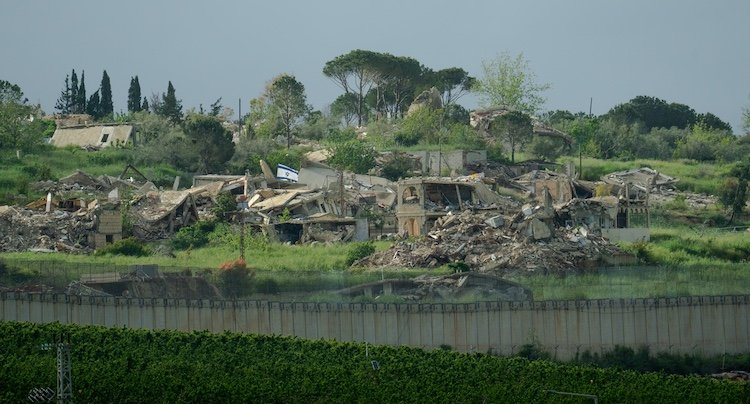

Twenty years ago, the great White House Press Secretary Tony Snow gave the world a memorable moment at the podium. Helen Thomas, the senior White House correspondent and anti-Semite—she told Jews to “get the hell out of Palestine” and go back to Poland and Germany—was ranting and raving about Israel’s actions in Lebanon during a war Hezbollah had started a week earlier.
“We have gone for collective punishment against all of Lebanon and Palestine,” she said, blaming the U.S. for not forcing Israel to stand down in the face of relentless attacks against its civilians.
To which Snow responded: “Well thank you for the Hezbollah view.”
I thought of this when I saw that Alex Crawford of Sky News had once again carpet-bombed the internet with her arsenal of ignorance.
After repeating Hezbollah talking points as if she were reporting the news, critics pointed out that the reason for Israel’s counteroffensive was to stop Hezbollah from firing into its northern towns. Crawford responded: “Israel was bombing and invading Lebanon long before Hezbollah existed.”
Now, this is technically true. Israel had reason to go into Lebanon before Iran planted its proxy force there. Crawford says this is “a point repeatedly brought up by Hez[bollah] supporters.” This is also correct: The reason Hezbollah repeats this talking point is to claim that the group itself is some kind of organic response to Israeli occupation.
Thus Crawford was demonstrating a common complaint against her: that she uncritically serves up Hezbollah propaganda. Israel did not cause Hezbollah’s rise: It had, with the diplomatic support of the Reagan administration, uprooted the Palestinian state-within-a-state occupying South Lebanon.
The Palestinian statelet occupying South Lebanon used its position as a launching pad for numerous massacres of Israeli civilians, sometimes murdering dozens at a time. Israel, along with allied factions from Lebanon, dislodged the Palestinian occupation that was destabilizing its host, in an attempt to restore Lebanese sovereignty. Hezbollah stepped into the vacuum, famously murdered more than 250 at a U.S. Marine barracks in Beirut, and the Iranian and Syrian regimes murdered pro-Western politicians. The U.S. packed up and left, leaving more of a vacuum and an Iranian proxy force as the only power to fill it.
Since then, Lebanon has known continuous internal strife and war with Israel, both caused by the foreign-planted Hezbollah.
What’s the lesson here? Crawford suggests the lesson is for Israel to stop attacking Hezbollah and to bring it to the table, empowering a foreign occupier and smashing Lebanese sovereignty to pieces in the process.
Thank you for the Hezbollah view, as Snow might say.
What’s the lesson for those who don’t want to see permanent war in the Middle East? The obvious conclusion is that the two forces of disruption—Iran and Hezbollah—need to be defeated.
Putting the onus on Israel instead would undermine the sovereignty of both Israel and Lebanon and guarantee death and destruction in perpetuity, thanks to Hezbollah’s arsenal.
So there is the path of death and the path of life.
That choice may seem simple—who would choose the Hezbollah path instead of the path of life?
The answer to that is another lesson. When South Lebanon was held by the Palestine Liberation Organization, it was used as a base for brutal cross-border terrorism against Israelis. From where did the PLO come? They’d been expelled from Jordan—where they had set up a mini-state to use as a launchpad for brutal terrorism against Israelis (and to destabilize Jordan).
Eventually, Israel pulled out of South Lebanon entirely, which is why the IDF is back in South Lebanon today. Eventually, Israel also pulled out of Gaza entirely, which is why the IDF is back in Gaza today.
It is fun to believe that if only Israel would create more vacuums without establishing concrete peace arrangements, there would somehow be peace. Yet 100 percent of the times Israel has done so, the result was war. And 100 percent of the times Israel has first made concrete peace arrangements, there has been peace.
You would think something that is true 100 percent of the time is a pretty good bet. But there’s a very simple reason people still do not want Israel to do what brings peace 100 percent of the time: Israel’s critics, including much of the world’s media, don’t want peace.
Source:
www.commentary.org




