
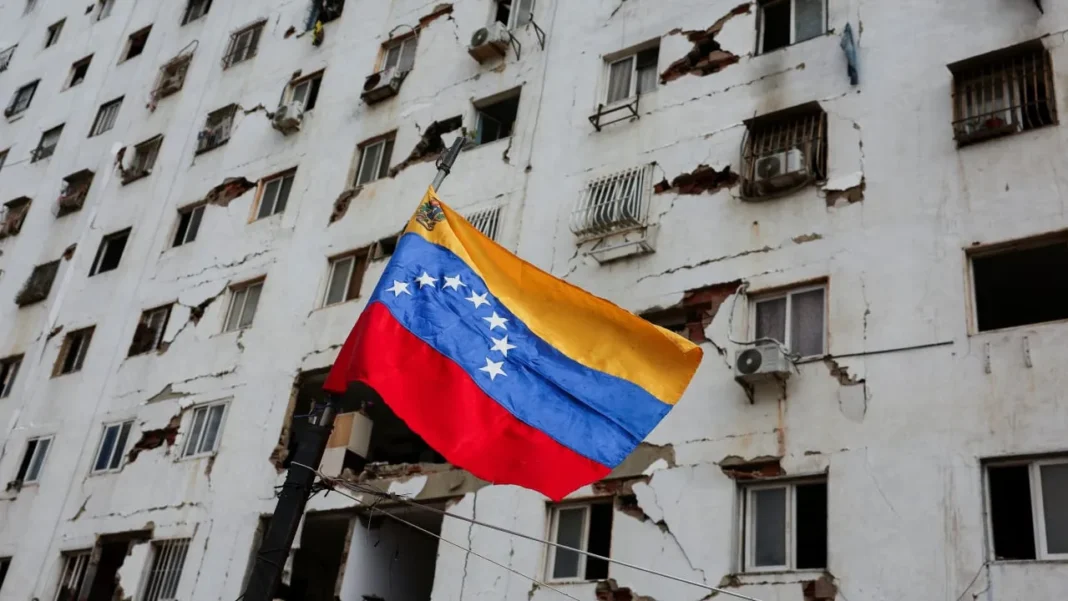

Venezuela’s Interim President Delcy Rodríguez thanked Israel this week for sending “a highly specialized and professional group” after the twin earthquakes that recently shook the country. The team, she said, was brought in through the efforts of Venezuela’s Jewish community, allowing the Venezuelans “to connect with the Israeli government,” and was helping determine which damaged buildings might still hold survivors and whether they still contain bodies needing to be recovered.
The death toll from the June 24 earthquakes has risen to 3,535, with 16,740 people injured and 17,854 left without housing.
Israel jumped into action immediately, with the country’s Foreign Ministry, Health Ministry, KKL-JNF, SID Israel, and others, including IsraAID, sending delegations days after the quakes.
The specialized team that the country’s acting president was referring to was specifically the 30-member IDF delegation led by Brig.-Gen. Elad Edri, at Venezuela’s request, with the specific mission of engineering assessment. Israeli experts began mapping roughly 1,300 damaged buildings, categorizing which should be demolished and which might still be salvageable. They advised on debris, including ways it could be recycled into future construction, and helped propose a multi-year plan for mapping and rebuilding disaster areas.
This is what Israel does, and why our country can sometimes make us so proud. It sends doctors, engineers, search-and-rescue specialists, and disaster experts to places where people are trapped, wounded, missing, or grieving. It does so because we know that every life matters, because technical skill carries moral responsibility which not every country can afford, and because the Jewish state has learned, through bitter experience, the urgency of arriving quickly when seconds and structures decide whether people live or die.
‘You do not need to be Israel’s friend, for Israel to help you’
The lesson from Venezuela is brought even more into focus when one considers the recent diplomatic relations between the two. It is a lesson. You do not need to be Israel’s friend for Israel to help you.
For two decades, its leadership helped turn hostility to Israel into a political language. Former president Hugo Chávez condemned Israel during the 2006 Lebanon war in extreme terms, accusing Israel of “going mad and inflicting on the people of Palestine and Lebanon the same thing they have criticized, and with reason: the Holocaust. But this is a new Holocaust.”
In August 2006, Reuters reported that Chávez had called for Israeli leaders to face a trial for genocide, stating the Jewish state had “done something similar or, perhaps worse, who knows, than what the Nazis did.”
In 2008, during a diplomatic disagreement with neighboring Colombia over the latter’s intrusion into Ecuador, Chávez said: “the Colombian government has become the Israel of Latin America.”
In 2009, during the Israel-Hamas War, Venezuela expelled Israel’s ambassador and broke diplomatic relations. A year later, Chávez accused Israel and the Mossad of plotting against him and denounced Israel as a “terrorist and murderous state.”
Under Chávez, Caracas also saw a deepening relationship with Iran. Under Chávez’s successor, Nicolás Maduro, Venezuela and Iran signed a 20-year cooperation plan in 2022, binding two sanctioned regimes together in economics, energy, aviation, technology, and political defiance of the West.
There is no need to pretend that these acts never happened lest anyone confuse humanitarian aid with political forgetfulness. Israel has no obligation to erase the record of those who have vilified it, embraced its enemies, or helped normalize some of the ugliest rhetoric used against the Jewish state.
Israel’s strength of character on display for the world
But Israel’s strength is that it can remember this and still act.
Received with gratitude by local Jews and acknowledged by its interim president, Israeli uniforms in Venezuela are a reminder that the caricature the world sometimes portrays of Israel collapses a different reality appears. The state so often accused of cruelty sends experts to help save lives and rebuild homes, even to those who do not wish diplomatic relations with us.
Israel’s humanitarian instinct is part of the country’s national character.
That does not mean Venezuela will change course diplomatically. But it does mean the Venezuelan people have seen, on the ground, Israelis there helping day in and day out since the disaster occurred.
Because Israel shows up, and when it does, even its fiercest critics have no choice but to say thank you.
Source:
www.jpost.com



