
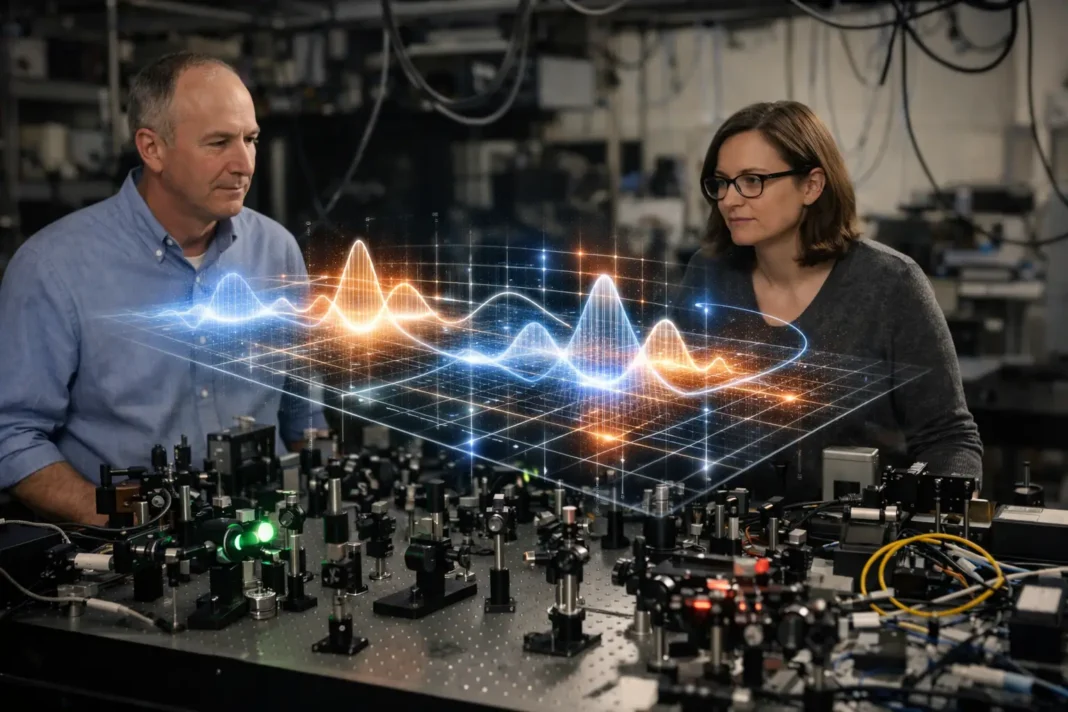

A newly identified boundary in quantum physics is sharpening the view of what can, and cannot, be known about electrons at the smallest scales. Scientists have found that electrons cannot be followed with unlimited precision in both space and time, revealing a constraint that sits at the heart of how matter behaves. The result is not simply a measurement problem: it defines a physical limit on how electron motion can be tracked when researchers try to observe where an electron is and when it is there.
The finding matters because electrons are central to both chemistry and modern technology. Their movements help determine how atoms bond, how chemical reactions unfold and how electrical signals travel through materials. A clearer understanding of the limits governing those movements could give researchers a more precise framework for controlling processes that are currently too fast and too small to manage directly. In practical terms, the discovery points toward new ways to guide reactions rather than merely observe their outcomes.
The same principle could influence the long-term development of electronics. Today’s devices depend on the controlled flow of electrons through circuits, yet conventional technologies face limits as engineers push for smaller components and faster switching. If electron behaviour can be manipulated with greater accuracy inside the newly understood quantum boundary, future systems could operate at speeds far beyond present capabilities. The research has been linked to the prospect of electronics hundreds of thousands of times faster than current technology, though such applications remain a future objective rather than an immediate product.
The discovery also adds context to a broader shift in advanced science: progress increasingly depends on understanding constraints as much as overcoming them. In quantum systems, limits are not always obstacles in the ordinary sense. They can become design rules, helping scientists identify which forms of control are physically possible and which are not. That distinction is especially important for fields seeking to connect fundamental research with usable technologies, from materials science to next-generation computing components.
For now, the importance of the result lies in the new map it provides. By defining a hidden limit in space and time, researchers have gained a clearer starting point for studying electron motion in matter. The path from this insight to faster devices or more precisely directed chemistry will require further experimental and technological development. Even so, the finding gives scientists a firmer basis for exploring one of the most consequential frontiers in modern physics: how to control the quantum behaviour that underpins the material world.







